
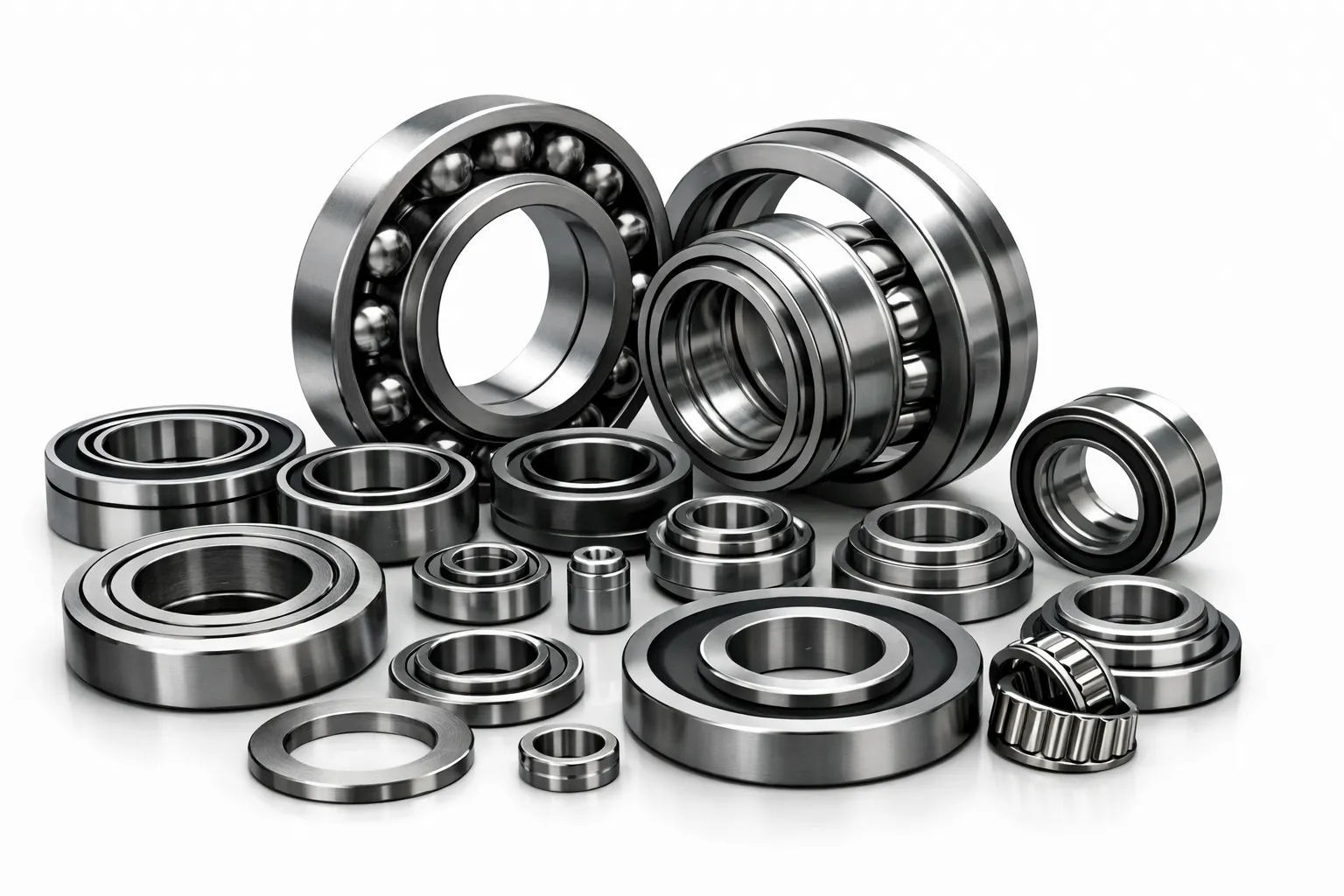
Industrial bearings include rolling bearings and plain bearings (bushings). Rolling bearings (ball and roller) offer lower friction and higher speed, while plain bearings handle shock, contamination, and compact spaces. Selection depends on load, speed, alignment, lubrication, and application.
What is Rolling Bearings?
Rolling bearings use balls or rollers between inner and outer rings to support shafts and reduce friction. They are widely used in rotating equipment due to predictable performance, standard sizes, and broad industrial applications.
Core Technology: Balls or rollers roll along raceways to convert sliding friction into rolling friction, improving efficiency at speed.
Construction: Typically includes inner ring, outer ring, rolling elements (ball/roller), cage, and optional seals/shields.
Common Bearing Types: Deep groove ball, angular contact ball, cylindrical roller, tapered roller, spherical roller, needle roller.
Best-Fit Bearing Applications: Electric motors, pumps, conveyors, gearboxes, fans, machine tools, and general industrial drives.
What is Plain Bearings (Bushings)?
Plain bearings are industrial bearings that support motion through sliding contact, usually with a shaft rotating or oscillating inside a bushing. As bearing types, they’re chosen for ruggedness, compact design, and strong performance under shock loads, dirty environments, or low-speed conditions where rolling bearings may fail early.
Core Technology: Sliding interface separated by boundary, mixed, or full-film (hydrodynamic lubrication) lubrication, or by self-lubricating materials.
Construction: One-piece or split bushing/sleeve, thrust washer, or lined housing; materials include bronze, PTFE-lined composites, polymers, or babbitt-lined shells.
Common Bearing Types: Sleeve (journal) bushings, flanged bushings, thrust bearings/washers, spherical plain bearings.
Best-Fit Bearing Applications: Heavy-duty pivots, construction equipment, hydraulic cylinder joints, agricultural machinery, slow-speed conveyors, high-contamination environments.
Key Differences: Rolling Bearings vs. Plain Bearings
| Dimension | Rolling Bearings | Plain Bearings (Bushings) |
|---|---|---|
| Friction & efficiency | Low friction; excellent efficiency at moderate/high speed | Higher friction at start/low speed; can be very low with proper hydrodynamic film |
| Load handling | Great for radial and combined loads; specific designs for thrust | Excellent shock load capacity; strong in oscillation and high static loads |
| Speed capability | Typically better for high RPM | Typically best at low to moderate speed (unless full-film designs) |
| Contamination tolerance | Sensitive unless sealed and well-maintained | Often more tolerant; can be designed for dirty environments |
| Misalignment tolerance | Limited unless using self-aligning/spherical roller types | Can be good (e.g., spherical plain) and forgiving in housings |
| Maintenance | Grease/oil needs vary; seals help but failures can be sudden | Can be grease/oil or self-lubricating; wear is often gradual |
ClearFilter Pro Tip: We prioritize the duty cycle first—high RPM + low torque usually favors rolling bearings, while shock loads, oscillation, and dirty washdown environments often push our recommendations toward plain bearings or sealed/spherical bearing types to protect uptime.
Pros & Cons Comparison
| Feature | Rolling Bearings | Plain Bearings (Bushings) |
|---|---|---|
| Pros | High efficiency, high-speed capability, standardized bearing types, easy replacement | Compact, shock-load resistant, tolerant of contamination, can be low-cost and self-lubricating |
| Cons | Sensitive to contamination/misalignment, can fail abruptly, may need tighter fits and cleaner lubrication | Higher starting friction, wear over time, lubrication design is critical for long life |
| Typical industrial bearings fit | Motors, pumps, gearboxes | Pivots, joints, heavy equipment linkages |
Conclusion
Rolling bearings are the default choice for high-efficiency rotating equipment and standardized replacements, while plain bearings win where shock loads, oscillation, space constraints, or contamination dominate. For most industrial buyers, match bearing applications to load direction, RPM, environment, and lubrication strategy before locking in bearing types.
FAQ
1. What are the main types of bearings used in industry?
The main bearing types are rolling bearings (ball and roller) and plain bearings (bushings), with many sub-types optimized for radial, thrust, or combined loads.
2. When should we choose ball bearings vs roller bearings?
Ball bearings generally suit higher speeds and lighter to moderate loads, while roller bearings typically handle higher loads (especially shock or combined loads) depending on the roller geometry.
3. Are sealed rolling bearings better for dirty environments?
Yes—sealed rolling bearings usually last longer in contamination-heavy settings, but plain bearings can still outperform them in severe dirt, slurry, or impact-prone applications.
4. How do we select bearing types for misalignment?
Use self-aligning bearing types (e.g., spherical roller or self-aligning ball) for rolling bearings, or consider spherical plain bearings when sliding designs are acceptable.