
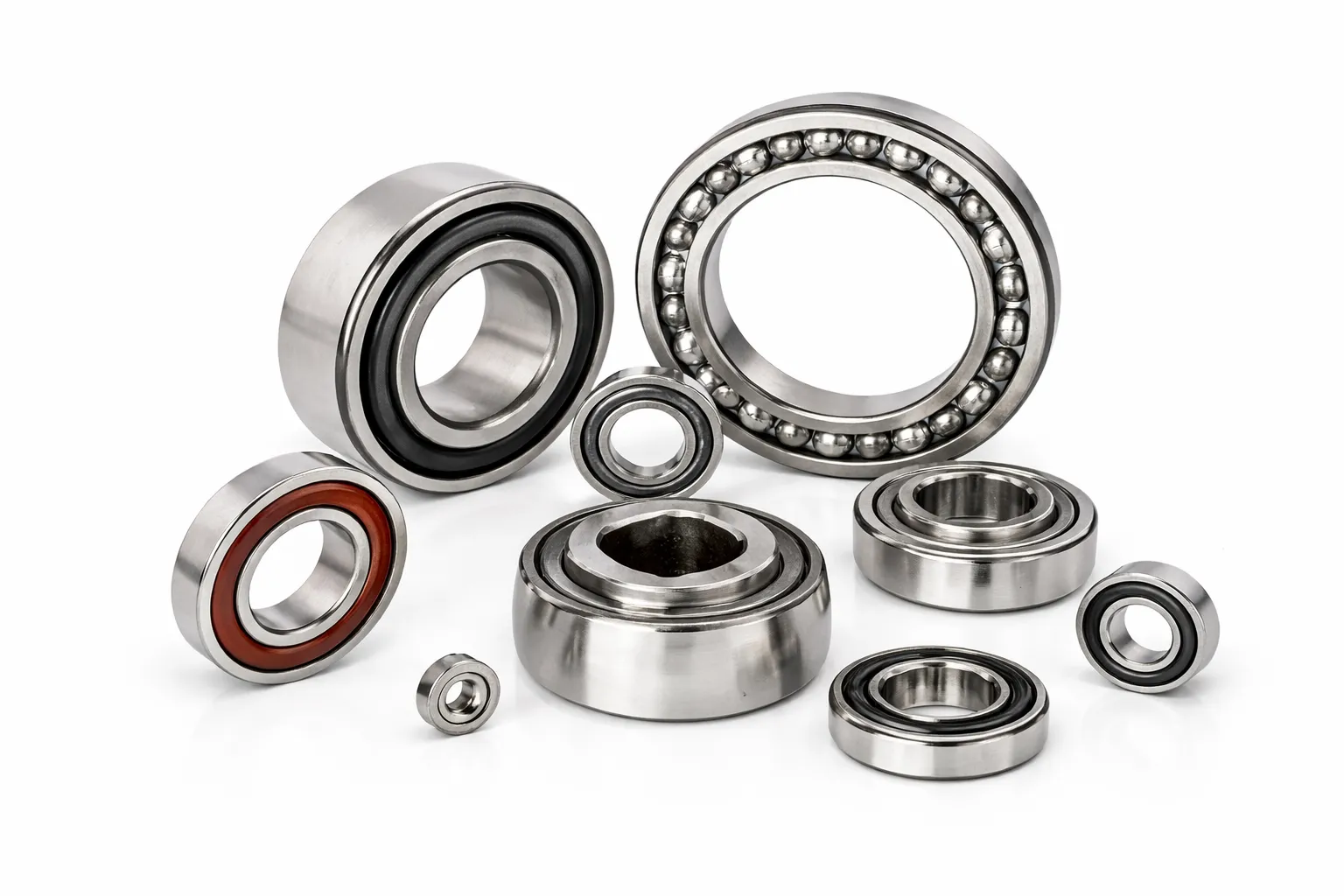
Deep groove ball bearings support high radial loads and moderate axial loads in both directions. Their simple structure offers low friction, quiet running, high speed, and easy sourcing for motors, pumps, and many industrial applications.
What is Deep Groove Ball Bearings?
Deep groove ball bearings are single-row radial ball bearings designed with deep raceway grooves to guide balls smoothly at high speed. This deep groove bearing style balances load capacity, efficiency, and durability, which is why it’s widely used across general machinery and precision equipment.
Core Technology: Deep, uninterrupted raceways closely conform to the ball diameter, improving guidance and load distribution while keeping friction low.
Bearing Structure: Inner ring + outer ring + ball set + cage (steel, brass, or polymer), often with seals/shields and factory grease options.
Load Profile: Primarily radial load; also handles moderate axial load in both directions due to the groove geometry.
Common Variants: Open, ZZ (shields), 2RS (contact seals), hybrid ceramic versions, C3 clearance, stainless steel, and other precision options.
Typical Ball Bearing Applications: Electric motors, fans, conveyors, gearboxes, pumps, agricultural machines, office equipment, and household appliances.
What is Radial Ball Bearings?
Radial ball bearings are a broad category of ball bearings primarily designed to carry loads perpendicular to the shaft (radial loads). Deep groove ball bearings are the most popular subtype of radial ball bearings, but the category can also include designs optimized for specific speeds, load directions, or mounting constraints.
Core Concept: “Radial” describes the main load direction (across the shaft), not a single bearing design—so performance depends on the specific subtype.
Construction Range: Can include deep groove bearing designs, thin-section bearings, maximum-capacity variants, and specialty radial ball bearings with different cages, clearances, and sealing.
Load Profile: Best for radial loads; axial capacity varies widely—deep groove types handle moderate axial loads, while some radial designs are more limited.
Selection Factors: Speed, radial load, axial load, misalignment tolerance, sealing needs, lubrication method, and mounting alignment accuracy.
Key Differences: Deep Groove Ball Bearings vs. Radial Ball Bearings
| Dimension | Deep Groove Ball Bearings | Radial Ball Bearings (General Category) |
|---|---|---|
| Definition | A specific bearing type with deep raceways | An umbrella term for bearings mainly carrying radial loads |
| Axial load capability | Moderate axial load in both directions | Varies by subtype; can be limited or moderate |
| Speed & friction | Typically excellent high-speed, low-friction performance | Depends on design; not guaranteed by the term “radial” alone |
| Common use in industry | Standard “default” choice for general machinery | Used when a radial-load solution is needed; subtype must be chosen |
ClearFilter Pro Tip: We recommend specifying the exact bearing type (e.g., “deep groove ball bearings, 6205-2RS C3”) instead of just “radial ball bearings,” because the category is too broad to lock in sealing, clearance, axial capacity, and speed performance.
Pros & Cons Comparison
| Feature | Deep Groove Ball Bearings | Radial Ball Bearings (General Category) |
|---|---|---|
| Clarity of spec | Clear, standardized design family | Ambiguous unless subtype is defined |
| Availability & cost | Very widely available; cost-effective | Varies by subtype and specialty design |
| Axial load handling | Moderate, both directions | Varies; may be lower than deep groove |
| Speed capability | Typically high | Depends on subtype and cage/sealing |
| Use-case fit | Best “general purpose” option | Best when matched to a specific radial-bearing subtype |
Conclusion
Deep groove ball bearings are a specific, highly standardized solution within the larger radial ball bearings category. If your application needs a proven bearing structure with high speed, low friction, and moderate axial capability, deep groove bearing designs are usually the best first choice—then refine by seals, clearance, and lubrication.
FAQ
1. Are deep groove ball bearings the same as radial ball bearings?
No. Deep groove ball bearings are a specific type of radial ball bearing; “radial ball bearings” is a broader category.
2. What loads can deep groove ball bearings handle?
They primarily handle radial loads and also support moderate axial loads in both directions.
3. Why are deep groove ball bearings so common in ball bearing applications?
They combine simple bearing structure, low friction, high speed capability, easy installation, and strong availability across standard sizes.
4. When should I avoid deep groove ball bearings?
If you need high axial load capacity, significant misalignment tolerance, or very heavy combined loads, a different bearing type may fit better (e.g., angular contact ball bearings or spherical roller bearings).