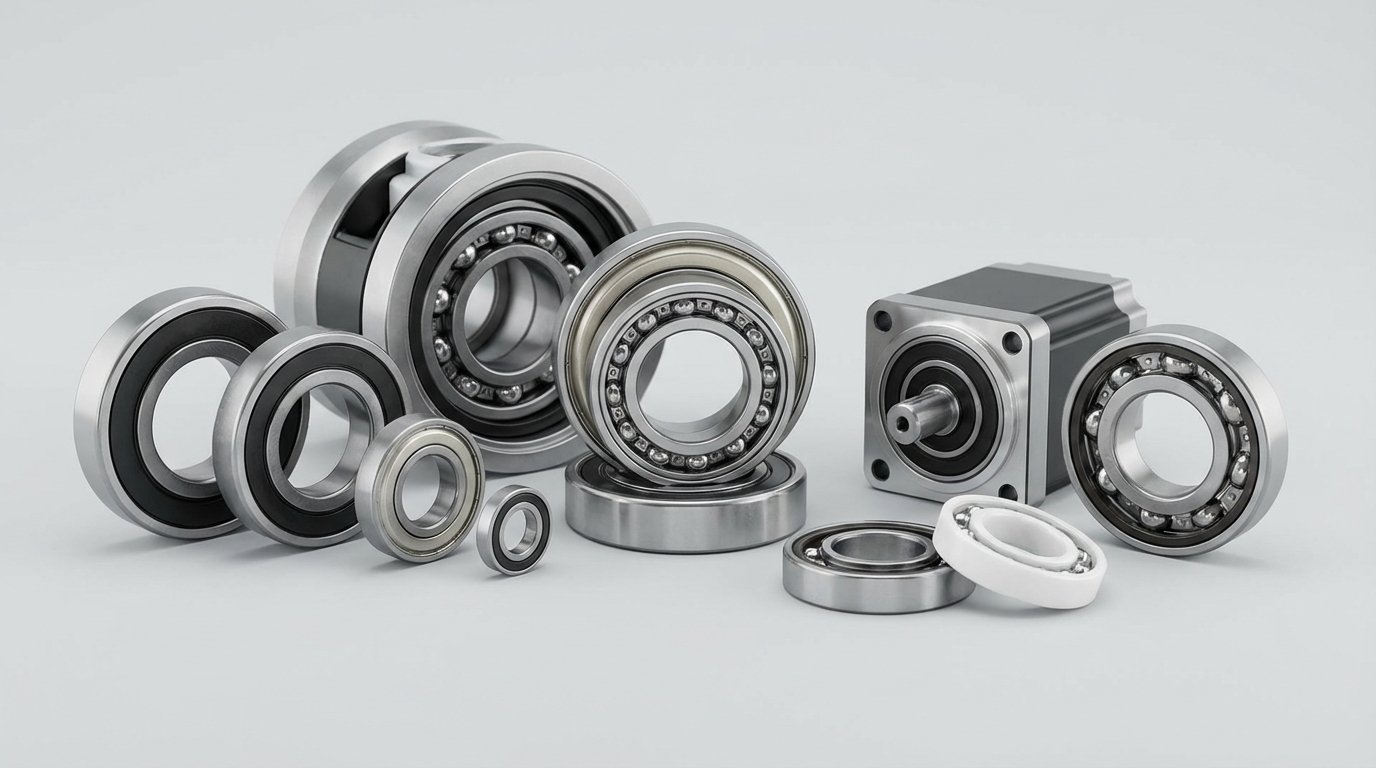
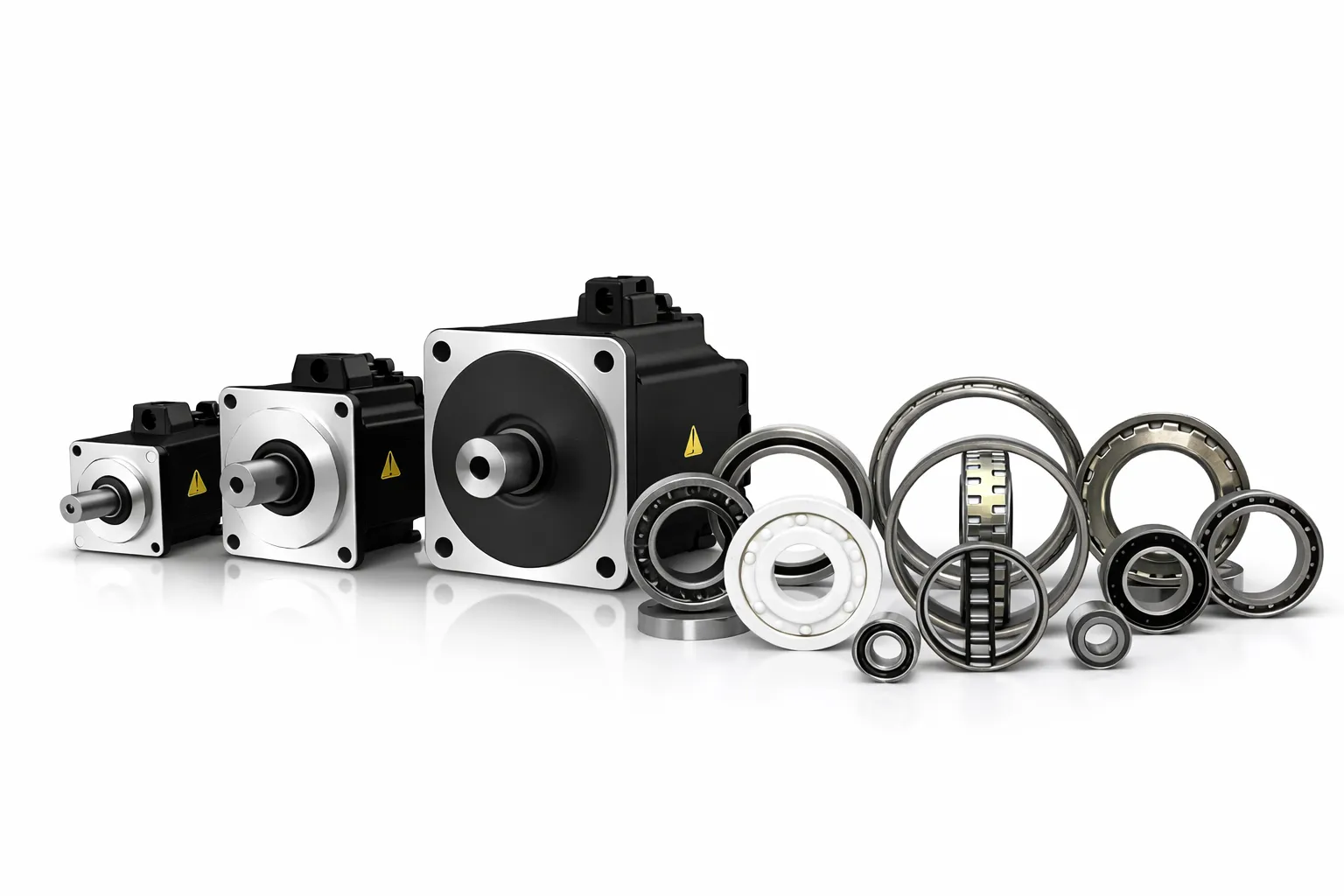
Servo motor bearing selection affects noise, accuracy, drift, and wear. Buyers should evaluate load, speed, rigidity, sealing, lubrication, fits, motor, gearbox, housing, and duty cycle as one system for reliable robot automation.
Video Guide: This overview explains why bearings matter in robotics and automation, linking bearing choice to accuracy, efficiency, and service life.
What is bearings for robot servo motors?
Robot servo motor bearings support the servo shaft, carry radial/axial loads, and reduce friction and runout. They directly affect positioning accuracy, stiffness, vibration, noise, heat, and service life under dynamic motion.
Video Guide: This tutorial shows how bearings support rotating shafts in robotics, helping visualize fit, alignment, and load support basics.
Definition in a servo context and where they sit in the stack
In robot joints, bearings support the servo shaft or gearbox input/output inside the motor, gearbox, or housing. They control shaft position under changing loads, keeping encoder feedback and motion consistent.
Common bearing roles in servo-driven robotics include:
- Motor-end support: Limits shaft wobble, reduces rotor-to-stator rub risk, controls noise.
- Gearbox/joint support: Handles higher external loads and moments from arms and end effectors.
- Preload/stiffness control: Increases rigidity to improve repeatability and reduce backlash feel.
Haron Bearing Pro Tip: I always ask customers to specify whether the bearing is supporting only the motor rotor or also the external joint load—those are two very different duty cases, and mixing them up is a top cause of premature “mystery” failures.
How Does bearings for robot servo motors Work?
Robot servo motor bearings use balls or rollers between raceways to carry loads with low friction. Proper clearance/preload, lubrication, and fits keep the shaft centered, reduce vibration, and maintain stiffness during acceleration, braking, and reversals.
Video Guide: This inspection-focused video helps connect real-world motor symptoms (noise, heat, vibration) to bearing condition and operating issues.
Load paths, stiffness, and why preload matters
In servo applications, loads are rarely steady. The bearing continuously sees changing forces from:
- Rapid acceleration/deceleration (inertial loads)
- Belt/pulley tension or gear mesh forces (radial loads)
- Lead screw thrust or harmonic drive reactions (axial loads)
- Overhung arm moments (combined load and misalignment)
Key mechanisms that determine performance:
- Contact geometry: Deep groove ball bearings tolerate radial loads and moderate axial loads; angular contact bearings handle combined loads with higher axial capacity and stiffness.
- Internal clearance vs preload: Clearance reduces friction but can increase runout and compliance; preload increases rigidity but raises heat and reduces speed margin if excessive.
- Lubrication regime: Grease selection affects torque ripple (important for low-speed smoothness), noise, and life.
- Sealing: Shields/seals trade speed and torque for contamination resistance—critical in dusty factory environments.
Haron Bearing Pro Tip: If your servo “hunts” or won’t hold position smoothly at low speed, I check bearing preload/clearance and grease type before blaming the drive tuning—mechanical drag variability can look like a controls issue.
How to know which bearing to buy?
Robot servo motor bearings use balls or rollers between raceways to carry loads with low friction. Proper clearance/preload, lubrication, and fits keep the shaft centered, reduce vibration, and maintain stiffness during acceleration, braking, and reversals.
Video Guide: This structured selection method provides a practical checklist mindset you can adapt to servo motor bearing selection.
A buyer’s checklist that prevents common mismatches
Use this decision flow to reduce risk:
- Confirm envelope constraints: bore/OD/width, shoulder heights, snap ring grooves, and available preload features.
- Quantify loads: radial, axial, and moment; note peak vs continuous and shock events (collisions, e-stops).
- Define motion profile: max RPM, acceleration, reversing frequency, dwell times, and thermal environment.
- Select bearing family: deep groove ball, angular contact, cylindrical/tapered roller, thin-section, crossed roller (for joints).
- Decide on clearance/preload: C0/C3 or factory-preloaded sets; validate thermal growth.
- Choose sealing and lubrication: open (low drag) vs shielded/sealed (better protection); pick grease compatible with temperature and speed.
- Specify precision and noise: runout limits, vibration grade, and consistency for smooth servo response.
- Validate fits and housing stiffness: avoid creep, distortion, and misalignment; confirm installation method.
Selection quick guide:
- High stiffness + axial load: Angular contact (often paired/back-to-back).
- General motor support, high speed: Deep groove ball.
- High radial load, limited axial: Cylindrical roller (typically with another bearing handling axial location).
- Harsh contamination: 2RS with suitable grease (accept higher drag).
- Ultra-smooth low-speed motion: Low-noise bearings + optimized grease + controlled preload.
Haron Bearing Pro Tip: I recommend you document peak load + peak speed + target service life in one line on the RFQ—without those three, suppliers will default to “catalog safe,” which often adds unnecessary drag or cost.
Which is better, 2RS or ZZ bearing?
For robot servo motor bearings, 2RS offers better contamination protection and grease retention, while ZZ provides lower friction and higher speed. The best choice depends on environment, torque drag, maintenance, and servo sensitivity.
Video Guide: This material-and-application discussion helps frame how sealing and bearing construction choices affect friction, durability, and performance.
Practical tradeoffs in servo joints and motor ends
2RS vs ZZ in robotics is typically a trade between protection and drag:
- 2RS advantages: Excellent dust/water resistance, better grease sealing, longer life in dirty environments.
- 2RS drawbacks: Higher starting torque and running torque; more heat at high RPM; can affect low-speed smoothness.
- ZZ advantages: Lower drag, better for higher speeds, good for cleaner enclosures.
- ZZ drawbacks: Limited sealing—fine dust and coolant mist can still enter over time.
Decision list:
- Choose 2RS when: open factory floor dust, washdown risk, long maintenance intervals, or exposed joints.
- Choose ZZ when: clean enclosure, high RPM, low torque ripple requirements, or frequent relube/short service intervals are acceptable.
- Choose Open when: fully sealed housing with controlled lubrication system and maximum efficiency is needed.
Haron Bearing Pro Tip: In robotics, I often specify ZZ at the motor end (for low drag) and 2RS at the joint/gearbox interface (for contamination)—splitting locations like this can balance efficiency and durability.
What are the disadvantages of ceramic bearings?
Ceramic or hybrid bearings can reduce wear and improve corrosion resistance, but they are not always better for robot servo motors. Drawbacks include higher cost, shock brittleness, possible noise differences, and stricter preload/lubrication needs.
Video Guide: This explains bearing material tradeoffs, helping you decide when ceramic or hybrid bearings make sense versus premium steel options.
Where ceramic helps—and where it can backfire
Common downsides buyers should plan for:
- Cost premium: Often 2–5× versus standard bearing grades depending on precision and brand.
- Shock sensitivity: Ceramic balls are hard but less forgiving under impact loads (robot collisions, abrupt stops).
- Noise behavior: Some setups report higher acoustic pitch; may matter in cobots or lab automation.
- Raceway compatibility: In hybrid bearings, steel raceway quality and lubrication are still critical; ceramic doesn’t “fix” poor fits or contamination.
- Procurement variability: “Ceramic” is a broad label; ball grade, cage type, and grease quality vary widely.
Best-fit scenarios vs avoid scenarios:
- Consider ceramic/hybrid: high speed, marginal lubrication, electrical discharge concerns, light loads with high RPM.
- Avoid or validate carefully: high shock, heavy moment loads, uncertain alignment, or aggressive vibration environments.
Haron Bearing Pro Tip: I only recommend hybrid ceramic after we confirm shock loads and mounting stiffness—if the joint can see impacts, a premium steel bearing with the right sealing and grease often lasts longer per dollar.
Key Features & Comparison
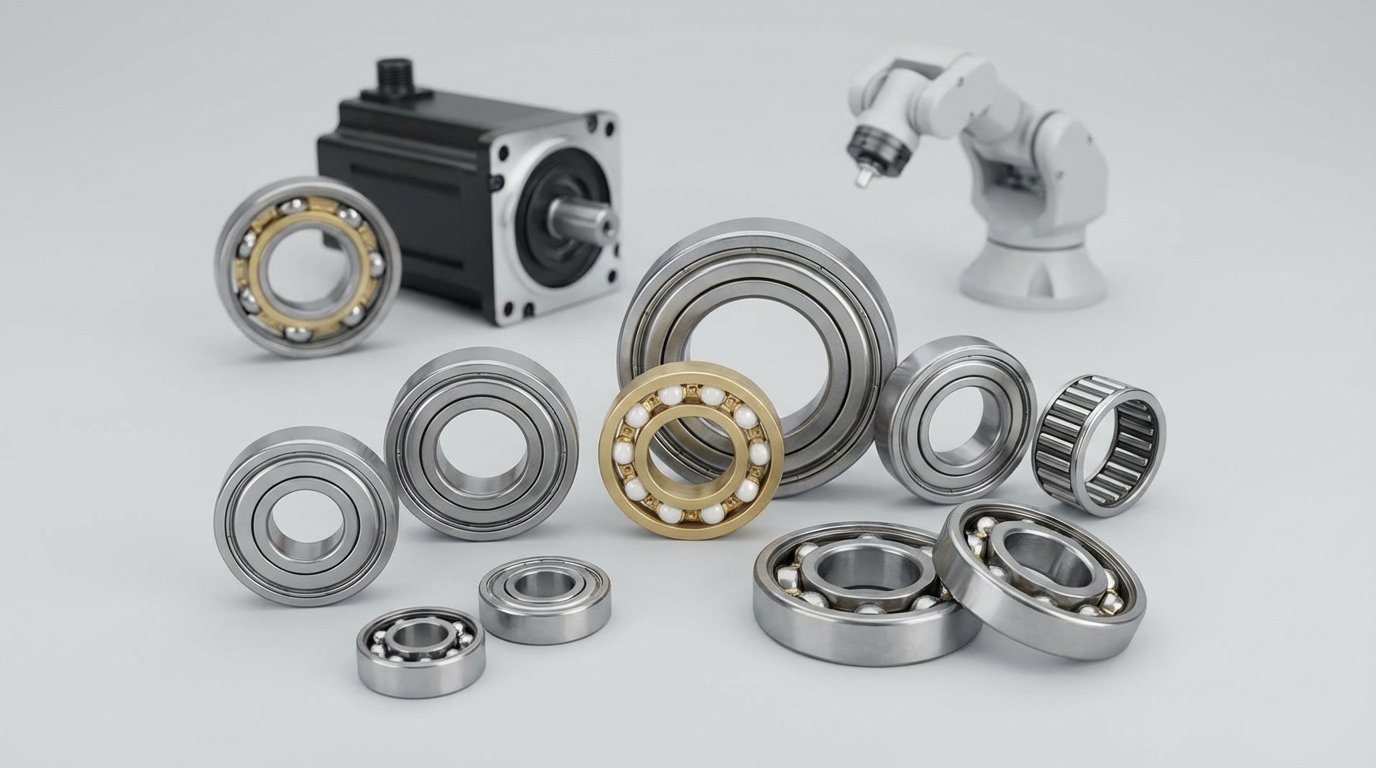
Key robot servo motor bearing features include stiffness, precision, load capacity, speed/torque drag, sealing, lubrication life, and fit compatibility. Comparing these helps balance servo performance, reliability, and maintenance needs.
Feature-by-feature comparison buyers actually use
Based on our internal data and market analysis, here is the breakdown:
| Option | Strengths in servo use | Main drawbacks | Typical best use |
|---|---|---|---|
| Deep groove ball (open/ZZ/2RS) | High speed, simple, widely available, cost-effective | Limited axial stiffness vs angular contact | Motor-end support, light-to-moderate axial loads |
| Angular contact ball (single or paired) | High axial capacity, high stiffness, controllable preload | Higher cost, more sensitive to installation | Precision joints, gearboxes, high rigidity needs |
| Cylindrical roller | High radial load capacity, good stiffness radially | Needs separate axial locating bearing | High radial loads with dedicated thrust control |
| Crossed roller (joint bearing) | Handles radial/axial/moment loads in compact form | Costly; demands precise mounting | Robot joints with high moment loads |
| ZZ shielded | Lower drag than 2RS; decent for clean environments | Limited contamination protection | Enclosed motors, clean automation cells |
| 2RS sealed | Best contamination resistance; grease retention | Higher torque/heat; speed limits | Dusty floors, longer maintenance intervals |
| Hybrid ceramic (ceramic balls) | Higher speed potential, corrosion benefits, less smearing risk | Cost; shock sensitivity; requires correct setup | High-speed spindles, special servo cases (validated) |
Haron Bearing Pro Tip: When comparing options, I ask teams to rank just three priorities—(1) stiffness, (2) contamination resistance, (3) torque drag—and then choose the bearing type and sealing that best matches that ranked list.
Cost & Buying Factors
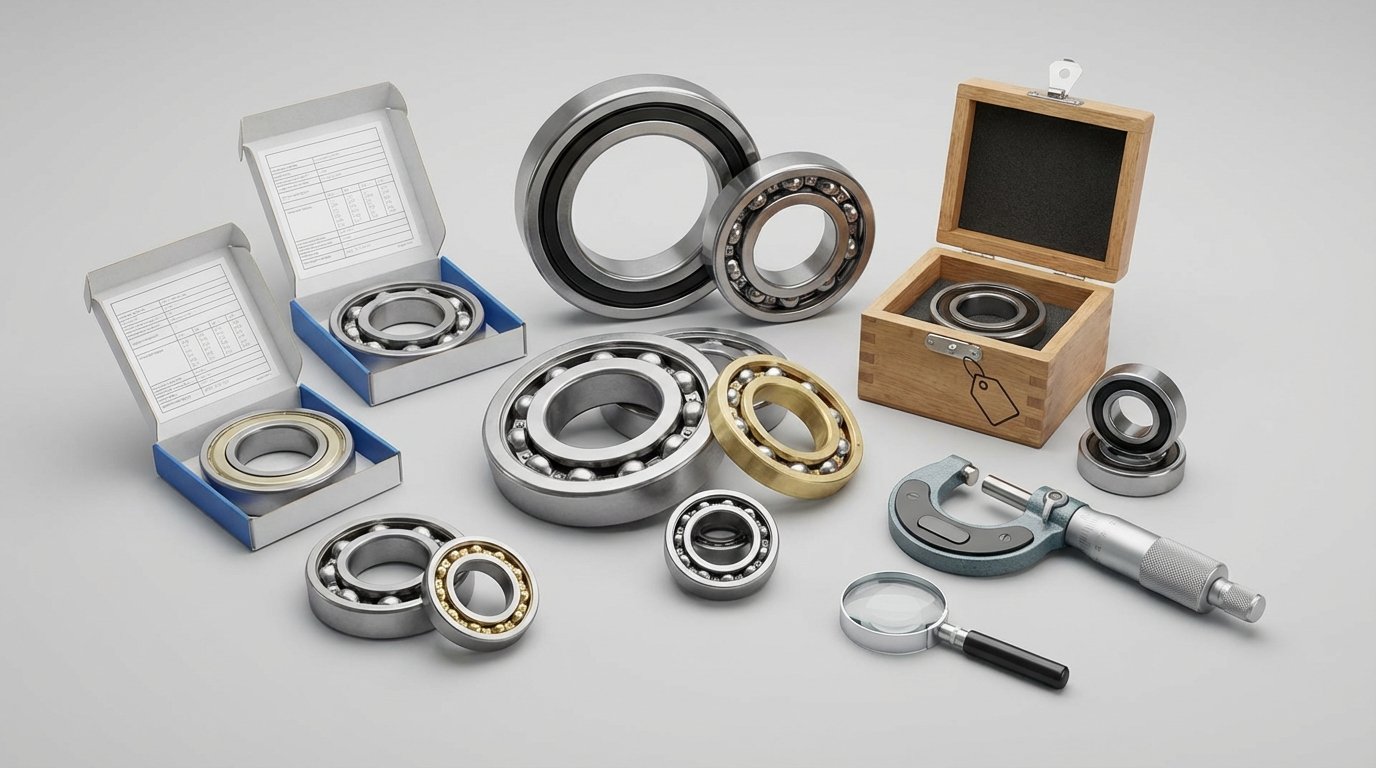
Robot servo motor bearing cost depends on precision grade, type, sealing, lubrication, and brand consistency. Low unit price may increase tuning time, noise, replacement, and downtime, so buyers should compare total cost of ownership.
What really drives price—and how to write a strong RFQ
Main cost drivers:
- Precision/runout/noise grade: Tighter tolerances and quieter running increase price.
- Bearing architecture: Angular contact pairs and crossed rollers cost more than deep groove.
- Sealing and grease spec: Specialty low-torque greases or high-temp greases add cost.
- Material and heat treatment: Premium steels, hybrid ceramic elements, corrosion-resistant variants.
- Consistency and traceability: Lot control, inspection reports, and warranty support.
RFQ checklist (include these to get comparable quotes):
- Bearing size (bore/OD/width) and type (deep groove / angular contact / etc.)
- Load case: radial/axial, peak and continuous, any shock events
- Speed profile: max RPM, duty cycle, reversing frequency
- Target life: hours or cycles + allowable maintenance interval
- Sealing preference: open / ZZ / 2RS
- Lubrication: grease type requirement (low torque, food-grade, high-temp) and fill amount if needed
- Precision needs: runout/noise/vibration requirements; matched pair requirements if applicable
- Operating environment: temperature, dust, moisture, chemicals
- Mounting fits: shaft/housing tolerances, expected preload method
Pricing guidance (typical market pattern):
- Standard deep groove (ZZ/2RS): lowest cost, broad availability
- Low-noise/precision deep groove: moderate premium for smoother servo behavior
- Angular contact matched sets: higher cost, strong stiffness payoff
- Crossed roller joint bearings: highest cost, replaces multiple bearings and supports moments
Haron Bearing Pro Tip: I’ve seen the best ROI when buyers specify measurable acceptance criteria—runout, noise/vibration grade, and torque band—because it prevents “equivalent” substitutions that look fine on paper but degrade servo smoothness in production.
Conclusion
Robot servo motor bearings affect accuracy, smooth motion, heat, and joint life. Match bearing type, sealing, preload/clearance, and lubrication to load and environment, then define them in your RFQ. Haron can recommend a reliable configuration.