
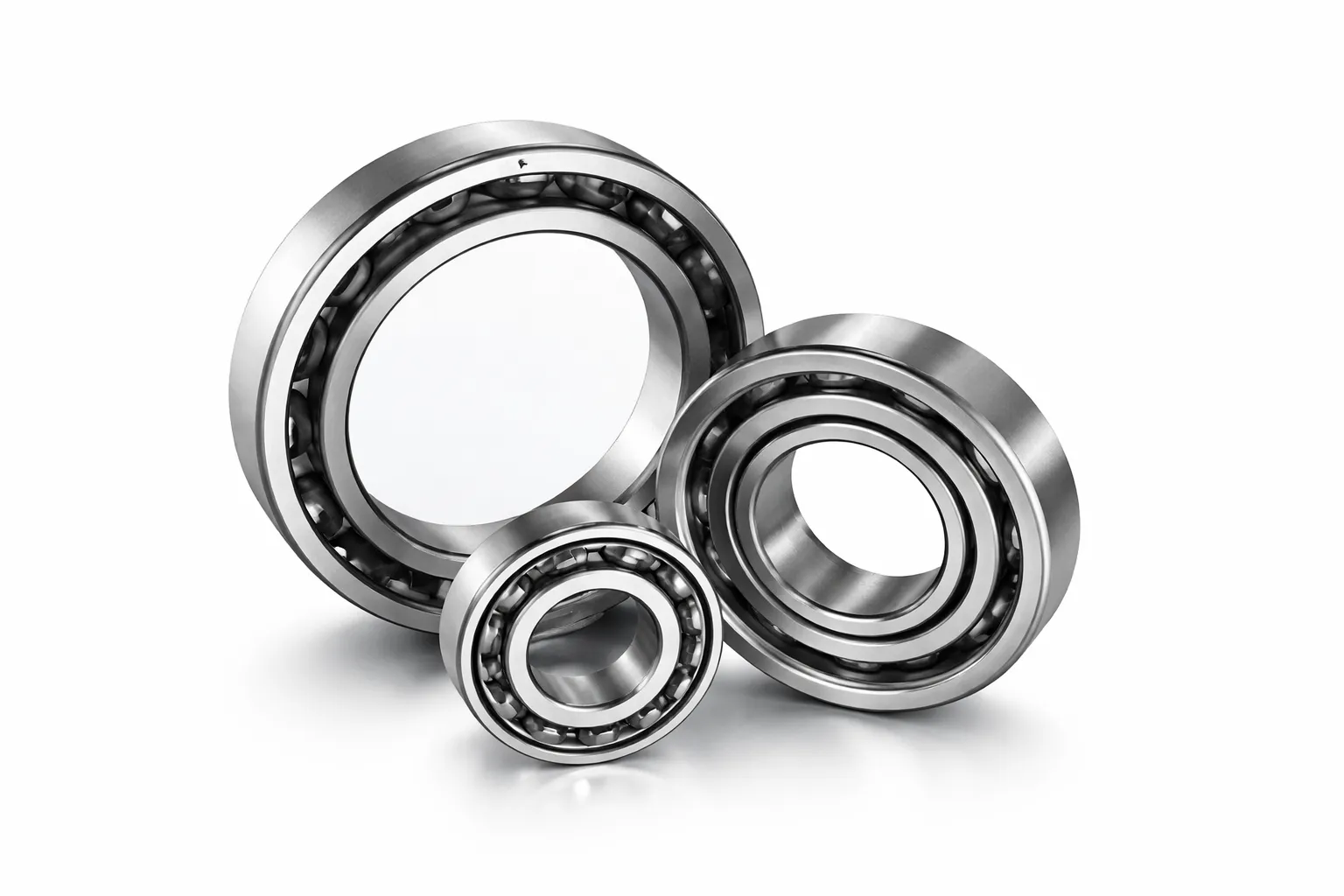
Angular contact ball bearings are used in robot joints, gearboxes, and spindles to support radial and axial loads. Their contact angle and preload help reduce deflection, vibration, and improve repeatability in high-speed, precision axes.
Video Guide: This overview explains why bearings matter in robotics and automation, linking stiffness, accuracy, speed, and uptime to bearing selection.
What is angular contact ball bearings in robotics?
Angular contact ball bearings carry radial load and one-way axial load together. In robots, they are often used in preloaded pairs to improve stiffness, reduce compliance, and maintain accurate positioning under dynamic motion and moment loads.
Video Guide: This animation-style explanation clarifies what an angular contact ball bearing is and why the contact angle enables combined-load capability.
Design traits that matter in robot joints
Angular contact ball bearings differ from deep groove bearings by their contact angle, allowing better axial load support. In robot axes, this improves rigidity and end-effector repeatability during acceleration, braking, or off-center payloads.
Key identifiers in robotics applications include:
- Contact angle (e.g., 15°, 25°, 40°): Higher angles generally support higher axial load and stiffness.
- Pairing arrangement: Bearings are often installed in DB (back-to-back), DF (face-to-face), or DT (tandem) sets to manage axial loads in both directions and handle overturning moments.
- Preload options: Light/medium/heavy preload improves stiffness and runout control, but raises heat and torque.
- Precision class and runout: Critical for harmonic drives, cycloidal reducers, and robot spindles/end-of-arm tooling.
Haron Bearing Pro Tip: Robot accuracy starts with stiffness. If the axis faces reversing axial loads or overturning moments, use paired angular contact bearings with defined preload instead of relying on software tuning.
How Does angular contact ball bearings in robotics Work?
Angular contact ball bearings transmit loads at a contact angle, supporting both radial and axial forces. In robots, preloaded pairs remove clearance, improve stiffness, and reduce micro-movement during acceleration, direction changes, and overturning moments.
Video Guide: This animation shows the force path through the contact angle and how angular contact bearings support axial load compared with radial designs.
Load path, preload, and stiffness in real robot duty
Because the contact angle creates a directional axial-load capacity, a single bearing typically supports axial load primarily one way. Robots therefore use matched pairs or sets so the axis can handle thrust in both directions and maintain position under oscillating motion profiles.
A practical working model in robotics:
- Radial + axial forces enter the joint (payload weight, acceleration, belt/gear forces).
- Contact angle redirects part of the force axially through the raceways.
- Preload removes clearance, preventing skidding and limiting deflection.
- Bearing set arrangement carries moment loads, especially in shoulder/elbow joints and reducer outputs.
- Lubrication and sealing manage heat and wear under high duty cycles.
Typical pairing choices (quick selection logic):
- DB (back-to-back): Highest moment stiffness; common for robot joints and reducer outputs.
- DF (face-to-face): Better misalignment tolerance; used when housing alignment is less rigid.
- DT (tandem): Higher axial capacity in one direction; used for dominant thrust direction.
Haron Bearing Pro Tip: If your robot axis heats up and torque rises after preload changes, I usually step back and check two things first: preload class (too high) and grease fill (too much). Both can mimic “bearing failure” symptoms.
Where are angular contact ball bearings used?
Angular contact ball bearings are used in robot reducer outputs, rotary joints, servo spindles, and end-effectors. They provide high stiffness and accurate rotation under combined loads, especially with long reach, fast acceleration, or off-center payloads.
Video Guide: This explains practical differences between radial and angular contact bearings, helping map load types to real robot locations.
Common robot assemblies and why the bearing choice fits
Robotics concentrates loads into compact joints. Angular contact designs perform well in these spots because they can be preloaded and configured as rigid bearing sets.
Typical placements include:
- Robot shoulder and elbow joints: High moment loads and frequent direction reversals demand stiffness.
- Wrist axes: Space constraints plus high precision favor compact, preloaded bearing sets.
- Harmonic/cycloidal reducer output support: Bearing stiffness directly affects torsional compliance and repeatability.
- Linear actuator screw supports: Fixed-end support often uses paired angular contact bearings to control axial positioning.
- End-of-arm tooling (EOAT) spindles/grippers/rotary tables): High-speed rotation and axial thrust during machining, polishing, or indexing.
Selection cues by application (fast checklist):
- High axial thrust or reversing thrust → paired angular contact
- High overturning moment at flange/output → DB arrangement
- High speed + low heat tolerance → lower preload + optimized lubrication
Haron Bearing Pro Tip: When a wrist axis shows “mysterious” repeatability loss, I look for bearing seat fretting or housing ovality—angular contact bearings amplify the benefits of stiffness, but they also expose weak fits and thin housings fast.
What is the purpose of the angular bearing?
An angular contact bearing supports combined radial and axial loads in robots. With contact angle and preload, it reduces axial play and deflection, improving positioning accuracy, repeatability, and stability during fast motion.
Video Guide: This compares angular contact and radial bearings, focusing on why angular designs are chosen when axial load and precision matter.
What you gain (and what you trade) in robot performance
Angular contact bearings are chosen to solve measurable problems in robot axes: compliance, vibration, and drift under thrust loads. Preloaded sets also improve servo response because the mechanical system behaves more predictably.
Main performance objectives:
- Stiffness increase: Less axis deflection under payload and acceleration.
- Axial positioning control: Reduced endplay supports encoder accuracy and stable gear meshing.
- Moment load handling: Bearing set geometry resists overturning moments at flanges.
- Runout control: Supports accurate rotation for spindles and rotary tooling.
Trade-offs to plan for:
- Higher friction torque vs. radial bearings (especially with heavy preload).
- More heat at speed if preload/lube is not optimized.
- More sensitivity to fits and alignment—poor seating reduces life and precision.
Haron Bearing Pro Tip: I recommend specifying purpose first—“minimize deflection under X Nm moment” or “hold axial position within Y μm”—then selecting contact angle and preload to meet that target, instead of defaulting to the highest preload available.
How to use angular contact bearings?
Use angular contact bearings in matched pairs/sets. Select DB, DF, or DT arrangements based on load and moment needs, apply correct preload, and ensure proper fits, cleanliness, lubrication, and alignment to prevent heat, noise, and early failure.
Video Guide: This shows single-row angular contact bearing basics and helps visualize orientation and installation intent.
Practical installation and configuration workflow
Angular contact bearings are precision components; performance depends as much on mounting as on the bearing itself. Use a controlled process:
- Confirm load directions and required stiffness (axial, radial, moment, speed, duty cycle).
- Select arrangement: DB for stiffness, DF for misalignment tolerance, DT for one-way thrust capacity.
- Define preload method: matched pair preload, spring preload, or spacer-controlled preload.
- Specify correct fits: interference/transition fits as needed for ring creep control and heat expansion.
- Control cleanliness and handling: avoid brinelling from shock loads during pressing.
- Lubricate correctly: choose grease/oil for speed and temperature; avoid overfilling.
- Verify after assembly: measure starting torque, temperature rise, noise, and runout.
Common mounting mistakes to avoid:
- Flipping one bearing in a pair (wrong orientation)
- Excessive preload due to incorrect spacer lengths
- Over-greasing sealed or open bearings
- Using thin housings that deform under clamp load
Haron Bearing Pro Tip: I always mark the bearing orientation during dry assembly and re-check after final torque—one reversed angular contact bearing in a DB set can turn a “precision joint” into a heat generator within minutes.
Key Features & Comparison
Angular contact ball bearings offer axial capacity, preload stiffness, and flexible pairing for robot axes. They control play and deflection better than radial bearings but need careful mounting and lubrication to improve repeatability, speed stability, and service life.
Video Guide: This practical talk-through contrasts radial and angular contact bearings in a way that maps well to robotics load cases.
Specification points that drive robot performance
Based on our internal data and market analysis, here is the breakdown:
| Feature / Decision Point | Angular Contact Ball Bearing (Robotics) | Deep-Groove Radial Ball Bearing (Typical Alternative) | What it means on a robot |
|---|---|---|---|
| Primary strength | Combined radial + high axial (directional) | Radial + limited axial | Better thrust control in joints and screw supports |
| Moment load capability | High when paired (DB/DF) | Moderate (depends on geometry) | Improved flange/output stability and repeatability |
| Preload capability | Excellent, commonly specified | Limited/less predictable | Lower compliance, better servo response |
| Direction of axial load | One direction per bearing; needs pairs for both | Both directions (limited) | Pairing is standard in precision axes |
| Speed potential | High, but preload/lube sensitive | High, generally forgiving | Thermal management matters more with preload |
| Mounting sensitivity | Higher (fits/alignment critical) | Lower | Housing rigidity and fits must be controlled |
| Typical robot uses | Reducer outputs, wrist joints, fixed-end screw supports, spindles | Idlers, light-load joints, auxiliary rollers | Choose based on combined load + precision needs |
Haron Bearing Pro Tip: If you’re comparing options, I look at stiffness per package size: a properly preloaded DB angular contact pair often delivers a bigger accuracy gain than moving up one frame size of motor or adding control filtering.
Cost & Buying Factors
Cost for angular contact ball bearings in robotics depends on precision class, preload type, sealing, materials, and whether bearings are sold as matched sets. The lowest total cost usually comes from selecting only the stiffness/accuracy you truly need, and then protecting life with correct lubrication, fits, and contamination control in the joint.
What actually drives price and lead time
Main buying factors that typically move cost:
- Precision/grade (runout, dimensional tolerance): Higher grades cost more but can reduce calibration drift and vibration.
- Matched pairs/sets: Factory-matched preload sets add cost but reduce assembly risk and variation.
- Contact angle and design series: Certain geometries and slim/compact series can be pricier.
- Seals/shields and grease fill: Robotics often benefits from optimized greases for torque consistency and temperature.
- Material and heat treatment: Options for corrosion resistance or higher hardness increase price.
- Quantity and supply stability: Standard sizes in steady demand have better lead times than niche dimensions.
A practical purchasing checklist:
- Define axial load (both directions), radial load, and overturning moment at the bearing location.
- Specify target stiffness/deflection, not just “high precision.”
- Choose preload class based on speed, heat limits, and torque budget.
- Confirm shaft/housing fits and expected operating temperatures (thermal growth changes preload).
- Decide on sealed vs. open based on contamination risk and maintenance strategy.
Haron Bearing Pro Tip: When customers ask me how to cut cost without sacrificing accuracy, I usually start by right-sizing preload and confirming the housing stiffness—overspending on ultra-high precision bearings won’t help if the surrounding structure flexes more than the bearing ever will.
Conclusion
Angular contact ball bearings improve robot joint stiffness, precision, and stability under combined loads. Proper contact angle, pairing, preload, and mounting help protect repeatability and service life. Haron Bearing can support bearing selection for reliable robot axes.