

Robots use several bearing types depending on their structure, load, speed, stiffness, precision, and installation space. The most common bearings used in robots include:
- deep groove ball bearings — used for motors and high-speed rotation.
- angular contact bearings — used for precise radial and axial load support.
- cross-roller bearings — used for robot joints with high rigidity.
- thin-section bearings — used for compact and lightweight designs.
- needle roller bearings — used for high loads in limited space.
- slewing (turntable) bearings — used for large bases and rotary platforms.
Common bearing types used in robots (quick mapping):
| Bearing type | Strength in robots | Typical robot locations | Notes (robot-grade considerations) |
|---|---|---|---|
| Cross-roller bearings | Very high rigidity, supports combined loads & moment loads | Joint axes (shoulder/elbow/wrist), rotary tables | Often preloaded; excellent for harmonic-drive outputs and compact joints |
| Thin-section bearings (ball/AC) | Saves space, low inertia | Wrist joints, compact rotary axes, end-effector pivots | Watch deflection; usually paired with stiff housings and controlled preload |
| Angular contact ball bearings | High axial stiffness, supports axial + radial loads, high speed | Servo motors, precision gearboxes, ball-screw supports | Common in matched pairs (DB/DF) with set preload for accuracy |
| Deep groove ball bearings | Versatile, economical, good speed | Idlers, auxiliary shafts, fan/encoder supports, light-load joints | Choose low-noise grades and correct seals for low torque |
| Slewing/turntable bearings | Large diameter, supports overturning moments | Base rotation (robot pedestal), positioners, gantries | Can be integrated with gear teeth; focus on rigidity & sealing |
| Needle roller bearings | High radial load in small space | Gearbox planet pins, compact link pivots | Not ideal for high moment loads unless supported by guides |
Haron Bearing Pro Tip: Many robot accuracy issues are caused by preload and housing stiffness, not just the bearing model. At Haron Bearing, we tune preload to balance repeatability and torque, especially in cross-roller and angular-contact bearing applications.
What is a bearing in robotics?
A robotic bearing supports shafts and joints, reduces friction, and handles radial, axial, and moment loads while helping maintain motion accuracy and repeatability.
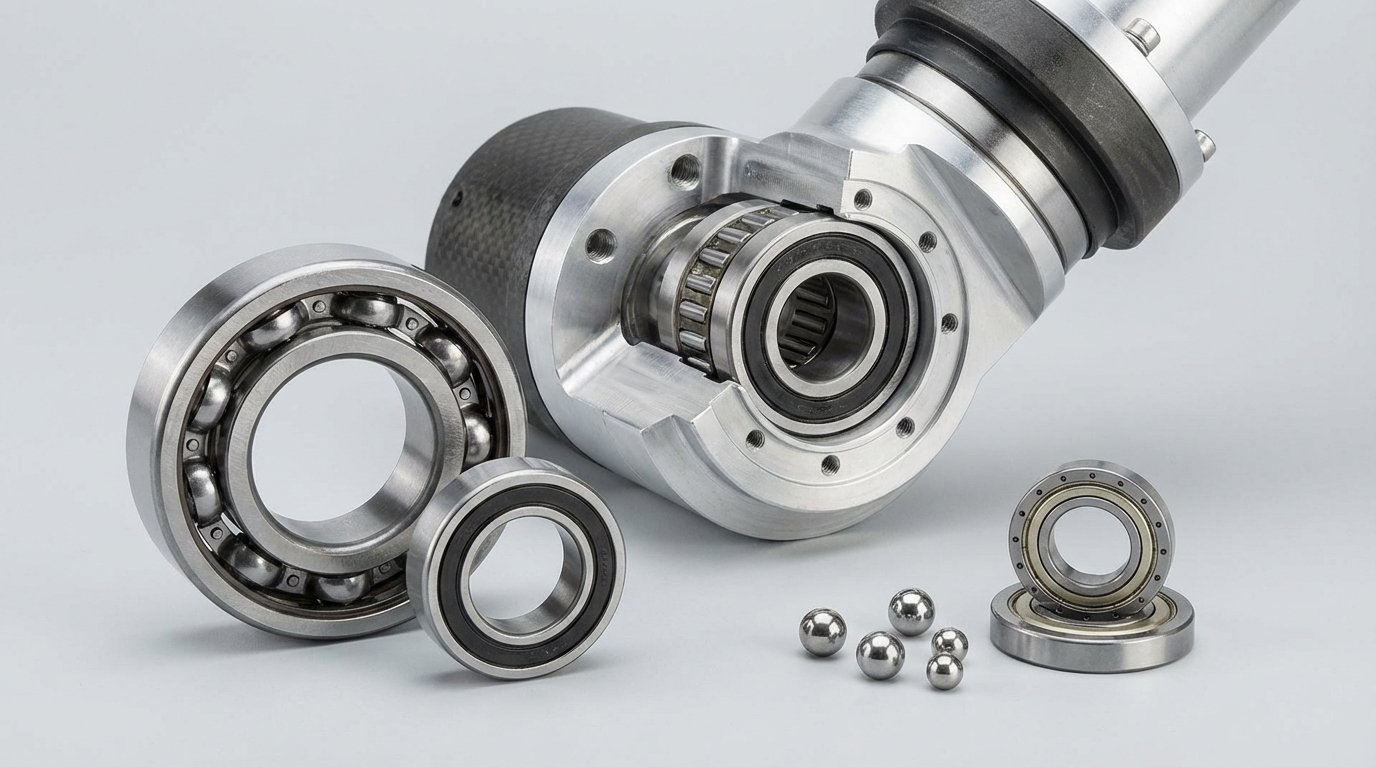
Functional roles inside robotic mechanisms
- Load support: radial/axial/moment load handling in joints and gearboxes
- Motion quality: runout control, low vibration, smooth torque
- Accuracy retention: stiffness + preload maintain pose under load
- Durability: resists contamination, fretting, false brinelling during dithering
Haron Bearing Pro Tip: Some robots pass load ratings but still fail in use because tilting moment and micro-oscillation were ignored. We optimize grease, preload, and sealing to prevent false brinelling and improve performance.
Which is better, RS or ZZ bearing?
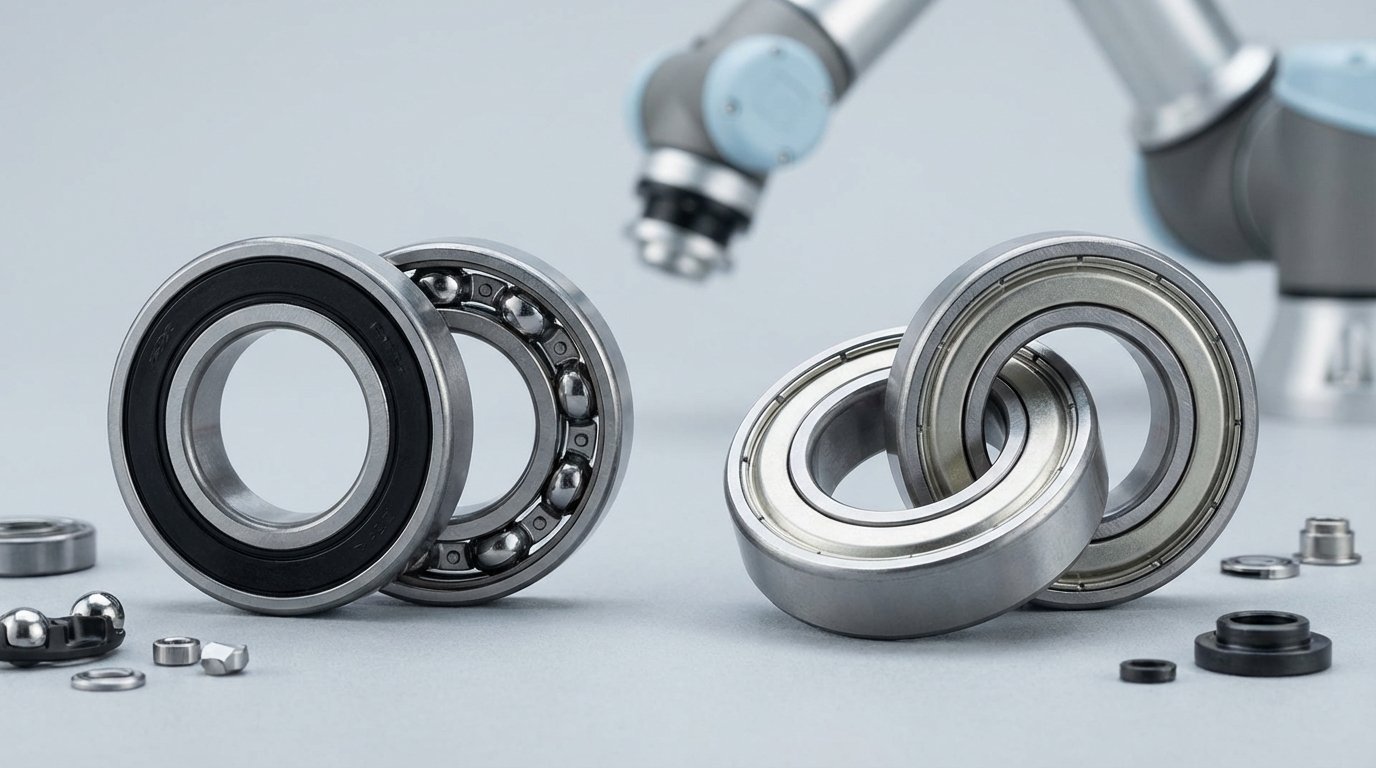
• RS bearings provide better protection against dust and moisture, making them ideal for dirty or moisture-prone robotic environments.
• ZZ bearings offer lower friction and higher speed capability, making them better suited for clean, high-speed applications such as motors and encoder supports.
RS vs ZZ comparison table
| Feature | RS (sealed) | ZZ (shielded) |
|---|---|---|
| Contamination protection | Better | Moderate |
| Torque / drag | Higher | Lower |
| Max speed (typical) | Lower | Higher |
| Grease retention | Better | Moderate |
| Best robot use cases | Weld dust, grinding, general factory debris | Clean servo housings, light-load high RPM |
Haron Bearing Pro Tip: Our technicians often see overheating traced to “over-sealing.” We recommend ZZ when the housing is already labyrinth-protected, and RS when the bearing is the primary barrier—then we tune grease fill to keep starting torque within servo limits.
Do robots have bearings?
Yes—almost every robot uses bearings in joints, motors, gearboxes, wrists, and rotating modules to reduce friction, control wear, and maintain repeatability.
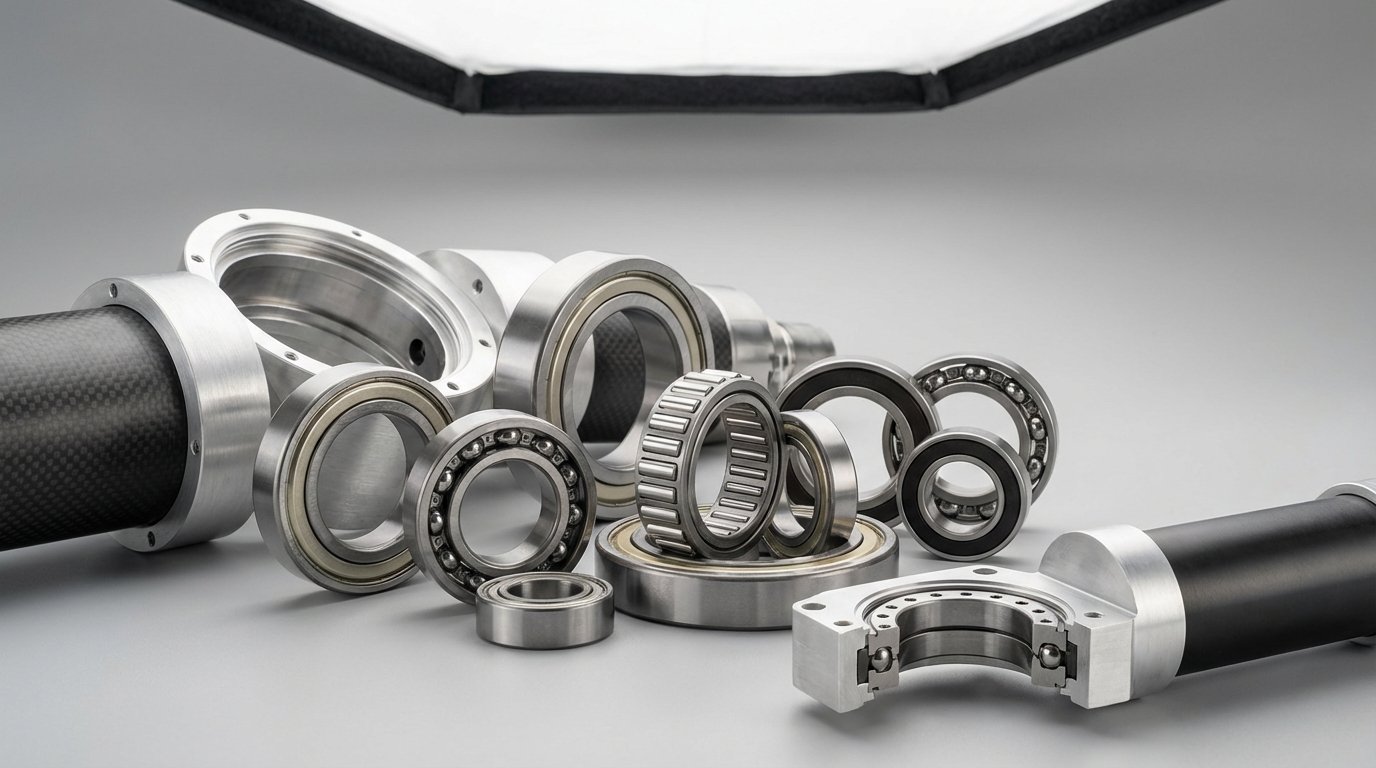
Where bearings typically appear (by subsystem)
- Joints: cross-roller / thin-section / angular-contact sets
- Gearboxes (planetary/harmonic): needle rollers, angular contact, supporting bearings
- Servo motors: precision deep groove or angular contact
- Base rotation: slewing bearings or large cross-rollers
- End effectors: compact deep groove/thin-section for pivots and spindles
Haron Bearing Pro Tip: Many “backlash” issues are caused by bearing seat creep or low preload, not the gears. Proper fits and retention help keep stiffness stable over time.
What material is a 6203 bearing made of?
A standard 6203 deep groove ball bearing is usually made from through-hardened chromium bearing steel such as AISI 52100 or GCr15, with a steel cage. Stainless steel and polymer cage versions are also available for corrosion resistance or lower noise.
Typical 6203 material options
| Component | Most common | Optional variants (robot/automation use) |
|---|---|---|
| Rings & balls | 52100 / GCr15 bearing steel | 440C stainless, hybrid ceramic balls |
| Cage | Pressed steel | Nylon/PA66, PEEK (low noise/high speed) |
| Seals/shields | NBR (RS), steel (ZZ) | FKM for higher temp/chemicals |
Haron Bearing Pro Tip: Early noise in 6203 positions often comes from the wrong grease. Proper grease selection helps reduce torque and prevent vibration.
What robot bearing types do you supply, and where are they used?
Common industrial robot bearings include cross-roller, thin-section, angular-contact, and slewing bearings, widely used in robot joints, wrists, motors, gearboxes, and base rotation systems.
Typical industrial robot applications we support
| Robot module | Common bearing choice | Why it’s used |
|---|---|---|
| Harmonic drive output / joint axis | Cross-roller (often preloaded) | High moment stiffness + compactness |
| Servo motor supports | Precision deep groove / angular contact | Low vibration, high speed, controlled runout |
| Planetary gearbox | Needle rollers + angular contact | High radial capacity and axial stiffness |
| Base rotation / positioner | Slewing bearing / large cross-roller | Overturning moment capacity, durability |
Haron Bearing Pro Tip: Dynamic rating alone is not enough for robot bearings. Stiffness, runout, torque variation, and preload stability are also critical to repeatability.
What are your pricing, MOQ, lead time, and volume discounts for robot bearings?
Robot bearing wholesale pricing depends on type, precision, preload, materials, and inspection requirements. MOQ and lead time vary by whether the bearings are standard or customized.
Haron Bearing Pro Tip: Late decisions on preload and precision often delay projects. Defining accuracy and inspection requirements early helps avoid rework and surprises.