
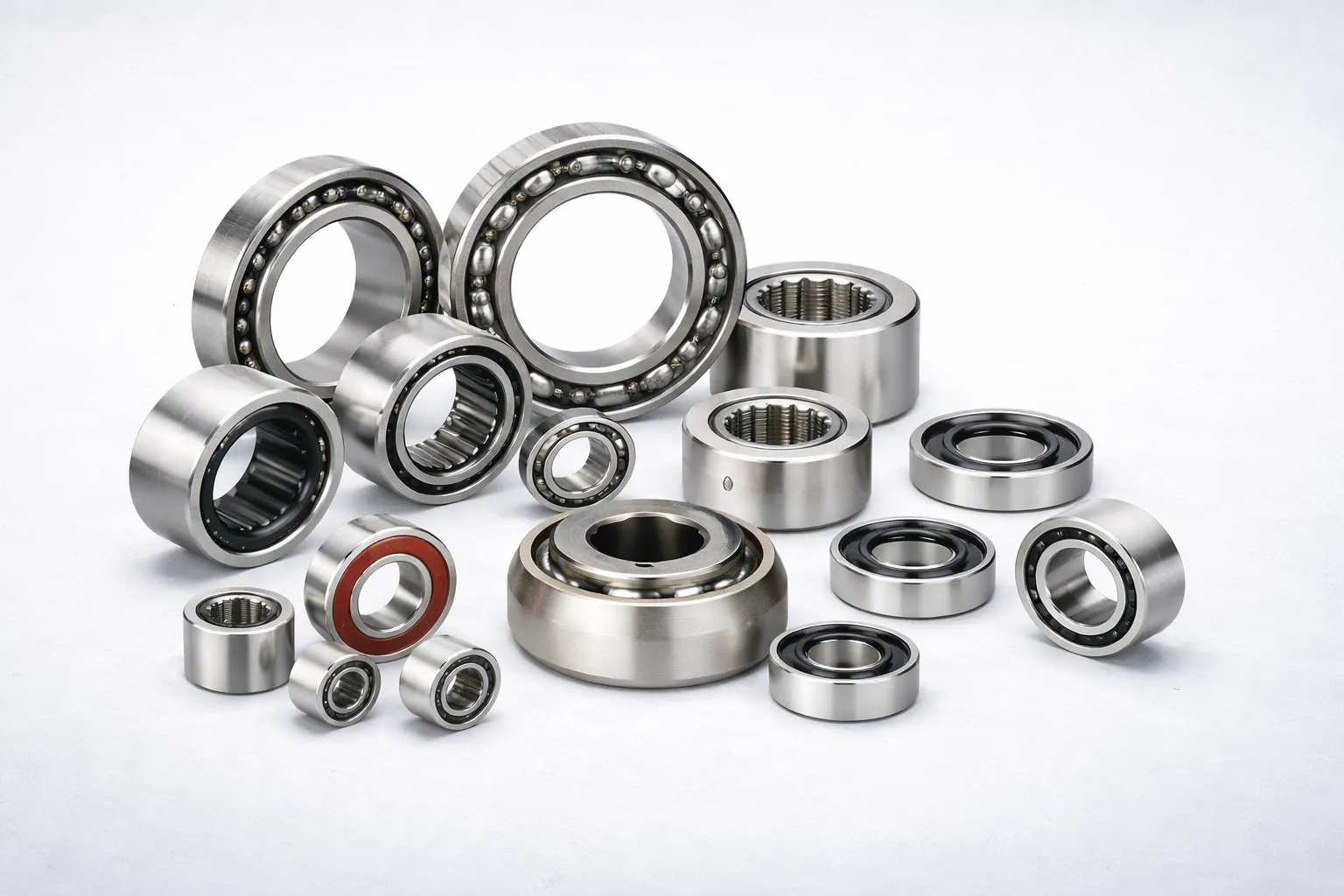
Precision bearings are engineered rolling-element bearings built to tighter tolerances so machines can run with lower runout, better repeatability, and more stable performance under speed and load. This guide explains what they are, how they work, practical handling rules, common lubrication mistakes, and how to compare options so engineers and buyers can specify confidently for real-world reliability.
What is precision bearings?
Precision bearings are high-accuracy bearings manufactured to stricter dimensional, geometric, and running-accuracy tolerances than standard bearings. They reduce runout, vibration, and heat generation, enabling higher spindle speeds, better surface finish, and tighter positioning accuracy in equipment like machine tools, robotics, and aerospace assemblies.

Where “precision” shows up in real performance
Precision is not a marketing label—it is expressed through measurable tolerances and operating behavior, commonly including inner/outer ring geometry, raceway waviness, bore/OD size accuracy, and running accuracy (radial/axial runout).
Key characteristics engineers typically specify:
- Accuracy class (e.g., ABEC/ISO P classes) tied to allowable deviations
- Runout limits (radial and axial)
- Noise/vibration level (important for spindles and instrumentation)
- Preload capability (consistent stiffness and positioning)
- Material and heat treatment quality (dimensional stability, fatigue life)
Haron Bearing Pro Tip: I treat “precision” as a system spec: bearing class + correct fit + preload + lubrication + cleanliness. If any one of these is uncontrolled, the assembly won’t behave like a precision unit—no matter how good the bearing is on paper.
How Does precision bearings Work?
Precision bearings work by guiding rolling elements (balls or rollers) along finely finished raceways so the shaft rotates with minimal friction and tightly controlled radial and axial motion. Their tighter geometry limits micro-slippage and runout, improving stiffness, heat stability, and repeatable positioning at high speed compared with standard bearings.
Load paths, contact angles, and preload behavior
A precision bearing’s “work” is defined by how it carries loads and maintains position:
- Radial loads are carried perpendicular to the shaft.
- Axial (thrust) loads are carried along the shaft axis.
- Contact angle (especially in angular contact ball bearings) determines axial-load capacity and stiffness.
- Preload removes internal clearance to increase stiffness and control runout—at the cost of higher heat if excessive.
Typical functional elements and what they do:
- Raceways (inner/outer ring): Provide hardened, ground tracks with controlled geometry.
- Rolling elements: Transfer load through point/line contact with minimal friction.
- Cage: Spaces rolling elements to reduce skidding and heat.
- Lubrication film: Separates surfaces, controls wear, and manages heat.
Haron Bearing Pro Tip: When a “precision” bearing runs hot, I first suspect preload/fit before lubrication. Too-tight fits or excessive preload can erase the efficiency advantage and quickly destabilize accuracy through thermal growth.
What are the three rules for bearings?
The three rules for bearings are: keep them clean, install them correctly, and lubricate them properly. Contamination, mounting force through rolling elements, incorrect fits, or wrong lubricant quantity are the fastest ways to create noise, runout, overheating, and premature fatigue—even with premium precision bearings.

Practical shop-floor rules that prevent most failures
Follow these three rules as a repeatable checklist:
- Cleanliness rule (control contamination):
- Keep bearings sealed until use
- Use clean gloves and lint-free wipes
- Protect from grinding dust and shop aerosols
- Correct installation rule (avoid mechanical damage):
- Apply force to the correct ring (press inner ring onto shaft; press outer ring into housing)
- Use proper tools (arbor press, induction heater, correct sleeves)
- Avoid hammering and “driving” through balls/rollers
- Lubrication rule (right type, right amount, right interval):
- Use grease/oil suited to speed, temperature, and load
- Avoid overfilling (churning = heat)
- Relube based on condition/interval, not guesswork
Haron Bearing Pro Tip: I tell installers: “Clean hands, straight press, correct grease.” If you can verify those three, you prevent the majority of early-life precision bearing returns.
Why not use WD-40 on bearings?
WD-40 is not a bearing lubricant; it’s primarily a water-displacing penetrating fluid with limited film strength and poor long-term load-carrying capability. It can thin or wash out proper grease, reduce corrosion protection over time, and lead to metal-to-metal contact—especially in precision bearings where consistent lubrication film and stability matter.
What to use instead (and when)
Common problems when WD-40 is used in bearings:
- Lubrication film collapses under load → wear and noise
- Grease dilution → lower viscosity and reduced protection
- Short-lived corrosion resistance compared with proper bearing greases
Better alternatives by situation:
- For cleaning (disassembled bearing only): A dedicated solvent/parts cleaner, then dry thoroughly and relubricate
- For light corrosion prevention (stored parts): Rust preventive oils designed for storage
- For operation: Bearing-grade grease (EP, high-speed spindle grease) or oil (oil mist lubrication/oil-air) matched to RPM and temperature
Haron Bearing Pro Tip: If WD-40 ever touches a precision bearing in service, I assume the grease system is compromised—flush, dry, and relube with the specified product before running at speed.
Who makes the best ball bearings in the world?
“Best” ball bearings depend on the application: high-speed spindles, aerospace reliability, ultra-low noise, or value-driven industrial duty each favor different manufacturers and product lines. Top-tier makers typically combine consistent metallurgy, tight process control, advanced grinding/superfinishing, and strong quality traceability. Choose based on verified performance data, not reputation alone.
How to evaluate “best” for your use case
Instead of a single global ranking, use a qualification matrix:
- Performance fit: speed factor, load ratings, stiffness/runout requirements
- Quality evidence: inspection reports, batch traceability, PPAP/FAI where needed
- Consistency: lot-to-lot variation, noise/vibration screening capability
- Support: engineering guidance on fits, preload, lubrication, sealing
- Supply chain: lead time stability and authorized distribution
A simple buyer checklist:
- Request the accuracy class and runout/noise specs in writing
- Confirm material and heat treatment (and if corrosion-resistant steel is needed)
- Ask how the supplier controls cleanliness and particulate
- Validate with application testing (temperature rise, vibration, runout at speed)
Haron Bearing Pro Tip: I’ve seen “top brand” bearings fail when the fit, preload, or grease selection was wrong. I always qualify the bearing and the mounting/lube plan together before calling anything “best.”
Key Features & Comparison
Precision bearings are differentiated by accuracy class, runout, stiffness (often via preload), speed capability, thermal stability, and noise/vibration performance. Comparing these features side-by-side helps engineers match bearing behavior to spindle, robotics, or metrology needs, while buyers can balance performance risk against cost, lead time, and supplier support.

Feature-by-feature comparison for specification decisions
Based on our internal data and market analysis, here is the breakdown:
| Feature | Standard Bearings | Precision Bearings | What It Impacts Most |
|---|---|---|---|
| Dimensional tolerances | Moderate | Tighter and more consistent | Fit quality, assembly repeatability |
| Running accuracy (runout) | Higher runout | Lower runout | Surface finish, positioning accuracy |
| Noise & vibration control | Basic screening | Enhanced control/screening options | Spindles, medical/instrumentation |
| Speed capability | General purpose | Higher with correct cage/lube | Heat, stability at RPM |
| Preload options | Limited | Defined preload classes/sets | Stiffness, axial control |
| Thermal stability | Typical | Better stability with controlled geometry/material | Drift, precision over temperature |
| Quality documentation | Varies | More traceability options | Audits, regulated industries |
| Unit price | Lower | Higher | Total cost of ownership tradeoff |
Haron Bearing Pro Tip: If your requirement is “better accuracy,” don’t just upgrade the bearing class—tighten runout targets, define preload, and document fits. That’s where precision performance becomes predictable.
Cost & Buying Factors
Precision bearings cost more because they require higher-grade materials, tighter grinding/superfinishing, stricter inspection, and better process control. Total cost should be evaluated against scrap reduction, uptime, and performance yield—not unit price alone. The best buying decisions come from matching accuracy class and preload to true requirements and validating supply quality.
What drives price—and how to buy without overspending
Primary cost drivers:
- Accuracy class and matching: higher classes and matched sets increase cost
- Type: angular contact, cylindrical roller, hybrid ceramic options vary widely
- Preload and pairing: universal/paired sets cost more than single bearings
- Cleanliness, noise screening, documentation: added inspection and reporting
- Volume and lead time: small batches and expedited orders raise price
Buying decision steps (practical workflow):
- Define operating conditions: RPM, loads, temperature, lubrication method, environment
- Set measurable targets: runout, stiffness, noise/vibration, life, allowable temperature rise
- Select bearing type and class: only as high as needed for targets
- Specify fits and preload: document shaft/housing tolerances and assembly method
- Qualify supplier: samples + inspection data + application test run
- Plan lubrication and sealing: include grease type/fill and relube strategy
Haron Bearing Pro Tip: I reduce cost by right-sizing precision: use the highest class only where it affects accuracy (e.g., spindle front bearing). Elsewhere, a lower class with good sealing and lubrication often delivers better ROI.
Conclusion
Precision bearings deliver measurable gains in runout, stiffness, speed stability, and vibration control when the full system—fits, preload, lubrication, and cleanliness—is managed correctly. Use feature comparisons and application-based qualification to choose the right accuracy level and avoid overpaying. If you want specification help or a matched recommendation for your duty cycle, Haron Bearing can support selection, fit guidance, and quality documentation for procurement teams.