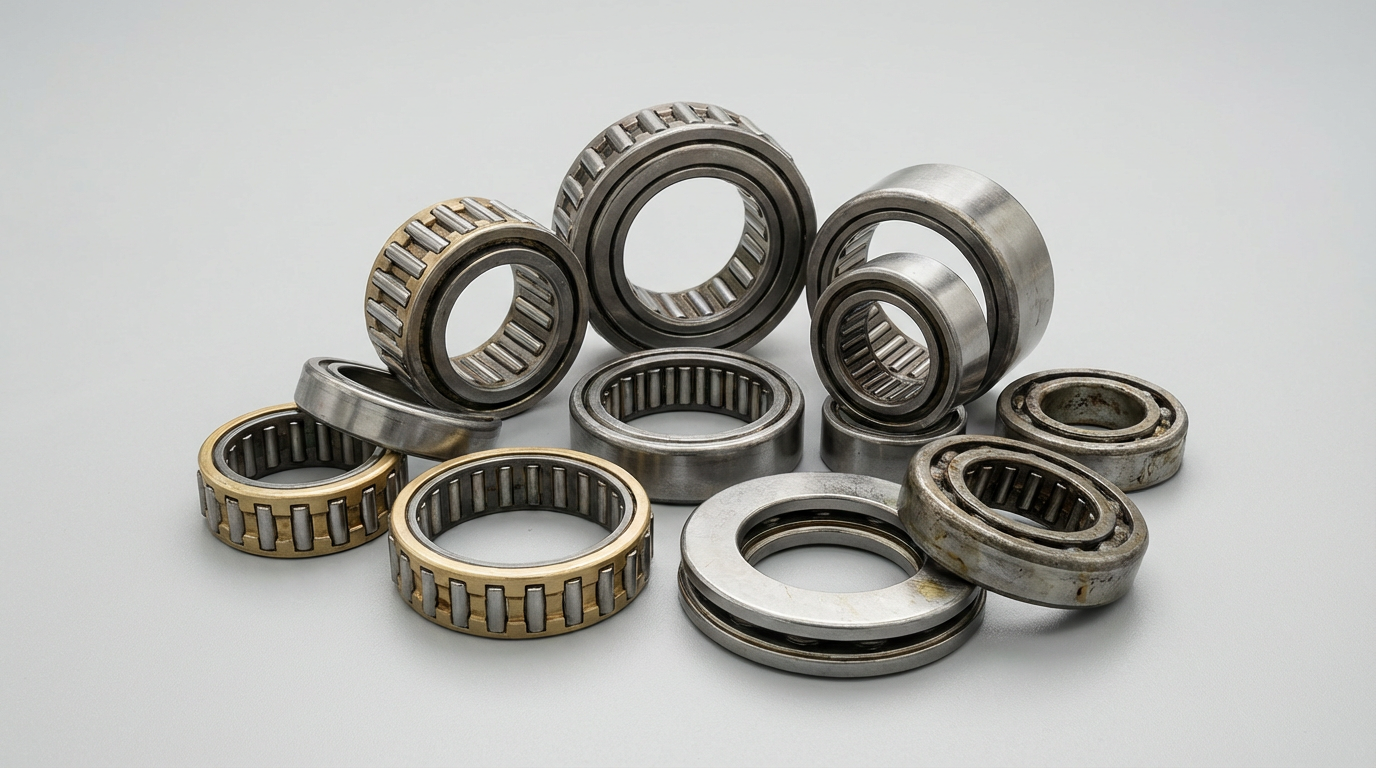

Needle roller bearings carry high radial loads in limited space. Their slim rollers provide large contact area, making them ideal for automotive drivetrains, gearboxes, and compact mechanisms. Haron Bearing helps you match the right type while considering load, speed, lubrication, and space limits.
Video Guide: A clear general overview of needle roller bearing construction, purpose, and where they fit among bearing types.
What is needle roller bearings?
Needle roller bearings are rolling-element bearings that use small-diameter cylindrical rollers to support high radial loads in compact spaces. Their long, slim rollers provide high load capacity, often with a thin outer ring or the housing as the raceway.
Video Guide: A broad bearing basics video that helps position needle roller bearings versus ball and other roller types.
Construction elements that define the type
Needle roller bearings are typically defined by their roller geometry and how the races are implemented (separate rings vs. integrated raceways). Common design building blocks include:
- Needle rollers: long rollers that distribute load over a larger line contact area.
- Cage (optional in some designs): separates rollers to reduce friction and heat; full-complement designs omit a cage to increase capacity.
- Inner ring (optional): used when the shaft surface isn’t suitable as a hardened raceway.
- Outer ring / drawn cup: thin-walled outer ring to minimize cross-section.
- Integrated raceways: the shaft and/or housing bore can serve as raceways if properly hardened and finished.
Haron Bearing Pro Tip: When space is tight, a drawn-cup needle roller bearing is tempting—but only specify “shaft-as-raceway” if you can guarantee hardness and finish; otherwise, use an inner ring to avoid early spalling and warranty headaches.
How Does needle roller bearings Work?
Needle roller bearings work by rolling slender rollers between raceways, reducing friction and spreading radial load through line contact. This gives high radial capacity in a compact size, but requires good alignment and raceway quality to prevent edge loading and wear.
Video Guide: A visual demonstration of how needle bearings roll and carry load across long rollers.
Load transfer and why alignment matters
Rollers contact the raceways along a line, not a point, so needle roller bearings carry higher radial loads than same-size ball bearings. But misalignment can concentrate load at roller edges, increasing stress, heat, and wear.
Key functional points:
- Radial load enters the outer ring/housing, passes through multiple rollers, and exits through the inner ring/shaft.
- Multiple rollers share the load, improving capacity per size.
- Lubrication film is critical because the contact patch is long; boundary lubrication increases scuffing risk.
- Misalignment creates edge loading, accelerating cage wear, roller scoring, and raceway spalling.
Haron Bearing Pro Tip: If your application has shaft deflection, belts, long shafts, or flexible housings, treat alignment as a key design factor. Even small misalignment can reduce needle roller bearing life and performance.
What is the use of needle roller bearing?
Needle roller bearings are used where high radial load capacity is needed in limited space, such as rotating joints, transmissions, and compact mechanisms. They work best in medium-to-high load, moderate-speed applications with good raceway quality, alignment, and lubrication.
Video Guide: Application-oriented examples showing where needle roller bearings are commonly installed and why.
Typical application categories (and what to check first)
Needle roller bearings appear in both high-volume OEM products and industrial equipment because they allow slimmer housings without sacrificing radial capacity.
Common uses:
- Automotive: transmissions, planetary gearsets, rocker arms, U-joints, alternators, starters, clutch and torque converter components.
- Industrial power transmission: gearboxes, reducers, couplings, cam followers (needle roller based designs), indexing mechanisms.
- Tools and appliances: compact motors, power tools, small gear trains, office machinery.
- Aerospace/defense (select use cases): compact linkages and accessory drives where space is constrained and raceway specs are controlled.
Selection checklist (fast filter):
- Radial load: high relative to available space.
- Speed: moderate; verify DN limits and lubrication.
- Shaft/housing hardness & finish: sufficient for raceway duty, or add an inner ring.
- Misalignment risk: low to moderate; otherwise consider alternatives.
Haron Bearing Pro Tip: If your drawing shows “bearing runs directly on shaft,” I always request the shaft heat-treatment and surface finish callouts before releasing the bearing spec—this one detail often decides whether needle rollers succeed or fail.
What are the disadvantages of needle bearings?
Needle bearings offer compact size and high radial capacity, but require good alignment, hard raceways, and proper lubrication. They handle limited axial load, are sensitive to contamination, and poor raceway quality can cause scoring or spalling.
Video Guide: A benefits-and-limitations overview that highlights where needle bearings fit—and where they can disappoint.
Practical limitations that show up in the field
Below are the most frequent “why it failed” themes seen across applications:
- Low axial capacity: most needle roller bearings are primarily radial; axial loads require a thrust solution.
- Raceway dependency: using the shaft/housing as a raceway demands tight control of hardness, roundness, and surface finish.
- Misalignment sensitivity: shaft deflection or housing distortion concentrates stress at roller edges.
- Lubrication sensitivity: thin films at line contact require correct viscosity and delivery method.
- Contamination vulnerability: debris causes brinelling/scoring faster due to high contact stress.
Haron Bearing Pro Tip: When a customer reports “premature noise,” I first ask about filtration and sealing. With needle rollers, keeping lubricant clean often extends life more than upgrading to a higher load rating.
What are the advantages of roller bearings?
Roller bearings, including needle roller bearings, offer higher radial load capacity than same-size ball bearings due to line contact. They improve stiffness, handle shock loads well, and suit compact gear, drivetrain, and moderate-speed applications.
Video Guide: A focused explanation of thin, high-capacity roller/thrust concepts that complements needle roller advantages.
Where roller bearings outperform ball bearings
Roller bearings are not “better” universally, but they win in several common engineering constraints:
- Higher radial capacity per size due to line contact.
- Higher stiffness (less deflection under load), which helps gears maintain mesh accuracy.
- Better shock tolerance in many designs.
- Packaging flexibility: needle rollers in particular minimize radial cross-section.
- Scalable designs: caged vs. full-complement to balance speed vs. capacity.
Haron Bearing Pro Tip: If your system is gear-driven and you’re fighting deflection or gear noise, moving from balls to rollers (or needles where space is tight) is often the cleanest mechanical fix—just validate lubrication and speed margins.
Key Features & Comparison
Needle roller bearings offer compact size and high radial load capacity, but require good raceway quality and alignment. Compared with ball, cylindrical roller, and plain bearings, they win on space and radial capacity, but are weaker in axial load and high-speed use.
Video Guide: A general needle bearing basics refresher that pairs well with side-by-side comparison concepts.
Spec-level comparison of common bearing options
Based on our internal data and market analysis, here is the breakdown:
| Bearing type | Best at | Typical limitations | Common use cases |
|---|---|---|---|
| Needle roller bearings | High radial load in minimal space, good stiffness | Low axial capacity, alignment/raceway sensitivity, moderate speed limits | Transmissions, compact geartrains, rocker arms, tools |
| Ball bearings | Higher speed, lower friction, handles combined loads (depending on type) | Lower radial capacity per size, less stiffness under heavy load | Motors, fans, pumps, general rotating equipment |
| Cylindrical roller bearings | Very high radial load and stiffness | Typically limited axial load (unless special types), larger cross-section than needles | Heavy gearboxes, industrial drives, high-load shafts |
| Plain bushings (sleeve) | Simplicity, dirt tolerance (in some materials), low cost | Higher friction, wear management, start-stop sensitivity | Hinges, oscillating motion, low-speed shafts |
| Needle + thrust bearing set | Compact radial + axial solution | More parts, stack-up tolerance needs, lubrication routing | Gearboxes, clutch packs, automotive joints |
Haron Bearing Pro Tip: If you need both radial and axial capacity, don’t “force” a radial needle bearing to do thrust work—pair it with a matched thrust solution and design the lubrication path for both elements.
Cost & Buying Factors
Needle roller bearing cost depends on system needs, not just unit price. Raceway hardness, shaft grinding, sealing, lubrication, inner rings, and thrust elements can affect total cost and service life.
Video Guide: A real-world performance context for needle bearings in clutch-like duty where heat, lubrication, and load spikes influence selection.
What drives total cost (not just unit price)
Key buying factors to evaluate:
- Bearing style: drawn cup vs. solid outer ring vs. combined needle/thrust assemblies.
- Caged vs. full complement: full complement increases capacity but can reduce allowable speed and increase heat.
- Need for an inner ring: adds cost but reduces risk when shaft hardness/finish is uncertain.
- Sealing strategy: contamination control often determines life more than rating.
- Lubrication method: grease vs. oil bath vs. directed oil; verify operating temperature and relube intervals.
- Tolerance stack & housing stiffness: thin-walled bearings are sensitive to housing deformation.
Haron Bearing Pro Tip: When budgeting, I recommend you price two scenarios: “runs on shaft” and “with inner ring.” The inner ring option often looks pricier on paper but cheaper after you account for shaft grinding, scrap risk, and field reliability.
Conclusion
Needle roller bearings suit compact designs needing high radial load, especially drivetrains and gear systems. Performance depends on alignment, lubrication, and raceway quality. Share load, speed, space, and shaft/housing specs—Haron Bearing can help match the right design.