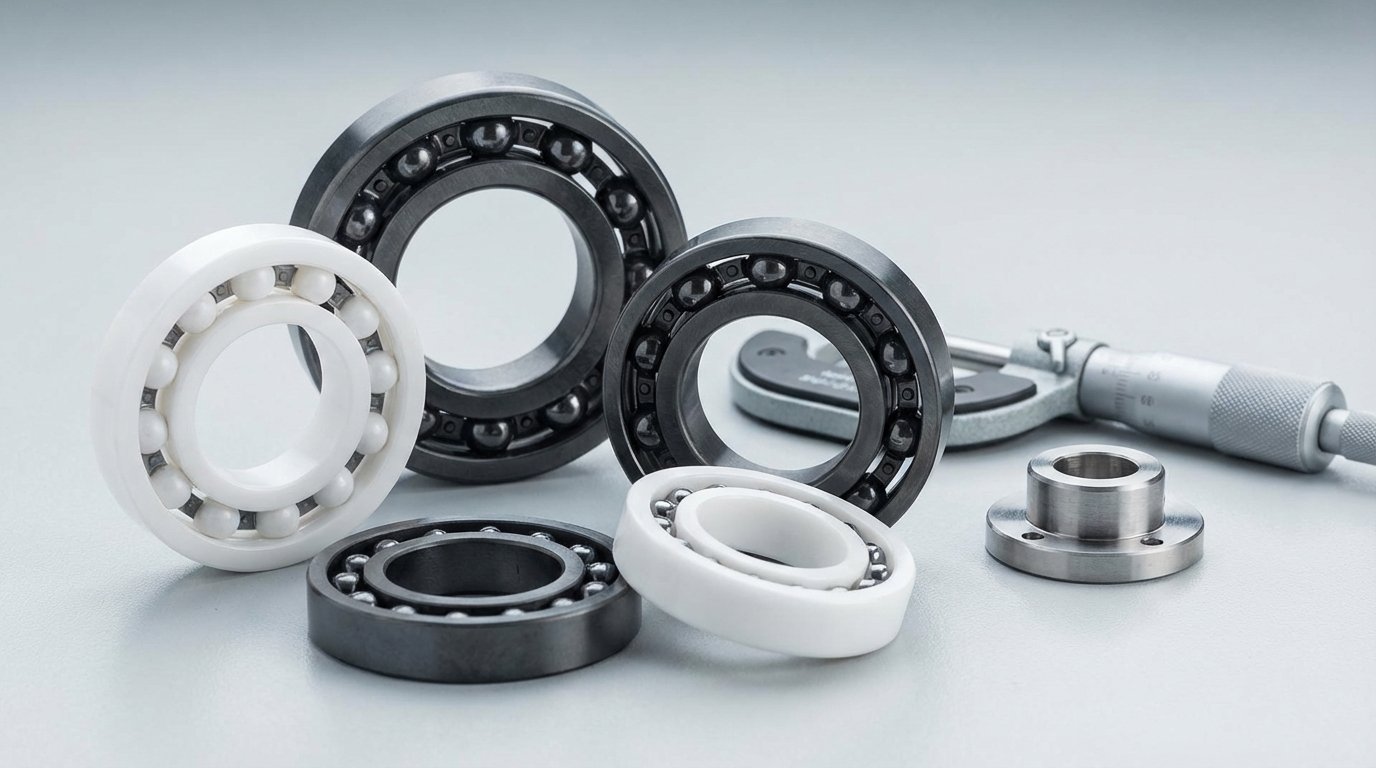
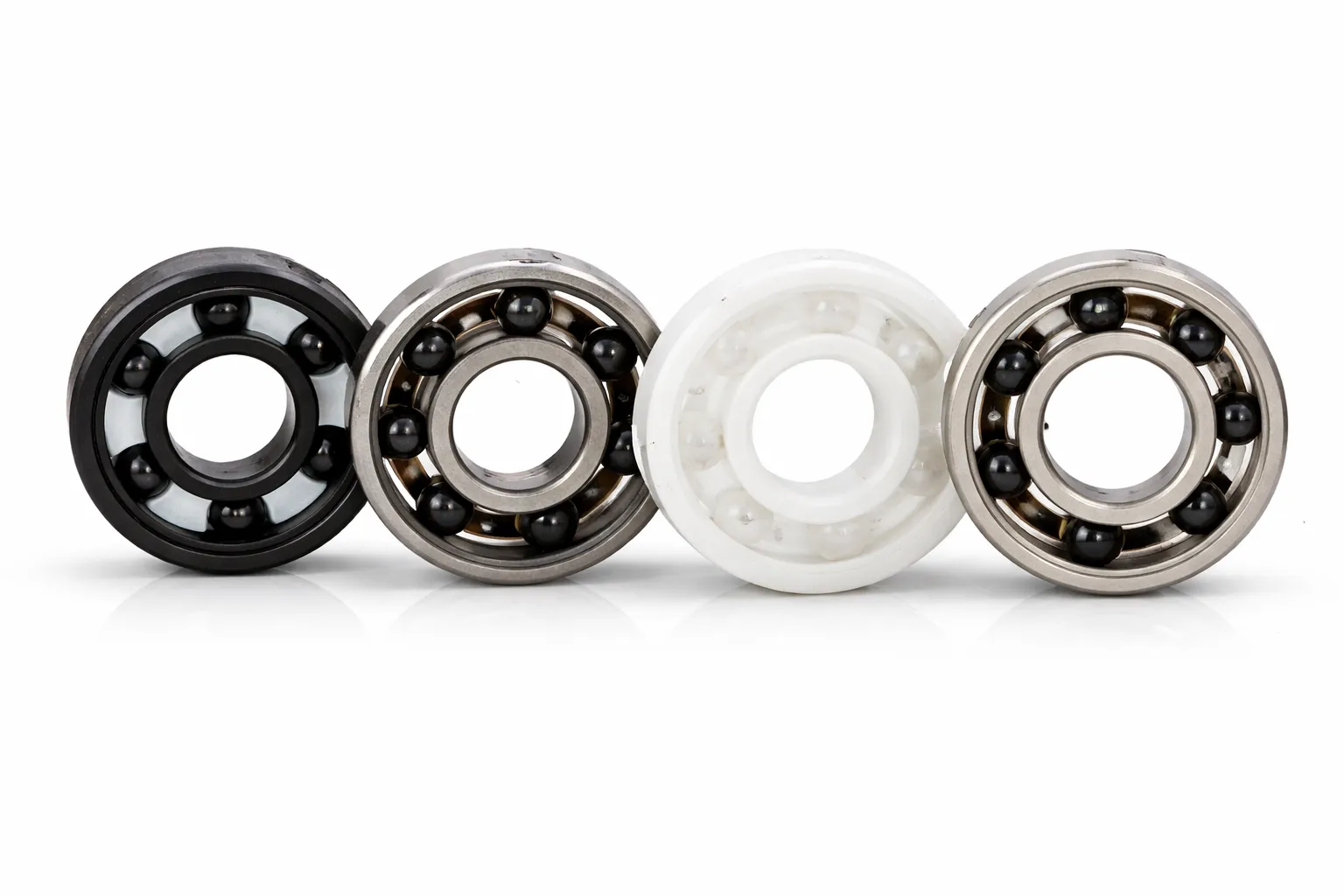
Full ceramic bearings use ceramic rings and rolling elements, often silicon nitride or zirconia, for corrosion resistance, electrical insulation, and high-temperature use. They suit harsh environments but may be brittle under shock loads and cost more.
Video Guide: This overview explains what ceramic bearings are, where they help most, and common misconceptions to avoid during selection.
Full Ceramic Bearings: What Are They?
Full ceramic bearings are non metallic bearings where both inner/outer rings and balls are ceramic (commonly silicon nitride or zirconia). They’re used as corrosion proof bearings and chemical resistant bearings in wet, caustic, or electrically sensitive environments, offering low friction and high-temperature capability with specific load and impact limitations.
Video Guide: This myth-busting video helps clarify what “full ceramic” actually means and where performance claims are often misunderstood.
Definition, common materials, and where they fit best
Full ceramic bearings use ceramic races and ceramic rolling elements rather than steel. In practice, “full ceramic” most often refers to either:
- Zirconia bearings (ZrO₂): strong corrosion resistance and good toughness among ceramics; commonly chosen for wet/chemical exposure and moderate speeds.
- Silicon nitride bearings (Si₃N₄): very hard, lower density, high speed capability, and strong thermal stability; often chosen for high-speed, high-temperature ceramic bearings and electrically insulating needs.
Typical full ceramic bearing applications include:
- Chemical processing equipment (pumps, mixers, dosing systems)
- Food & beverage washdown areas
- Marine or salt-spray environments
- Semiconductor and cleanroom equipment
- Electrically sensitive systems (to avoid current passage through bearings)
Key “fit” considerations:
- Best when corrosion, chemicals, heat, or electrical insulation drive the design
- Less ideal when impact, misalignment, or heavy shock loading are expected
Haron Bearing Pro Tip: I treat “full ceramic” as a solution for environment-driven failures (corrosion, chemicals, stray current), not as a universal upgrade—confirm your actual failure mode first, then select zirconia vs silicon nitride based on speed, temperature, and chemical exposure.
Full Ceramic Bearings: How Do They Work?
Full ceramic bearings work by supporting rotating shafts with ceramic balls rolling between ceramic races, minimizing sliding friction while resisting corrosion and electrical arcing. Because ceramics are hard, dimensionally stable, and non-reactive, they maintain performance in chemical washdowns and elevated temperatures—provided loads, alignment, lubrication, and shock impacts are controlled.
Video Guide: This practical discussion shows how ceramic bearings behave in real mechanisms and why installation and use conditions matter.
Load transfer, lubrication modes, and failure triggers
A full ceramic bearing’s rolling elements carry radial and/or axial loads through small contact areas. Key operating points:
- Contact mechanics: High hardness helps reduce wear, but point contacts concentrate stress; shock loads can initiate cracks.
- Lubrication options: Many applications still use grease/oil; some use dry or minimal lubrication where contamination is unacceptable.
- Thermal behavior: Lower thermal expansion than steel can improve stability at temperature, but internal clearance must be selected appropriately.
- Electrical insulation: Full ceramic construction interrupts current paths that can damage steel bearings via electrical discharge.
Common “works well when…” checklist:
- Stable alignment and controlled preload/clearance
- Loads within ceramic design limits (including transient loads)
- Contamination managed (seals, clean assembly)
- Correct lubricant (or validated dry-running design)
- Proper mounting practices to avoid race chipping
Common failure triggers:
- Shock/impact (dropping, hammering, sudden load spikes)
- Edge loading from misalignment
- Incorrect fits (overly tight housing/shaft fits)
- Abrasive contamination without sealing/filtration
Haron Bearing Pro Tip: I always validate transient loads (start/stop torque spikes, cavitation events in pumps, belt slap) because ceramics often survive steady load fine but fail from brief impacts that never show up in average load calculations.
What are the disadvantages of ceramic bearings?
Ceramic bearing limitations usually center on brittleness and cost: they can be less forgiving under impact, vibration, misalignment, or improper mounting, and they typically cost more than steel alternatives. They also require careful clearance, fit, and lubrication choices, since the wrong setup can cause chipping, noise, or premature fracture.
Video Guide: This video challenges overhyped claims and highlights where ceramic bearings can disappoint if the application is mismatched.
Practical drawbacks to account for before specifying
Key disadvantages seen in real installations:
- Brittleness vs. shock: Ceramics resist wear but can crack from impact or edge loading.
- Higher upfront cost: Material and precision finishing often increase total part cost.
- Noise sensitivity: Hard materials can transmit vibration; noise may increase if preload/clearance is not optimized.
- Installation sensitivity: Incorrect tools or pressing through rolling elements can chip races/balls.
- Limited forgiveness to misalignment: Skewed loads can cause localized stress and fracture initiation.
- Supply/standardization constraints: Not every size, cage design, seal type, or tolerance class is widely stocked in full ceramic.
Typical “avoid full ceramic” scenarios:
- High shock/impact (certain conveyors, heavy press equipment, rough handling)
- Poor alignment or flexible housings
- Extremely heavy loads where steel capacity is needed
- Applications where cost is the primary driver and corrosion is manageable by sealing or stainless steel
Haron Bearing Pro Tip: If your environment is harsh but your system sees frequent impact, I often start by comparing stainless or hybrid ceramic first—full ceramic is excellent when the environment dominates, but it’s rarely the most impact-tolerant choice.
What are the properties of ceramic bearings?
Ceramic bearings are defined by high hardness, strong corrosion and chemical resistance, electrical insulation, and good performance at elevated temperatures. Compared with steel, many ceramic types offer lower density (better for speed), reduced thermal expansion, and lower friction potential. However, material toughness varies—zirconia and silicon nitride behave differently under load and shock.
Video Guide: This real-world perspective helps connect ceramic bearing properties to where you’ll actually notice performance differences.
Material properties that matter in design decisions
Key properties and what they influence:
- Corrosion resistance: Enables corrosion proof bearings in washdown, salt spray, acids/alkalis (compatibility still must be verified).
- Chemical resistance: Suitable for chemical resistant bearings in process fluids and cleaning agents.
- Electrical insulation: Helps prevent fretting and EDM-related damage.
- High hardness / wear resistance: Supports long life in clean, controlled loads.
- High-temperature capability: Useful where steel loses hardness or lubricants degrade (system design still limits max temperature).
- Low density (notably Si₃N₄): Reduced centrifugal forces at high RPM.
Property-to-application mapping (quick list):
- Wet/caustic media → zirconia bearings often favored
- High speed / high temp / low mass → silicon nitride bearings often favored
- Stray current risk → full ceramic (or insulated solutions)
- Cleanroom / non-metallic requirement → full ceramic construction
Haron Bearing Pro Tip: I always ask for the exact chemical list (including cleaners) and temperature cycle; “chemical resistant” isn’t universal—compatibility depends on concentration, exposure time, and whether the bearing sees thermal cycling that can stress fits.
Which company is no. 1 in bearing?
There isn’t a single universal “no. 1” bearing company because leadership depends on the segment—automotive, industrial, aerospace, or specialty ceramics—and on criteria like reliability, availability, application engineering, and total cost of ownership. For full ceramic bearings, the best choice is typically the supplier that can prove material traceability, tight tolerances, and application-specific validation.
Video Guide: This discussion helps frame when ceramic bearings are genuinely valuable versus when brand claims and marketing can overtake application reality.
How to evaluate “best” for full ceramic bearings (practical criteria)
When choosing a supplier for zirconia bearings or silicon nitride bearings, compare:
- Material certification & traceability: batch control, incoming inspection, documentation
- Dimensional capability: tolerance class, roundness, surface finish
- Application engineering support: fit/clearance guidance, lubrication recommendations
- Quality systems: consistent QC, defect screening, failure analysis support
- Availability: lead times, stocked sizes, customization options (seals/cages)
- Field validation: proven use in similar chemical/temperature environments
A simple selection checklist:
- Confirm operating environment (chemicals, temperature, moisture, conductivity)
- Confirm loads (steady + transient) and speeds
- Decide material (zirconia vs silicon nitride)
- Define clearance, sealing, and lubrication strategy
- Select supplier based on documentation + capability, not just branding
Haron Bearing can support full ceramic bearing selection by aligning material and tolerances to your specific environment and failure mode, rather than offering a one-size-fits-all upgrade.
Haron Bearing Pro Tip: I recommend shortlisting suppliers only after you’ve locked the operating envelope (media, temperature, RPM, loads) and required documentation—then ask for evidence: inspection reports, material certs, and guidance on fits/clearances for your housing and shaft.
Key Features & Comparison
Full ceramic bearings stand out for corrosion resistance, chemical inertness, electrical insulation, and strong performance in high-temperature or clean environments. The trade-offs are higher cost and lower tolerance for shock and misalignment compared with steel. Comparing zirconia vs silicon nitride and steel alternatives clarifies which bearing type best fits your risk profile.
Video Guide: This wrap-up style video helps reinforce selection tradeoffs—where ceramics help most and where expectations should be tempered.
Side-by-side comparison for specification decisions
Based on our internal data and market analysis, here is the breakdown:
| Attribute | Full Ceramic (Zirconia, ZrO₂) | Full Ceramic (Silicon Nitride, Si₃N₄) | Steel Bearing (Typical) | Hybrid Ceramic (Si₃N₄ balls + steel races) |
|---|---|---|---|---|
| Corrosion resistance | Excellent | Excellent | Low–Moderate (depends on alloy/coatings) | Moderate (races still corrode) |
| Chemical resistance | Excellent (verify compatibility) | Excellent (verify compatibility) | Low–Moderate | Moderate |
| High-temperature capability | Good (system-dependent) | Very good (system-dependent) | Moderate | Moderate–Good |
| Electrical insulation | Excellent | Excellent | Poor | Moderate (depends on races/insulation strategy) |
| Density / high-speed suitability | Moderate | Best | Moderate | Good |
| Shock/impact tolerance | Moderate (better toughness than many ceramics) | Moderate–Low (application-dependent) | Best | Good |
| Cost | High | High | Low | Medium–High |
| Best-fit applications | Wet/chemical, washdown, corrosion proof bearings | High speed/high temp ceramic bearings, electrically sensitive | General industrial loads | Balanced upgrade where corrosion isn’t extreme |
Selection shortcut (list):
- Choose zirconia when chemicals/water dominate and speeds are moderate.
- Choose silicon nitride when speed, temperature stability, and low mass are critical.
- Choose hybrid when you need some ceramic benefits but can’t justify full ceramic cost or need higher shock tolerance.
- Choose steel when the environment is benign and impact/load capacity is the priority.
Haron Bearing Pro Tip: I match the bearing to the dominant failure mode: corrosion/chemicals → full ceramic; speed/heat → silicon nitride; mixed demands → hybrid; heavy shock → steel or a protected steel solution with sealing and lubrication control.
Cost & Buying Factors
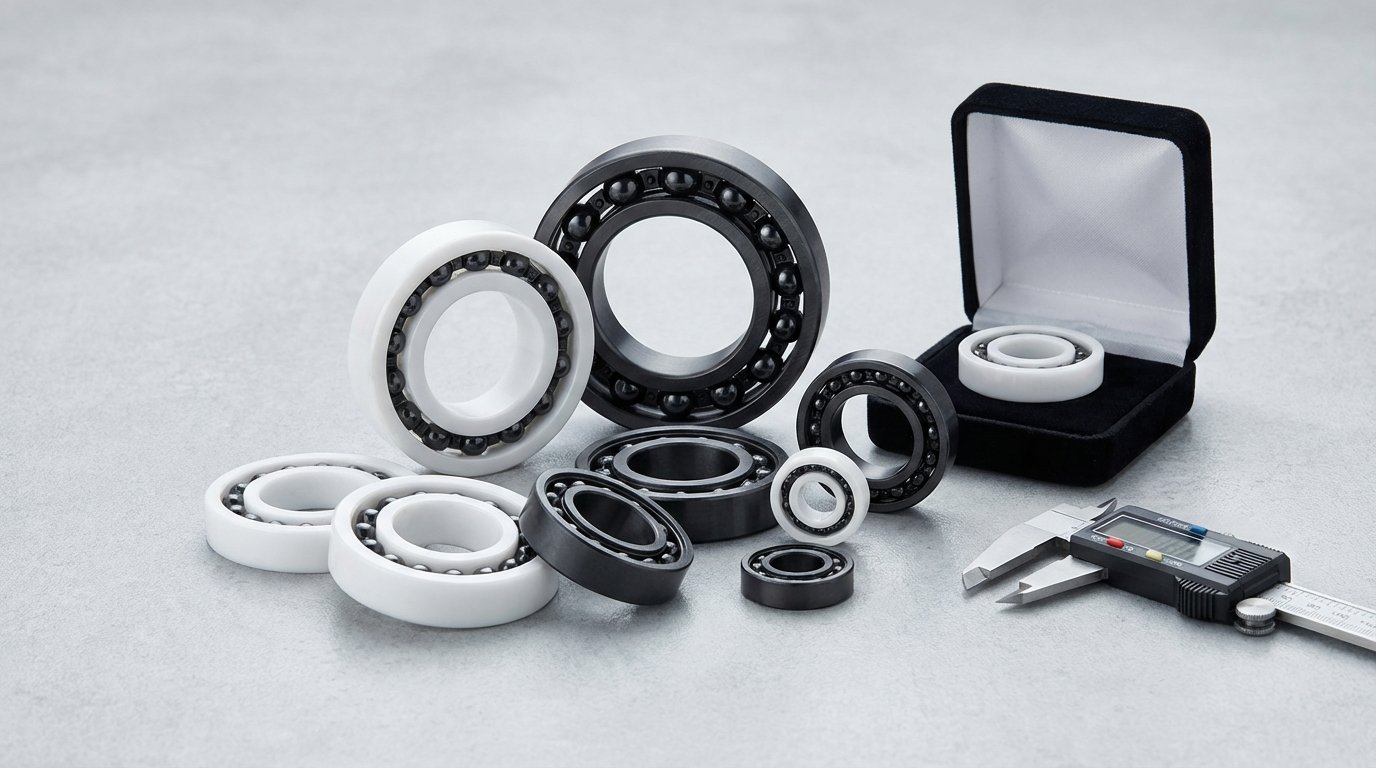
Full ceramic bearings cost more because ceramic raw materials, sintering, grinding, and inspection requirements are demanding. The right purchase decision depends on total cost of ownership: downtime risk from corrosion, cleaning chemical exposure, temperature, and electrical damage can justify the premium. Focus on validated material grade, tolerance, clearance, sealing, and supplier documentation.
What drives price—and what to specify to avoid costly mistakes
Primary cost drivers:
- Material choice (zirconia vs silicon nitride) and grade consistency
- Size and precision tolerances (higher classes increase grinding/inspection)
- Cage design (ceramic vs polymer vs specialty high-temp designs)
- Seal/shield options and cleanroom packaging requirements
- Quantity and lead time (custom or low-volume runs raise cost)
Buying factors checklist (practical):
- Environment: exact chemicals, concentration, temperature, washdown frequency
- Duty cycle: continuous vs intermittent; thermal cycling magnitude
- Loads: radial/axial + transient shock events
- Speed: RPM and acceleration/deceleration profiles
- Fits & clearance: shaft/housing materials, interference, thermal growth
- Sealing & contamination: IP targets, abrasive exposure, cleaning methods
- Lubrication strategy: grease/oil type or dry-running validation
- Verification: request material certs, inspection reports, and application guidance
Where ROI typically comes from:
- Reduced corrosion-related replacements
- Less lubricant contamination risk in sensitive processes
- Avoiding electrical fluting damage in motor-driven systems
- Improved uptime in chemical or high-temp duty
Haron Bearing Pro Tip: I advise customers to price the bearing plus the failure event—if one corrosion-related seizure causes hours of downtime or product loss, a properly specified full ceramic bearing is often cheaper than repeated steel replacements.
Conclusion
Full ceramic bearings are ideal for corrosion, chemicals, high temperature, and electrical insulation where steel fails. Zirconia and silicon nitride suit different conditions. Share media, temperature, RPM, and load—Haron Bearing can recommend a reliable configuration.