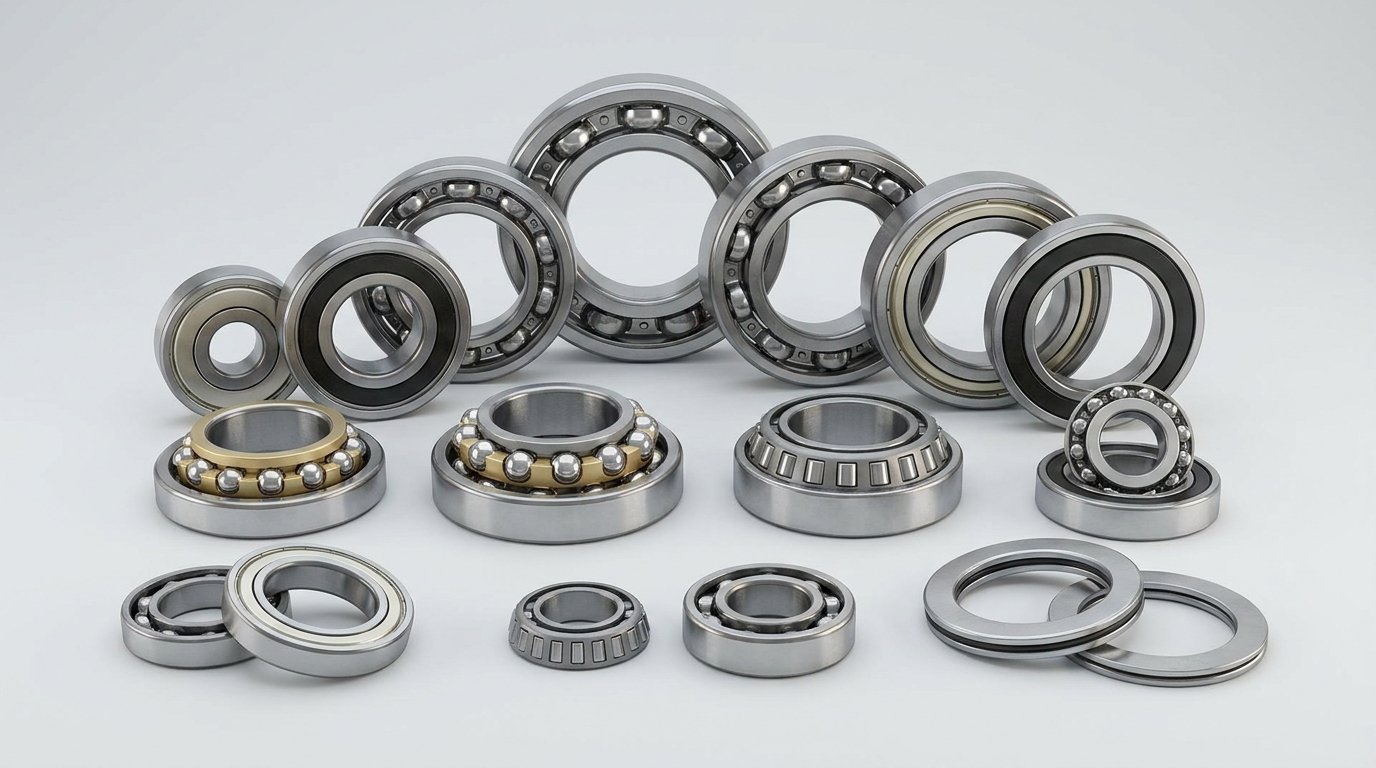
Bearings are precision mechanical components that let shafts and parts rotate or slide with controlled friction, improving efficiency, accuracy, and equipment life. In industrial settings, bearings in machinery reduce wear, support loads, and keep motion stable at speed. This beginner bearing guide explains bearing basics, how bearings work, and the most common types of bearings and functions you’ll encounter.
Video Guide: A clear, beginner-friendly overview of what bearings are and why they’re used in machines.
What are bearings and what are their functions?
Bearings are machine elements that support moving parts (usually a rotating shaft) while reducing friction and managing loads. Their core bearing function is to separate surfaces with rolling elements or low-friction sliding, helping equipment run smoother, cooler, and longer. You’ll find bearings in machinery from motors and pumps to conveyors and gearboxes.
Video Guide: Explains what a bearing is, introduces major bearing types, and shows how they work in practical terms.
Where Bearings Fit in a Machine System
A bearing typically sits between a rotating shaft and a stationary housing (or between two moving members). It controls motion, carries load, and maintains alignment so other components (seals, gears, couplings) can operate as intended.
Common “bearing basics” terminology you’ll see:
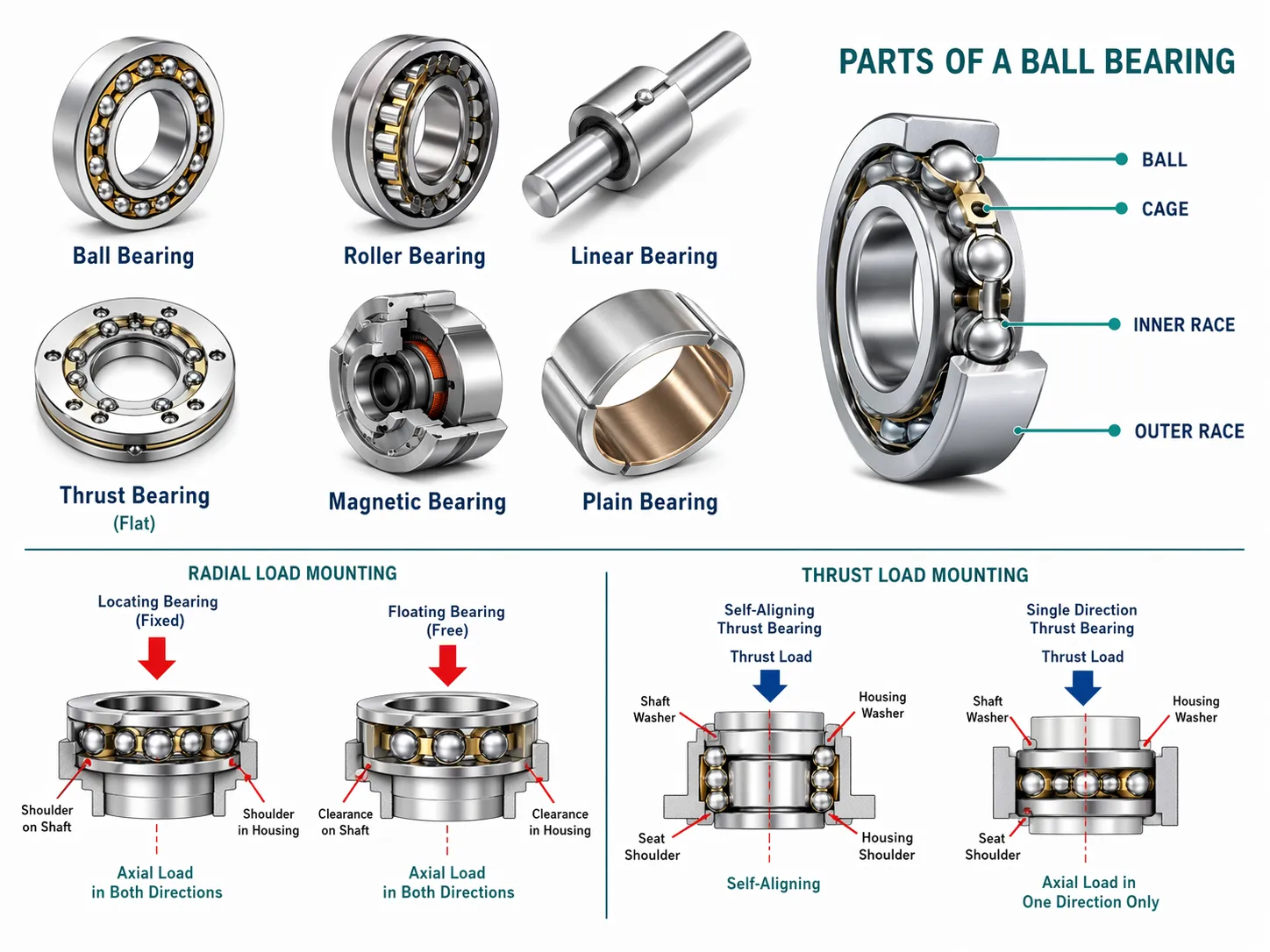
- Inner ring (race): Mounts to the shaft.
- Outer ring (race): Fits into the housing.
- Rolling elements: Balls or rollers that reduce friction.
- Cage/retainer: Spaces rolling elements evenly.
- Seals/shields (optional): Help retain lubricant and block contamination.
Typical high-level functions in industrial bearings explained:
- Reduce friction compared with sliding contact.
- Support radial load (perpendicular to shaft).
- Support axial (thrust) load (along the shaft).
- Maintain precision (runout, positioning, vibration control).
- Enable speed and efficiency while limiting heat generation.
Haron Bearing Pro Tip: When a customer asks “what are bearings and their functions,” I start by clarifying the load direction (radial, axial, or combined) and operating speed—those two inputs usually narrow the correct bearing family faster than any catalog search.
How do bearings work and what are their functions?
Bearings work by replacing sliding friction with rolling friction (ball/roller bearings) or by creating a controlled sliding interface (plain bearings). The bearing’s geometry spreads load through raceways and rolling elements, while lubrication forms a film that reduces wear and heat. Correct fit, preload/clearance, and sealing keep motion stable and reliable.
Video Guide: Covers bearing fundamentals—load paths, lubrication, and what makes bearings succeed or fail in real machines.
The Load Path and Motion Control Inside a Bearing
At a practical level, “how bearings work” comes down to three interacting mechanisms: load distribution, friction management, and contamination control.
Key steps in the operating principle:
- Load enters the bearing through the shaft (inner ring) or housing (outer ring).
- Rolling elements transmit load through a small contact patch to the opposite ring.
- Raceway geometry guides motion and controls axial/radial constraints.
- Lubricant reduces metal-to-metal contact, carrying heat and preventing scuffing.
- Seals/shields manage contamination, protecting surfaces and lubricant quality.
Typical failure accelerators (useful for beginners troubleshooting bearings in machinery):
- Wrong internal clearance/preload → heat, smearing, early fatigue
- Misalignment → edge loading and spalling
- Contamination (dust, chips, water) → denting, abrasive wear
- Lubrication mismatch (type/amount/interval) → overheating, seizure
Haron Bearing Pro Tip: If a bearing keeps running hot, I check fit and lubrication before blaming “bearing quality”—too-tight interference on the wrong ring or over-greasing is one of the fastest ways to turn a good bearing into scrap.
What are bearings and their functions?
Bearings primarily reduce friction, carry loads, and keep moving parts aligned so machines run efficiently and predictably. Depending on design, a bearing may carry radial load, axial (thrust) load, or both, while controlling vibration and rotational accuracy. In practice, bearings protect shafts, housings, seals, and gears from premature wear.
Video Guide: Walks through bearing function and fundamentals, focusing on what bearings do inside common equipment.
Practical Functions You Can Map to Real Equipment
When people ask “bearing function,” they often mean multiple performance goals at once. Here are the most common functions tied to measurable outcomes:
- Friction reduction: lower power draw and less heat
- Load support: prevent shaft sag and housing damage
- Accuracy and stiffness: better product quality (e.g., machining, printing, robotics)
- Noise and vibration control: smoother rotation and longer component life
- Speed capability: stable operation at high RPM
- Reliability in environment: seals and materials chosen for dust, water, chemicals, temperature
A quick “function-to-application” map:
- Electric motors: efficiency, quietness, high-speed stability
- Pumps: alignment and seal life improvement
- Gearboxes: stiffness and controlled gear mesh
- Conveyors: endurance under dirt and variable loads
- Machine tools: precision, low runout, high stiffness
Haron Bearing Pro Tip: I recommend documenting the actual failure mode (noise, heat, looseness, spalling pattern) before replacing a bearing—matching the symptom to the function that’s being lost is the fastest route to a correct upgrade.
What are the four types of bearings and their uses?
Four common bearing categories are ball bearings, roller bearings, plain (sleeve) bearings, and thrust bearings. Ball bearings prioritize speed and low friction, while roller bearings prioritize heavier radial loads. Plain bearings suit compact, cost-sensitive, or oscillating motion. Thrust bearings are selected when axial load support is the primary requirement.
Choosing by Load Direction, Speed, and Misalignment Tolerance
Below is a practical selection list aligned with “types of bearings and functions”:
- Ball bearings
- Best for: higher speed, lower to moderate loads, low friction
- Typical uses: motors, fans, small pumps, conveyors
- Roller bearings (cylindrical, tapered, spherical, needle)
- Best for: higher radial load, improved stiffness
- Typical uses: gearboxes, heavy conveyors, crushers, industrial drives
- Plain (sleeve) bearings
- Best for: simple construction, shock tolerance, dirty environments (with proper materials)
- Typical uses: hinges, low-speed shafts, agricultural equipment, some pumps
- Thrust bearings (ball or roller thrust)
- Best for: axial load management
- Typical uses: turntables, screw drives, vertical shafts, certain pump layouts
Quick rule-of-thumb decision prompts:
- Is axial load significant? If yes, consider thrust-capable designs (angular contact, tapered, thrust bearings).
- Is radial load heavy or shocky? If yes, lean toward roller bearings.
- Is speed very high and load moderate? Ball bearings often win.
- Is there misalignment? Self-aligning/spherical designs may be required.
Haron Bearing Pro Tip: If the application has both high radial load and meaningful axial load, I usually evaluate tapered roller vs. angular contact early—getting that combined-load match right prevents chronic overheating and early fatigue.
What are industrial bearings?
Industrial bearings are bearings designed and specified for production equipment—motors, pumps, compressors, gearboxes, conveyors, and processing lines—where uptime, load capacity, and contamination resistance matter. Compared with light-duty bearings, industrial bearings are selected by duty cycle, sealing, lubrication strategy, and tolerance class to meet reliability and maintenance targets.
Video Guide: Shows different bearing types and where they’re used across industrial equipment, helping connect selection to real machines.
What Makes a Bearing “Industrial” in Practice
“Industrial bearings explained” typically refers less to a single bearing type and more to application-driven specification:
Key industrial selection factors:
- Load profile: steady vs. cyclic vs. shock; combined load direction
- Speed and temperature: RPM range, ambient/operating temperature
- Contamination and moisture: sealing type, purge capability, corrosion risk
- Mounting and maintenance: ease of relubrication, cartridge units, housing compatibility
- Precision and vibration: tolerance class, noise targets, stiffness needs
Common industrial bearing formats you’ll see:
- Deep groove ball bearings: general-purpose, high-speed
- Spherical roller bearings: heavy loads + misalignment tolerance
- Tapered roller bearings: combined loads, robust in gear drives
- Mounted bearing units (pillow block/flange): easier installation and alignment support
- Sealed-for-life bearings: reduced maintenance where relube access is difficult
Haron Bearing Pro Tip: For harsh plants (dust/washdown), I prioritize sealing and lubrication strategy before chasing a higher load rating—contamination is often the real enemy, not capacity on paper.
Key Features & Comparison
Key bearing features that drive performance are load direction capacity, speed rating, misalignment tolerance, stiffness, sealing options, and lubrication requirements. Comparing these traits helps beginners match bearing type to machine duty without over- or under-specifying. In most machinery, the “best” bearing is the one that balances load, speed, and environment for reliable service life.
Video Guide: Explains bearing types and load handling ability, helping you compare designs by what they can carry and control.
Side-by-Side Comparison for Common Industrial Choices
Based on our internal data and market analysis, here is the breakdown:
| Bearing Type | Primary Strength | Typical Load Handling | Speed Capability | Misalignment Tolerance | Common Use Cases | Notes |
|---|---|---|---|---|---|---|
| Deep Groove Ball | Low friction, versatile | Radial + limited axial | High | Low | Motors, fans, light gear drives | Great default choice when loads are moderate |
| Angular Contact Ball | Axial + precision | Combined (good axial) | High | Low | Machine tools, pumps, servo drives | Often used in pairs for bidirectional axial load |
| Cylindrical Roller | High radial capacity, stiffness | Radial (high) | Medium to high | Low | Gearboxes, generators | Some designs allow axial displacement |
| Tapered Roller | Combined loads, robust | Radial + axial (high) | Medium | Low | Gear drives, wheel hubs, heavy shafts | Needs correct setting (preload/clearance) |
| Spherical Roller | Heavy load + misalignment | Radial (very high) + some axial | Medium | High | Conveyors, crushers, paper mills | Strong in shock and alignment variability |
| Needle Roller | Compact radial capacity | Radial (high for size) | Medium | Low | Transmissions, compact housings | Sensitive to shaft/housing hardness and finish |
| Plain (Sleeve) | Simplicity, shock tolerance | Depends on material | Low to medium | Medium | Low-speed shafts, dirty environments | Requires correct material + lubrication regime |
Haron Bearing Pro Tip: When comparing options, I treat “misalignment tolerance” as a first-order spec—choosing a bearing that forgives your real-world mounting conditions often beats choosing the highest theoretical load rating.
Cost & Buying Factors
Bearing cost depends on type, size, precision class, sealing, material, and brand, plus the true lifecycle costs of lubrication, downtime, and replacement labor. The best buying decision weighs application loads, RPM, temperature, contamination, and maintenance access. Paying slightly more for correct sealing or the right internal clearance often cuts failures dramatically.
Video Guide: A practical overview of different bearing types that helps buyers connect selection choices to real applications.
What to Specify Before You Request a Quote
Use this checklist to avoid mismatches and hidden lifecycle costs:
- Dimensions: bore (ID), outer diameter (OD), width
- Bearing type: ball vs roller vs thrust vs plain; any special design
- Load details: radial/axial values, shock, duty cycle
- Speed: RPM range, start/stop frequency
- Environment: dust, water, chemicals, washdown, temperature
- Lubrication: grease vs oil, relube interval, food-grade needs
- Sealing: open, shielded, contact seal, external seals in housing
- Fit and clearance: shaft/housing tolerances; C3/C4, preload targets
- Mounting constraints: housing style, misalignment, space limits
- Quality requirements: noise/vibration limits, precision class, certifications
Cost drivers to expect:
- Precision and low-noise grades increase cost for high-accuracy applications.
- Sealed and specialty materials/coatings increase cost for harsh environments.
- Larger sizes and higher load ratings raise cost due to material and processing.
Where buyers often save money unintentionally (by spending correctly):
- Upgrading sealing in contamination-heavy lines
- Choosing the right bearing arrangement (paired bearings, fixed/floating)
- Aligning lubrication to reality (correct grease type and fill amount)
Haron Bearing Pro Tip: If you’re cost-sensitive, don’t start by downgrading the bearing—start by confirming the sealing and lubrication plan; in my experience, most “expensive bearings” are actually inexpensive compared to one hour of unplanned downtime.
Conclusion
Bearings are foundational to industrial motion: they reduce friction, carry radial and axial loads, and keep machinery aligned so equipment runs efficiently and reliably. Understanding bearing basics—how bearings work, key bearing function, and the types of bearings and functions—makes selection far simpler and prevents repeat failures. For application-specific guidance, Haron Bearing can help match bearing type, sealing, clearance, and lubrication to your real operating conditions.