
Thin section bearings enable compact, lightweight assemblies while still carrying meaningful radial and axial loads, but their reduced cross-section makes load rating, stiffness, and mounting precision far more sensitive than standard bearings. Designing for thin wall bearing load performance requires balancing dynamic/static ratings, contact stress, deflection, and fit-up. This guide explains thin section bearing load capacity in compact designs, with practical sizing, limitation checks, and buying considerations.
How much radial and axial load can thin section bearings handle?
Thin section bearing load capacity is the allowable radial and/or axial load a thin wall (slim) bearing can support for a target life and reliability within a compact envelope. It is defined primarily by catalog dynamic and static ratings, but in compact designs it is strongly influenced by housing/shaft stiffness, fits, misalignment, and lubrication.
Load-rating definitions that matter in compact bearings
Thin section bearing engineering usually starts with the same catalog metrics as standard bearings, but the “compact bearing load capacity” reality depends more on installation and deflection.
- Dynamic load rating (C): Used to estimate fatigue life under rotating load.
- Static load rating (C0): Used to limit permanent deformation (brinelling) at low speed/standstill.
- Equivalent dynamic load (P): A combined radial/axial load value used with C for life calculations.
- Equivalent static load (P0): A combined radial/axial load value used with C0 for static checks.
Based on our internal data and market analysis, here is the breakdown:
| Term | What it represents | Why it’s critical for thin section bearings |
|---|---|---|
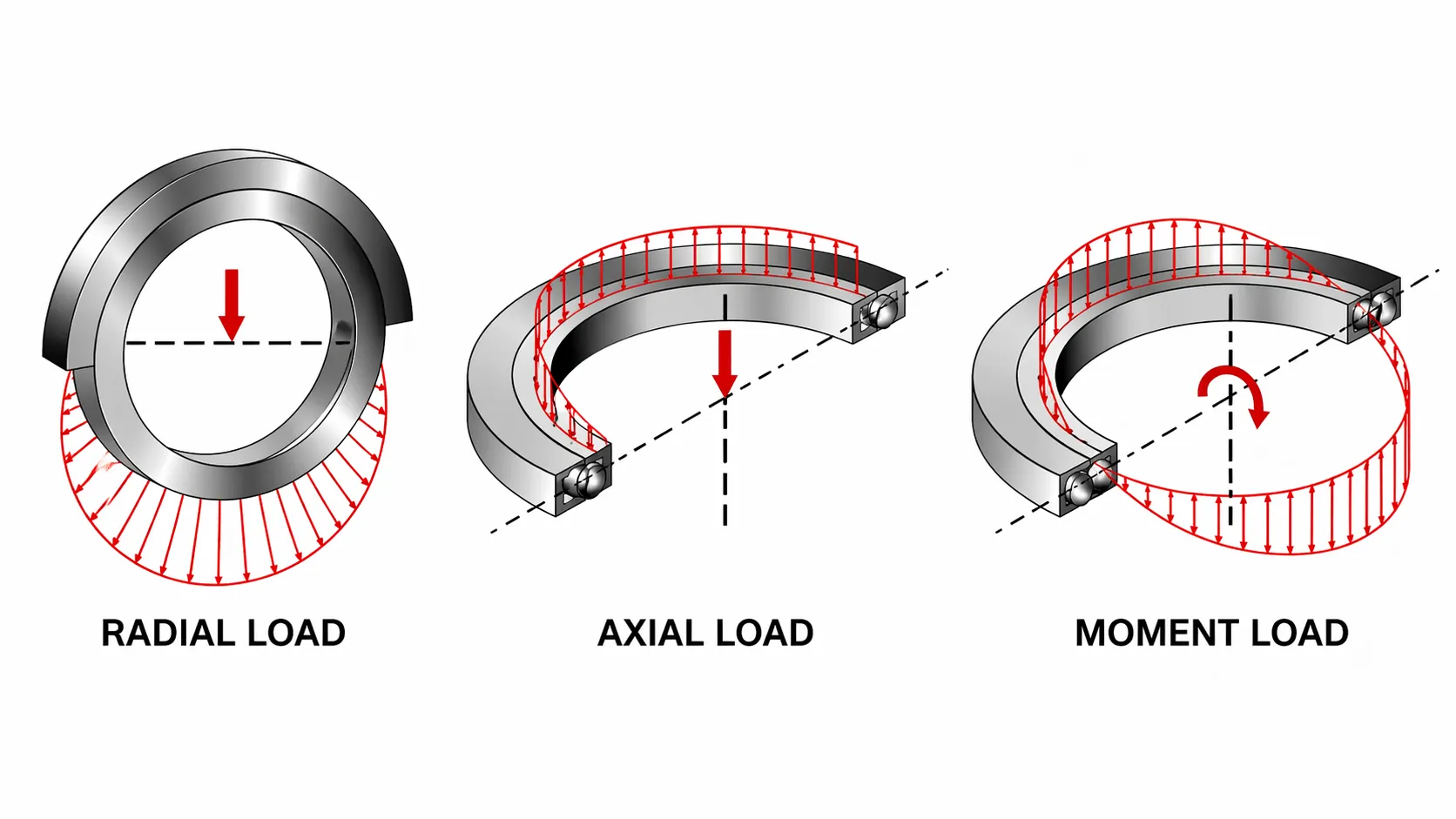
| Radial load (Fr) | Load perpendicular to shaft | Thin rings deflect more; contact stress rises quickly |
| Axial load (Fa) | Load along shaft axis | Often governs in compact rotary stages and gimbals |
| Moment load (M) | Overturning from offset forces | Slender cross-section makes moment sensitivity high |
| Stiffness | Load vs. deflection | Compact designs often fail functionally before fatigue |
| Misalignment tolerance | Angular error capability | Thin wall bearings are less forgiving of housing errors |
Haron Bearing Pro Tip: I treat thin section load rating as “catalog rating minus installation penalties.” If you can’t guarantee roundness, coaxiality, and a stiff surrounding structure, de-rate early and validate with deflection checks—not just L10 life.
How is thin section bearing load capacity determined?
Thin section bearing load capacity works by distributing radial and axial forces through rolling elements into thin rings, creating Hertzian contact stress that drives fatigue life and static deformation limits. Because the rings are thin, mounting distortion and housing/shaft flexibility change internal clearance and load distribution, often reducing usable capacity compared with catalog conditions.
Force paths, stress, and why thin rings change the outcome
In a slim bearing load analysis, the same core mechanics apply, but sensitivity increases:
- External load enters the inner/outer ring through the shaft/housing fits.
- Rolling elements carry load over a contact angle (deep groove, angular contact, four-point, etc.).
- Contact stress peaks at a small ellipse/line region (Hertzian contact).
- Ring deflection distorts geometry, concentrating load on fewer elements.
- Life or deformation limit is reached sooner if clearance, misalignment, or lubrication is poor.
Key limitations that frequently govern in compact design:
- Reduced stiffness: Functional runout/pointing error may fail before fatigue life does.
- Fit-induced ovality: Thin rings can “copy” housing errors, changing load zones.
- Moment sensitivity: Small offsets create large overturning effects relative to section thickness.
- Thermal effects: Differential expansion can eliminate clearance or add preload unintentionally.
Haron Bearing Pro Tip: When load capacity looks “fine” on paper but prototypes heat up or get noisy, I check ring distortion from fits first—thin rings can go out-of-round from perfectly normal press fits used on thicker bearings.
What are the benefits of high load capacity in thin section bearings?
The main benefit is achieving required radial/axial load support inside a much smaller envelope, enabling lighter, lower-inertia mechanisms without sacrificing precision. Thin section bearings also simplify packaging around large bores, improve mass distribution in rotating stages, and can reduce system-level cost by eliminating bulkier housings—when stiffness and mounting controls are properly engineered.
Where thin wall bearing load performance creates system wins
Thin section bearing sizing is often chosen for architecture benefits more than raw load rating.
- Compact packaging: Large bore with minimal cross-section supports cable pass-throughs, optics, or slip rings.
- Lower rotating inertia: Helps servos accelerate faster and reduces energy consumption.
- Precision potential: With correct preload/clearance and stable mounting, runout can be tightly controlled.
- Design flexibility: More room for seals, encoders, or brakes in the same envelope.
Based on our internal data and market analysis, here is the breakdown:
| Benefit | Why it matters | Typical application examples |
|---|---|---|
| Envelope reduction | Enables smaller OD/section for same bore | Robotics joints, UAV gimbals |
| Weight reduction | Improves payload-to-weight and dynamics | Aerospace actuators, portable devices |
| Lower inertia | Faster response, less motor size | Pick-and-place, rotary indexing |
| Large bore utility | Routing, optics, tooling access | Medical imaging, semiconductor tools |
| Precision packaging | Better integration with metrology components | Encoders, optical stages |
Haron Bearing Pro Tip: I recommend thin section bearings when the system-level gain (space, inertia, routing) is measurable; if the only goal is “more load,” a standard section bearing is usually the safer and cheaper path.
How do you maintain thin section bearings to preserve load capacity?
Maintain thin section bearing load capacity by preserving lubrication film, preventing contamination, and protecting ring geometry from distortion. Use the correct grease/oil for speed and load, keep seals effective, control preload/clearance, and verify fits and alignment during assembly. Because thin rings are sensitive, gentle handling and periodic condition checks prevent rapid loss of performance.
Maintenance controls that protect load rating and precision
A practical maintenance plan focuses on the failure drivers most common in thin wall bearings:
- Lubrication management
- Match lubricant to speed, temperature, and load (base oil viscosity and thickener type).
- Avoid over-greasing (churn heat) and under-greasing (boundary wear).
- Contamination control
- Use appropriate seals/shields; keep assembly clean.
- In dusty environments, consider positive pressure or labyrinth sealing.
- Mounting integrity
- Re-check housing/shaft runout and roundness when replacing bearings.
- Torque patterns on split housings can distort thin rings—tighten gradually and evenly.
- Condition monitoring
- Track temperature, vibration, and noise; thin sections show changes early.
- Inspect for fretting at fits and false brinelling in oscillatory motion.
Haron Bearing Pro Tip: I set acceptance criteria for housing roundness and coaxiality before the bearing arrives; if the mounting geometry isn’t controlled, no amount of “better lubrication” will recover lost compact bearing load capacity.
How much do thin section bearings cost?
Pricing varies widely because thin section bearings are often engineered products: cost depends on size (bore/OD), cross-section series, precision grade, material (chrome vs stainless), cage type, preload/clearance specification, and volume. As a practical expectation, thin wall bearings generally cost more than standard-section equivalents due to tighter geometry control and manufacturing complexity.
Main price drivers and how to estimate your range
Use these factors to quickly predict where your design will land:
- Size and section: Larger bore with very thin cross-section increases manufacturing difficulty.
- Precision grade: Tighter runout/variation raises inspection and process cost.
- Material and heat treatment: Stainless, corrosion-resistant, or specialty steels cost more.
- Design type: Angular contact/four-point and matched sets typically cost more than deep groove.
- Preload and matching: Factory-preloaded or matched pairs add cost but reduce assembly risk.
- Seals and lubrication: Integrated seals, special greases, or clean-room prep increase price.
Based on our internal data and market analysis, here is the breakdown:
| Specification choice | Price impact | When it’s worth it |
|---|---|---|
| Higher precision grade | ↑↑ | Optics, metrology, low runout stages |
| Stainless material | ↑ | Medical, marine, washdown environments |
| Preloaded/matched set | ↑↑ | High stiffness, reversing loads, minimal backlash |
| Seals/special grease | ↑ | Contaminated environments, long-life targets |
| Standard clearance/basic build | ↓ | Cost-driven designs with controlled mounting |
Haron Bearing Pro Tip: I ask customers to specify the functional requirement (runout, stiffness, torque, life) instead of defaulting to the highest precision—thin section bearing pricing climbs fast when you buy tolerances you don’t truly need.
Key Features & Comparison
Thin section bearings trade cross-section thickness for packaging and inertia benefits, so the “best” option depends on whether your compact design is dominated by radial load, axial load, moment load, stiffness, speed, or corrosion needs. Comparing bearing types by load direction support, stiffness, and tolerance sensitivity is the fastest way to avoid undersizing.
Feature comparison for precision compact bearings
Based on our internal data and market analysis, here is the breakdown:
| Bearing type (thin section) | Radial load capability | Axial load capability | Moment handling | Stiffness trend | Typical use case |
|---|---|---|---|---|---|
| Deep groove ball | Medium | Low–Medium | Low | Medium | General compact rotary support |
| Angular contact (single) | Medium | Medium–High (one direction) | Medium | Medium–High | Precision stages with thrust direction |
| Angular contact (duplex pair) | Medium–High | High (both directions) | High | High | Robotics joints, high stiffness spindles |
| Four-point contact | Medium | High (both directions) | Medium–High | Medium | Space-saving axial + radial in one bearing |
| Cross-roller (thin) | Medium | Medium | High | Very High | High rigidity, high moment compact stages |
Haron Bearing Pro Tip: If your compact design sees meaningful overturning moment, I start the shortlist with duplex angular contact or cross-roller—then I confirm housing stiffness, because thin rings can’t compensate for a flexible structure.
Cost & Buying Factors
Buying the right thin section bearing is primarily about reducing risk: confirm loads (radial, axial, moment), speed, life, and stiffness targets, then select type, preload/clearance, and precision grade that your manufacturing process can actually support. Costs rise with precision, matching, special materials, and integration features, so define requirements clearly to avoid over-specification.
A practical buying checklist for compact bearing load capacity
- Define the load case
- Radial (Fr), axial (Fa), and moment (M), including duty cycle and peak loads.
- Decide what “failure” means
- Fatigue life (L10), permanent deformation (static), or functional limits (deflection/runout/torque).
- Select bearing architecture
- Deep groove vs angular contact vs four-point vs cross-roller based on load directions and stiffness.
- Confirm mounting capability
- Housing/shaft tolerance, roundness, coaxiality, surface finish, and assembly torque practices.
- Choose clearance/preload
- Balance stiffness vs torque/heat; consider thermal growth and fits.
- Specify environment
- Corrosion, vacuum, clean-room, shock, vibration, contamination; pick material/seals/lube accordingly.
Haron Bearing Pro Tip: I always request your housing and shaft drawings (tolerances included) before final sizing—thin section bearing limitations are usually created by the surrounding parts, not the bearing catalog rating.
Conclusion
Thin section bearing load capacity in compact designs depends on more than catalog load ratings: thin rings amplify the effects of stiffness, fit distortion, misalignment, moment loading, and lubrication. Treat sizing as a combined fatigue, static, and functional-deflection problem, then choose a bearing type and preload strategy your manufacturing process can hold. Haron Bearing can support selection, de-rating guidance, and slim bearing load analysis for demanding precision compact bearings.