
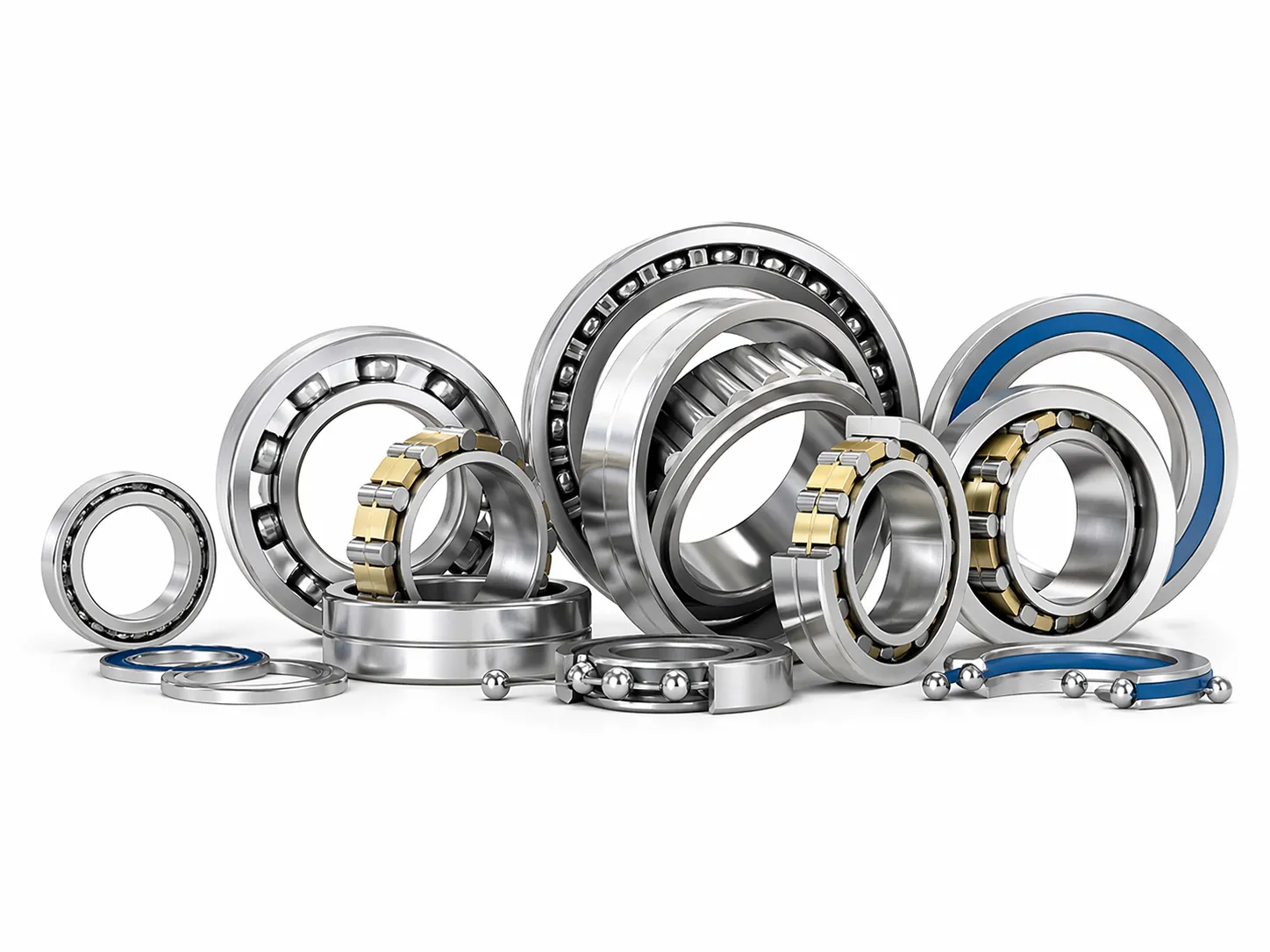
Industrial buyers face downtime, energy loss, and premature failures when the wrong bearing type is selected for load, speed, contamination, or misalignment. This guide clarifies bearing classification, explains how ball bearings and roller bearings differ, and shows where mounted bearing types, needle bearing types, and tapered roller bearing types fit in industrial applications—so you can specify reliably and buy confidently.
Video Guide: A practical overview of common bearing types and how to identify them for selection and ordering.
What is types of bearings bearing types industrial bearing types ball bearings and roller bearings mounted bearing types needle bearing types tapered roller bearing types bearing guide for buyers how many types of bearings bearing classification industrial bearing selection guide mechanical bearing categories?
Bearings are machine elements that support rotating or linear motion by reducing friction and controlling relative movement between components. “Types of bearings” refers to mechanical bearing categories such as ball bearings, roller bearings (including needle and tapered), and mounted bearing units, commonly classified by rolling element, load direction, and installation style.
Video Guide: Explains what a bearing is and walks through major bearing categories used in machines.
Practical bearing classification used in industry
In industrial purchasing, bearing classification is typically organized by how the bearing carries load and how it is integrated into the machine.
- By friction principle
- Rolling-element bearings: balls or rollers separate raceways (most common in industry).
- Plain bearings (bushings): sliding contact; strong in shock/contamination but higher friction.
- By load direction
- Radial: load perpendicular to shaft (motors, fans, conveyors).
- Axial (thrust): load along shaft (turntables, vertical shafts).
- Combined: both radial and axial (gearboxes, wheel hubs).
- By industrial packaging/installation
- Insert bearings + housings (mounted bearing types): pre-engineered units for faster installation and better sealing.
A quick buyer-oriented list of the most referenced bearing types:
- Ball bearings (deep groove, angular contact)
- Cylindrical roller bearings
- Spherical roller bearings
- Needle bearing types (compact radial capacity)
- Tapered roller bearing types (combined loads, adjustable preload)
- Thrust bearings (ball or roller)
- Mounted bearing units (pillow block, flange, take-up)
Haron Bearing Pro Tip: When a spec says “bearing type,” I confirm three things first: load direction (radial/axial/combined), misalignment tolerance, and sealing environment—those three filter the options faster than starting from part numbers.
How Does types of bearings bearing types industrial bearing types ball bearings and roller bearings mounted bearing types needle bearing types tapered roller bearing types bearing guide for buyers how many types of bearings bearing classification industrial bearing selection guide mechanical bearing categories Work?
Rolling-element bearings work by replacing sliding friction with rolling contact between raceways and balls or rollers. The rolling elements transmit load while a cage spaces them evenly, and lubrication creates a protective film to reduce wear and heat. Different bearing types change contact geometry to handle radial, axial, or combined loads.
Load paths and contact geometry that drive selection
How a bearing “works” is largely about contact shape and load path:
- Ball bearings
- Point (or small elliptical) contact
- Lower friction at high speed
- Generally lower load capacity than rollers of similar size
- Roller bearings
- Line contact (cylindrical/needle) or line-to-area (spherical)
- Higher load capacity, often lower speed limits
- More sensitive to lubrication and alignment (type-dependent)
- Tapered roller bearing types
- Conical rollers with an angle that resolves radial + axial loads
- Often used in opposed pairs to set endplay/preload
- Mounted bearing types
- A bearing insert (often spherical OD) seated in a housing
- Allows small misalignment and simplifies sealing and relubrication
Key functional components (what buyers should ask about):
- Raceways (inner/outer ring): determine running accuracy and fatigue life.
- Rolling elements (balls/rollers): determine load capacity and stiffness.
- Cage (retainer): stabilizes elements, affects speed and lubrication flow.
- Seals/shields: trade off contamination resistance vs heat/speed.
- Lubricant (grease/oil): controls wear, corrosion, and temperature.
Haron Bearing Pro Tip: If you’re seeing early failures, I check misalignment + housing fit + lubrication regime before blaming “bearing quality”—geometry and mounting errors can destroy even premium bearings fast.
What are the benefits of types of bearings bearing types industrial bearing types ball bearings and roller bearings mounted bearing types needle bearing types tapered roller bearing types bearing guide for buyers how many types of bearings bearing classification industrial bearing selection guide mechanical bearing categories?
Using the right bearing type improves uptime, energy efficiency, and repeatable machine accuracy. Ball bearings typically deliver low friction and high speed capability, while roller bearings provide higher load capacity and stiffness. Mounted bearing types reduce installation time and sealing mistakes, and specialized types (needle, tapered) solve compact-load and combined-load requirements.
Video Guide: Reviews pros/cons and typical use cases across common bearing types to guide practical selection.
Benefits mapped to industrial outcomes
Below is how bearing-type choices translate into buyer-relevant outcomes:
- Higher reliability / longer service life
- Correct contact geometry reduces fatigue stress.
- Proper sealing/lube reduces contamination wear.
- Lower total energy consumption
- Lower friction designs (often ball bearings) cut power draw and heat.
- Higher stiffness and load margin
- Roller bearings (especially cylindrical/spherical) handle heavier loads with less deflection.
- Simplified maintenance and installation
- Mounted bearing units reduce alignment complexity and provide accessible relube points.
- Better application fit
- Needle bearing types: maximum radial capacity in minimal cross-section.
- Tapered roller bearing types: supports combined loads and can be adjusted for preload/endplay.
Common “benefit-to-use” matching:
- Conveyors & process lines: mounted units for quick swap and sealing.
- Gearboxes: rollers for stiffness, tapered for combined loads.
- High-speed fans/motors: deep-groove ball bearings for speed and efficiency.
Haron Bearing Pro Tip: I treat “benefits” as measurable targets—temperature, vibration, relube interval, and L10 life—and then choose the bearing type that moves those KPIs in the right direction.
How to maintain a types of bearings bearing types industrial bearing types ball bearings and roller bearings mounted bearing types needle bearing types tapered roller bearing types bearing guide for buyers how many types of bearings bearing classification industrial bearing selection guide mechanical bearing categories?
Bearing maintenance focuses on clean lubrication, correct mounting, and early-condition monitoring. Keep contamination out with proper seals and handling, relubricate at the right interval using compatible grease or oil, and verify fits/alignment to avoid creep and overheating. Trend vibration and temperature to catch damage before it becomes downtime.
Video Guide: Shows common bearing types in real use and highlights practical handling and application considerations that affect maintenance.
A field-ready maintenance checklist (industrial)
Use this maintenance flow to prevent the most common failure modes (contamination, lubrication breakdown, misalignment, incorrect fits).
- Storage & handling
- Keep bearings sealed in original packaging until use.
- Avoid moisture/condensation; rotate stock (FIFO).
- Mounting practices
- Use correct tools (heater for interference fits; never hammer through rolling elements).
- Confirm shaft/housing tolerances and surface finish.
- For mounted bearing types, ensure housing sits flat and isn’t distorted.
- Lubrication control
- Choose grease/oil grade for temperature, speed, and environment.
- Prevent over-greasing (heat rise, churning) and under-greasing (metal contact).
- Verify grease compatibility before changing brands/thickeners.
- Sealing & contamination
- Select seals for washdown/dust/chemical exposure.
- Inspect labyrinths, contact seals, and shield damage routinely.
- Condition monitoring
- Trend temperature, vibration, and noise.
- Investigate sudden changes immediately (often lubrication or contamination).
Haron Bearing Pro Tip: In plants with frequent relubrication, I standardize grease guns with metered output and label each bearing point—most “mystery failures” trace back to inconsistent grease quantity or incompatible grease mixing.
What is the price of types of bearings bearing types industrial bearing types ball bearings and roller bearings mounted bearing types needle bearing types tapered roller bearing types bearing guide for buyers how many types of bearings bearing classification industrial bearing selection guide mechanical bearing categories?
Bearing prices vary widely by type, size, precision class, sealing, and brand. Small standard ball bearings may cost a few dollars, while large spherical or tapered roller bearings and mounted bearing units can range from tens to thousands. Total cost should include housing, lubrication method, downtime risk, and expected service life—not unit price alone.
Video Guide: Covers bearing classification and types, helping buyers connect bearing families to typical cost and specification drivers.
What drives bearing cost in procurement
Main pricing drivers you can control (or at least specify clearly):
- Bearing type & geometry: rollers typically cost more than balls at similar size due to load capacity and construction.
- Size (bore/OD/width): material and manufacturing time scale quickly with size.
- Precision class: tighter runout/noise requirements raise cost.
- Seals & prefill grease: better sealing and specialty greases increase price.
- Material and heat treatment: stainless, high-temp steels, or special coatings add cost.
- Internal clearance / preload: non-standard clearances can increase lead time and price.
- Mounted bearing types: add housing cost but can reduce labor and installation errors.
Typical buyer-facing cost buckets (indicative):
- Commodity: standard deep-groove ball bearings, basic seals.
- Industrial standard: common tapered/cylindrical rollers, better sealing options.
- Engineered: large OD, high precision, special materials, harsh-environment sealing, custom lubrication.
Haron Bearing Pro Tip: When quoting, I always ask for application RPM, load direction, contamination level, and mounting arrangement—missing any one of these usually causes the wrong (and more expensive) bearing to be selected “just to be safe.”
Key Features & Comparison
Choosing among bearing types is easiest when you compare load direction, speed capability, misalignment tolerance, and sealing/maintenance needs side by side. Ball bearings generally favor speed and efficiency, roller bearings favor load and stiffness, tapered rollers handle combined loads well, needle bearings fit tight spaces, and mounted units simplify installation in dirty environments.

Side-by-side comparison for industrial selection
Based on our internal data and market analysis, here is the breakdown:
| Bearing type | Primary load capability | Speed capability | Misalignment tolerance | Typical strengths | Common limitations | Typical industrial uses |
|---|---|---|---|---|---|---|
| Deep-groove ball | Radial + light axial | High | Low | Low friction, low noise, broad availability | Lower load vs rollers; sensitive to contamination without seals | Motors, fans, pumps |
| Angular contact ball | Radial + axial (higher) | High | Low | Handles axial loads in one direction; good stiffness in pairs | Requires correct arrangement/preload | Machine tools, pumps, gearboxes |
| Cylindrical roller | High radial | Medium–High | Low | High radial capacity, good stiffness | Limited axial (unless specific design); alignment critical | Gearboxes, large motors |
| Spherical roller | Very high radial + some axial | Medium | High | Tolerates misalignment, heavy load | Higher friction/heat; cost | Mining, pulp/paper, conveyors |
| Needle (needle bearing types) | High radial (compact) | Medium | Low | Very thin cross-section, high load density | Needs hard raceway; lubrication sensitive | Transmissions, compressors, compact mechanisms |
| Tapered roller (tapered roller bearing types) | High combined (radial + axial) | Medium | Low–Medium | Adjustable endplay/preload; strong for combined loads | Requires correct setup; axial load generates heat | Wheel hubs, gear drives, heavy machinery |
| Thrust ball/roller | Axial | Low–Medium | Low | Purpose-built axial capacity | Not for radial load; alignment critical | Turntables, vertical shafts |
| Mounted bearing units (mounted bearing types) | Mostly radial + some axial | Medium | Medium | Fast installation, integrated sealing, easy relube | Bulkier; housing quality affects life | Conveyors, agriculture, processing lines |
Haron Bearing Pro Tip: If you’re comparing options, I shortlist by load direction + misalignment, then optimize for sealing and lubrication access—those two factors usually decide real-world life more than theoretical load ratings.
Cost & Buying Factors
Industrial bearing selection should balance unit price against risk: downtime cost, maintenance labor, and replacement frequency. The right bearing type, seal, internal clearance, and lubrication plan often lowers total cost even if the initial purchase is higher. Standardization across lines can also reduce spares inventory and shorten lead times.

A buyer’s checklist for specifying and purchasing bearings
Use this to build a clear RFQ and avoid mismatched substitutions:
- Application basics
- Shaft diameter, housing bore, available envelope
- RPM (min/normal/max) and duty cycle
- Radial vs axial loads (and magnitude if available)
- Environment
- Dust, washdown, chemicals, temperature extremes
- Shock/vibration and misalignment expectations
- Configuration
- Bearing arrangement (single, paired, back-to-back, face-to-face)
- Mounted unit vs separate bearing + housing
- Performance targets
- Expected life, allowable vibration/noise, allowable temperature rise
- Maintenance constraints
- Relube access, relube interval, grease type standardization
- Preference for sealed-for-life vs relubricatable designs
- Commercial considerations
- Interchangeability, lead time, MOQ, quality documentation
- Aftermarket/service requirements and spares strategy
A simple buying process that reduces total cost:
- Define operating conditions (load, speed, contamination, temperature).
- Select bearing family (ball vs roller; mounted vs separate).
- Specify sealing and lubrication strategy.
- Confirm fits/clearance and installation method.
- Validate with supplier (life calculation + availability).
- Standardize part numbers where practical.
Haron Bearing Pro Tip: I recommend buyers calculate a “downtime-weighted cost” (bearing price + labor + production loss). It quickly justifies better sealing or a mounted unit when contamination and changeover time are the real drivers.
Conclusion
Bearings are best selected by function—not habit: match bearing type to load direction, speed, misalignment, and contamination, then lock in sealing and lubrication details. Ball bearings and roller bearings cover most industrial needs, while needle bearing types, tapered roller bearing types, and mounted bearing types solve common edge cases. Haron Bearing can support selection, cross-referencing, and standardization to reduce total lifecycle cost.