
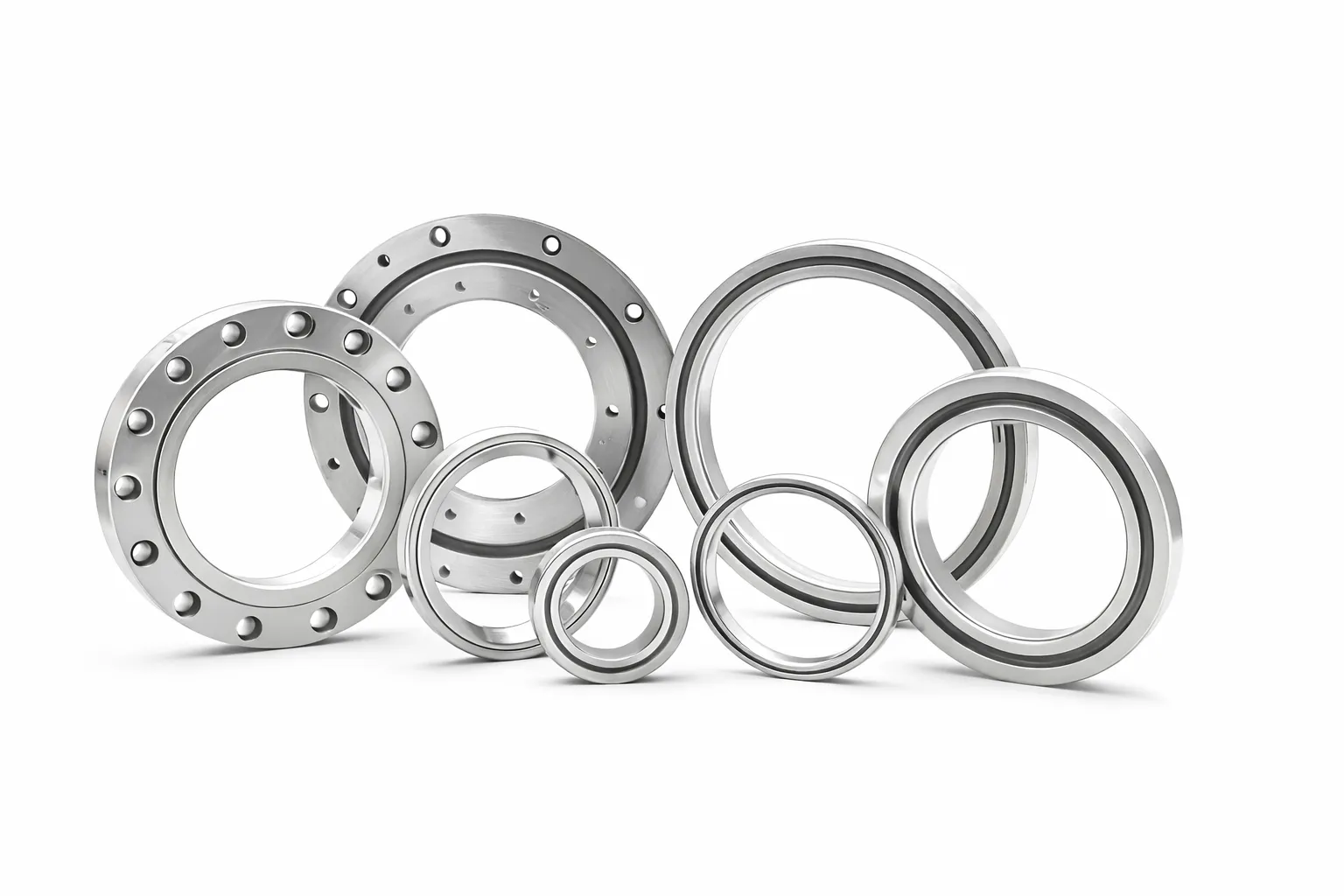
Choosing between thin section bearings and crossed roller bearings usually comes down to space, rigidity, and load direction. Thin section bearings prioritize minimal radial/axial envelope and low weight, while crossed roller bearings prioritize stiffness and moment capacity in compact rotary stages. Below is a practical, engineering-focused comparison to help you select confidently for your application and performance targets.
What is thin section bearings vs crossed roller bearings?
Thin section bearings are slim-profile ball bearings designed to save space and weight, while crossed roller bearings use alternating cylindrical rollers to deliver higher rigidity and better moment-load capacity. In thin section bearings vs crossed roller bearings, the core difference is stiffness and load handling (crossed roller) versus minimal envelope and speed-friendly ball geometry (thin section).

Definitions and typical use cases
Thin section bearings are usually ball bearings (deep groove, angular contact, or four-point contact) built with a very small cross-section relative to bore diameter, enabling compact designs. Crossed roller bearings arrange cylindrical rollers in alternating orientations (crossed) between inner and outer rings, allowing one bearing to support radial, axial, and moment loads with very high stiffness.
- Thin section bearings: robotics joints, aerospace actuators, medical devices, compact turntables where space/weight matter.
- Crossed roller bearings: precision rotary tables, machine tool indexing, semiconductor equipment, antenna pedestals where rigidity and moment loads dominate.
Haron Bearing Pro Tip: When customers tell me “I need compact,” I ask which compact: smallest cross-section (thin section) or smallest system for a given stiffness (often crossed roller reduces the need for dual-bearing arrangements).
How Does thin section bearings vs crossed roller bearings Work?
Thin section bearings use balls rolling in raceways to reduce friction and support loads (depending on type: radial, axial, or combined). Crossed roller bearings use perpendicular, alternating rollers that act like multiple line contacts, giving much higher stiffness and moment resistance. The working principle difference is point contact (balls) versus line contact (rollers).

Load transfer and contact mechanics
In thin section ball bearings, the ball-to-raceway contact is primarily point contact, which tends to reduce friction and allow higher speeds, but it generally provides lower stiffness than rollers. Different thin section types change how loads are shared: deep groove favors radial, angular contact favors combined loads, and four-point contact supports axial loads in both directions with one bearing.
Crossed roller bearings distribute loads through line contact along each roller, and because rollers alternate orientation, the bearing can simultaneously resist radial + axial + moment loads with high rigidity—often ideal for precision positioning and minimal deflection.
- Thin section (balls): lower friction, higher speed potential, lighter, less stiffness.
- Crossed roller (rollers): higher stiffness, higher moment capacity, more sensitive to mounting accuracy and contamination.
Haron Bearing Pro Tip: I always treat crossed roller bearings as a “structure,” not just a bearing—good housing flatness, alignment, and preload control are what turn their theoretical stiffness into real-world accuracy.
What are the advantages of cross roller bearings?
Crossed roller bearings excel when you need high rigidity, high moment-load capacity, and precise rotation in a compact package. They can often replace a pair of angular contact bearings because they handle radial, axial, and moment loads together. Their stiffness and low runout make them popular in precision rotary tables, robotics, and semiconductor equipment.

Where crossed roller bearings outperform
Based on our internal data and market analysis, here is the breakdown:
| Advantage | Why it matters | Typical applications |
|---|---|---|
| High rigidity | Less elastic deflection under load | Precision stages, metrology |
| High moment capacity | Resists overturning moments in short stack height | Robot joints, rotary tables |
| Combined-load capability | One bearing can take radial/axial/moment | Indexing heads, antenna mounts |
| Positioning accuracy | Stable guidance with low runout (when installed correctly) | Semiconductor, optical equipment |
| Compact system design | May eliminate paired bearing sets | Compact rotary modules |
Haron Bearing Pro Tip: If your main failure mode is “tilt” or “wobble” under load, I lean crossed roller first—then we validate lubrication, sealing, and mounting tolerances to protect the raceways.
Which company is no. 1 in bearing?
There isn’t a single global “No. 1” bearing company for every category because leadership varies by segment (automotive OE, industrial, precision, aerospace) and by metric (revenue, volume, accuracy, or innovation). The right choice depends on your application requirements, certification needs, lead time, and quality system—not only brand ranking.
How to evaluate “No. 1” for your project
Instead of relying on a universal ranking, define what “best” means for your use case and evaluate suppliers accordingly:
- Performance fit: load ratings, stiffness, speed, runout, noise.
- Quality system: traceability, inspection capability, certifications.
- Engineering support: application review, preload guidance, mounting specs.
- Supply chain: lead time stability, alternate sourcing, lifecycle support.
- Total cost of ownership: downtime risk, warranty, maintenance interval.
If you’re sourcing thin section bearings vs crossed roller bearings, the “best” supplier is the one that can consistently hit your tolerance stack, cleanliness level, and delivery schedule for your specific bearing series. Haron Bearing can support selection and specification matching based on your duty cycle and installation constraints.
Haron Bearing Pro Tip: In my experience, “No. 1” is the supplier who can prove consistency—ask for inspection data, runout reports, and process capability, not just a catalog.
What are the 4 types of roller bearings?
A common way to group roller bearings into four major types is: cylindrical roller, tapered roller, spherical roller, and needle roller bearings. Each uses rollers instead of balls to increase load capacity and stiffness. Crossed roller bearings are a specialized precision category (often cylindrical rollers arranged in a cross pattern) used for combined loads and high accuracy.
Roller bearing types and what they’re best at
Based on our internal data and market analysis, here is the breakdown:
| Roller bearing type | Primary strength | Common use |
|---|---|---|
| Cylindrical roller | High radial load, good stiffness | Gearboxes, motors, machine tools |
| Tapered roller | Combined radial + axial load | Automotive hubs, gear drives |
| Spherical roller | Misalignment tolerance + high load | Heavy industry, conveyors |
| Needle roller | High load in very small radial space | Transmissions, compact mechanisms |
Haron Bearing Pro Tip: If you’re space-limited radially, don’t default to needles—verify shaft/housing hardness and deflection first, because needle solutions can be unforgiving on raceway quality.
Key Features & Comparison
Thin section bearings favor minimal cross-section, lower friction, and lighter weight, while crossed roller bearings favor rigidity, combined-load handling, and moment resistance. For thin section bearings vs crossed roller bearings, selection typically hinges on deflection limits, overturning moments, and mounting accuracy. Use the table below to map your priority (space/speed vs stiffness/accuracy) to the right bearing style.
Side-by-side engineering comparison
Based on our internal data and market analysis, here is the breakdown:
| Factor | Thin section bearings (ball) | Crossed roller bearings (roller) |
|---|---|---|
| Primary value | Minimal envelope, low weight | High stiffness, high moment capacity |
| Contact type | Point contact | Line contact |
| Load handling | Depends on type; often moderate combined loads | Excellent combined (radial/axial/moment) |
| Rigidity/deflection | Lower stiffness (generally) | Very high stiffness |
| Speed capability | Typically higher | Typically lower than ball types (application-dependent) |
| Accuracy potential | Good with proper specs | Excellent in precision grades |
| Sensitivity to mounting | Moderate | High (flatness/alignment critical) |
| Typical system design | May need paired bearings for moment | Often single-bearing solution |
| Common applications | Robotics, aerospace, medical, compact turntables | Rotary tables, semiconductor stages, precision joints |
Haron Bearing Pro Tip: If your design includes a large overhung load, calculate overturning moment first—this one number often decides the bearing architecture before we even talk about size.
Cost & Buying Factors
Cost differences between thin section bearings and crossed roller bearings are driven by precision grade, size, preload, sealing, and manufacturing complexity. Thin section bearings can be cost-effective for compact, higher-speed needs, while crossed roller bearings often cost more but may reduce total system cost by replacing dual-bearing arrangements and improving accuracy. Buying should focus on performance per dollar, not unit price.
Pricing drivers and selection checklist
Key cost drivers to compare in thin section bearings vs crossed roller bearings:
- Precision grade / runout requirements (tighter = higher cost).
- Preload specification (improves stiffness/accuracy, affects torque and life).
- Material and heat treatment (corrosion resistance, vacuum compatibility, etc.).
- Seals and lubrication (cleanroom grease, low outgassing, long-life grease).
- Mounting requirements (crossed roller often needs tighter housing/shaft control).
- Total system cost (can you eliminate a second bearing, spacer stack, or complex housing?).
Practical buying questions to finalize selection:
- What are the radial/axial loads and overturning moments across the duty cycle?
- What is the allowable deflection at the tool point or payload interface?
- What are the speed, torque, and positioning accuracy targets?
- What is the environment (contamination, vacuum, temperature, corrosion)?
- Do you need matched sets, special grease, or inspection reports?
Haron Bearing Pro Tip: I recommend you buy the bearing after you lock the mounting tolerances—especially for crossed roller designs, the housing geometry can make a premium bearing perform like a budget one.
Conclusion
Thin section bearings excel when the goal is the smallest, lightest bearing package with good speed capability, while crossed roller bearings excel when stiffness, moment capacity, and precision rotation dominate. For thin section bearings vs crossed roller bearings, define loads (including moment), deflection limits, and mounting tolerances first—then select the bearing type that meets accuracy and lifecycle goals with the lowest total system cost.
If you share your bore/OD limits, load cases, moment, speed, and accuracy targets, Haron Bearing can recommend a shortlist and help validate preload, fits, and lubrication.