
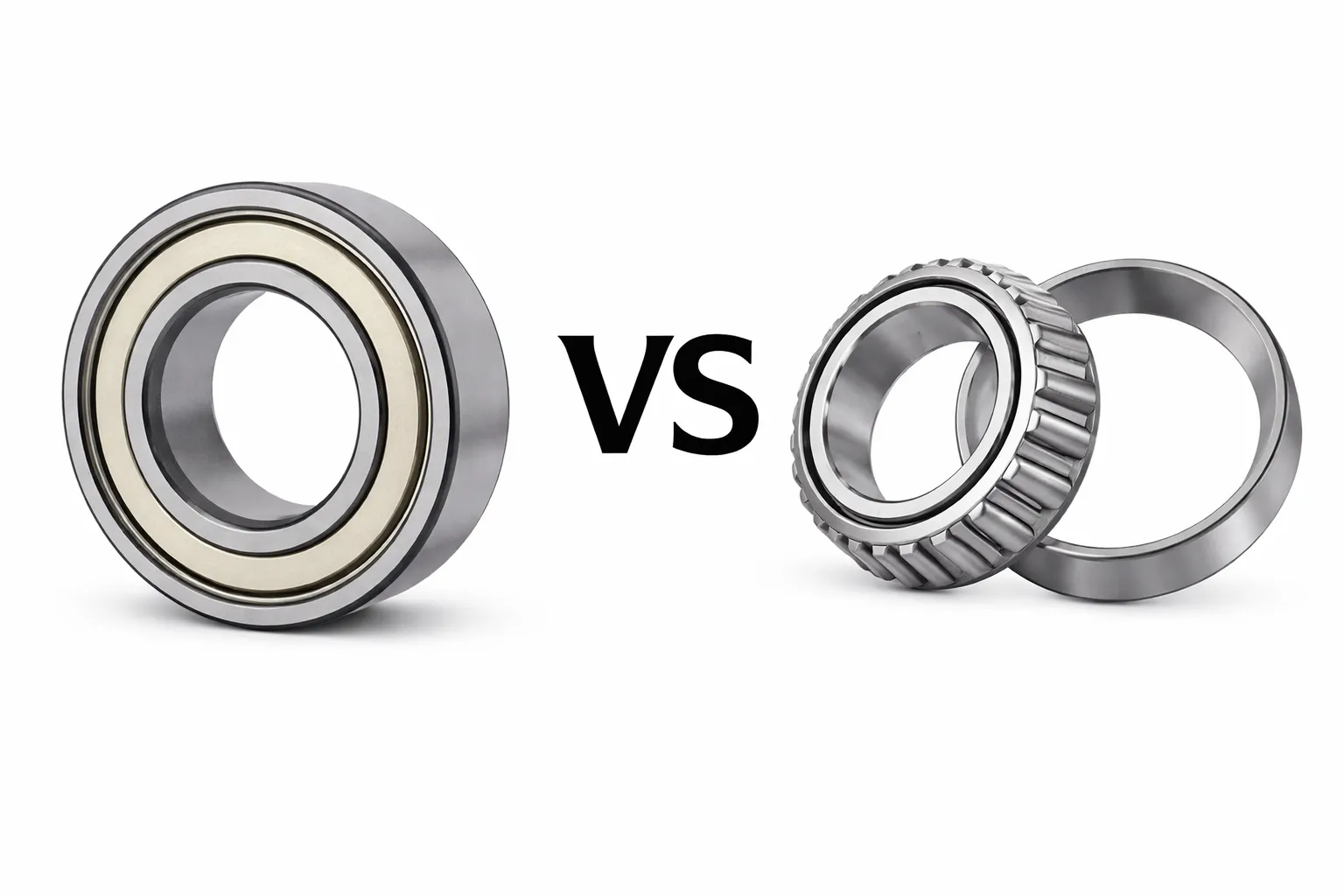
Choosing tapered roller bearings vs cylindrical roller bearingsdepends on load direction, stiffness, speed, and assembly. Tapered designs handle combined radial/axial loads and preload, while cylindrical designs suit high radial loads, speed, and low friction.
What is tapered roller bearings vs cylindrical roller bearings?
Tapered roller bearings use conical rollers and raceways to carry combined radial and axial loads, typically with adjustable preload. Cylindrical roller bearings use straight rollers primarily for high radial loads with low friction and high speed capability, with limited axial load capacity depending on flange design.
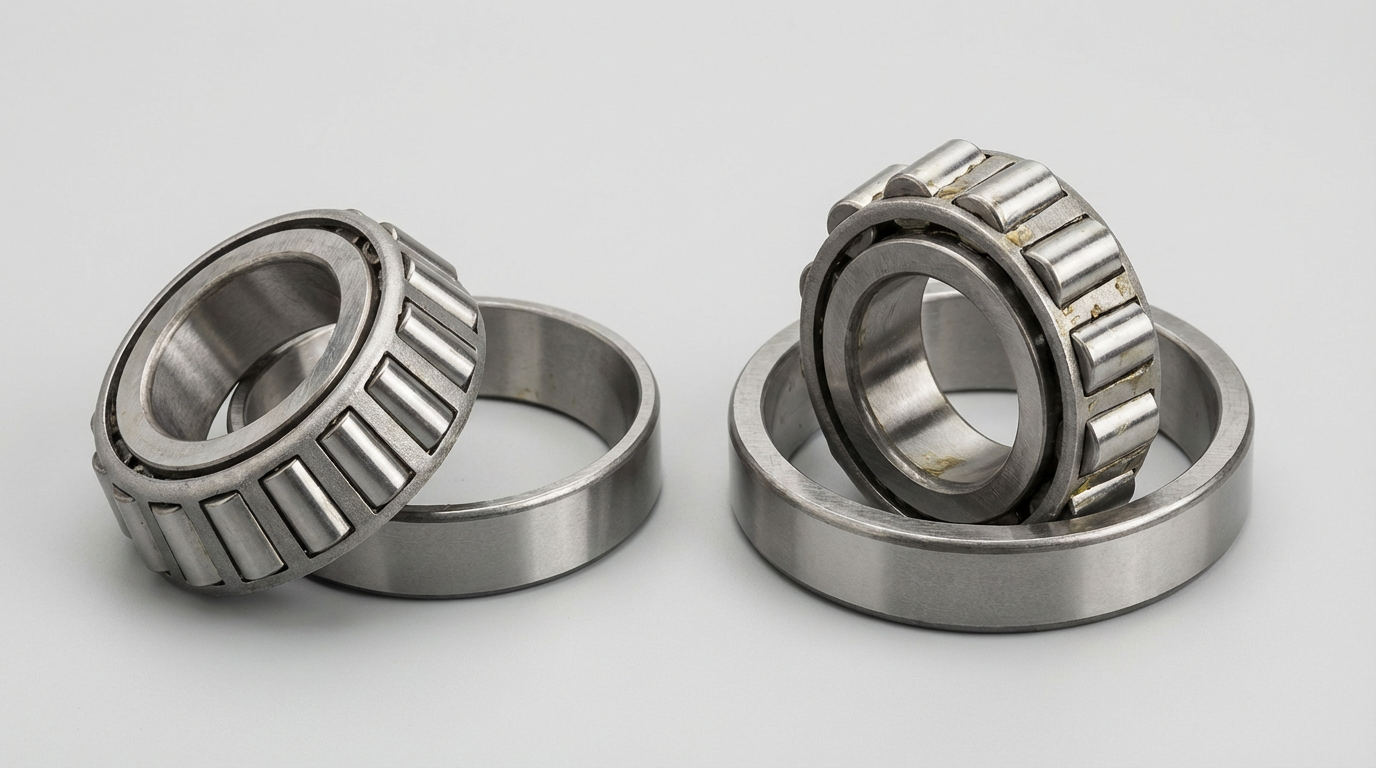
Video Guide: Overview demo of roller bearing types and typical application selection.
Definitions that matter in real selection
A “tapered” bearing’s geometry forces the load lines to intersect at a common point on the bearing axis, which is why it can react axial thrust alongside radial load—especially in opposed pairs.
A “cylindrical” bearing uses line contact with minimal sliding, making it efficient under heavy radial load and higher speed. Axial capability varies by style (e.g., NU, NJ, NUP), but it is not the default strength.
- Tapered roller bearing (TRB): Conical rollers; often installed in pairs; preload/endplay adjustable.
- Cylindrical roller bearing (CRB): Straight rollers; multiple internal designs; can allow axial displacement (floating) in some configurations.
- Key practical difference: TRB is the go-to for combined loads and stiffness tuning; CRB is the go-to for radial load + speed + low heat.
Haron Bearing Pro Tip: I treat the question as “Do you need adjustable stiffness and thrust capacity?” If yes, start with a tapered solution (often paired). If not—and the load is mostly radial—cylindrical usually gives cooler running and easier high-speed performance.
How Does tapered roller bearings vs cylindrical roller bearings Work?
Tapered roller bearings support radial and axial loads through angled contact lines, often using preload with a nut or spacer. Cylindrical roller bearings use rolling line contact for high radial load, lower friction, and less heat, with axial control depending on flanges.
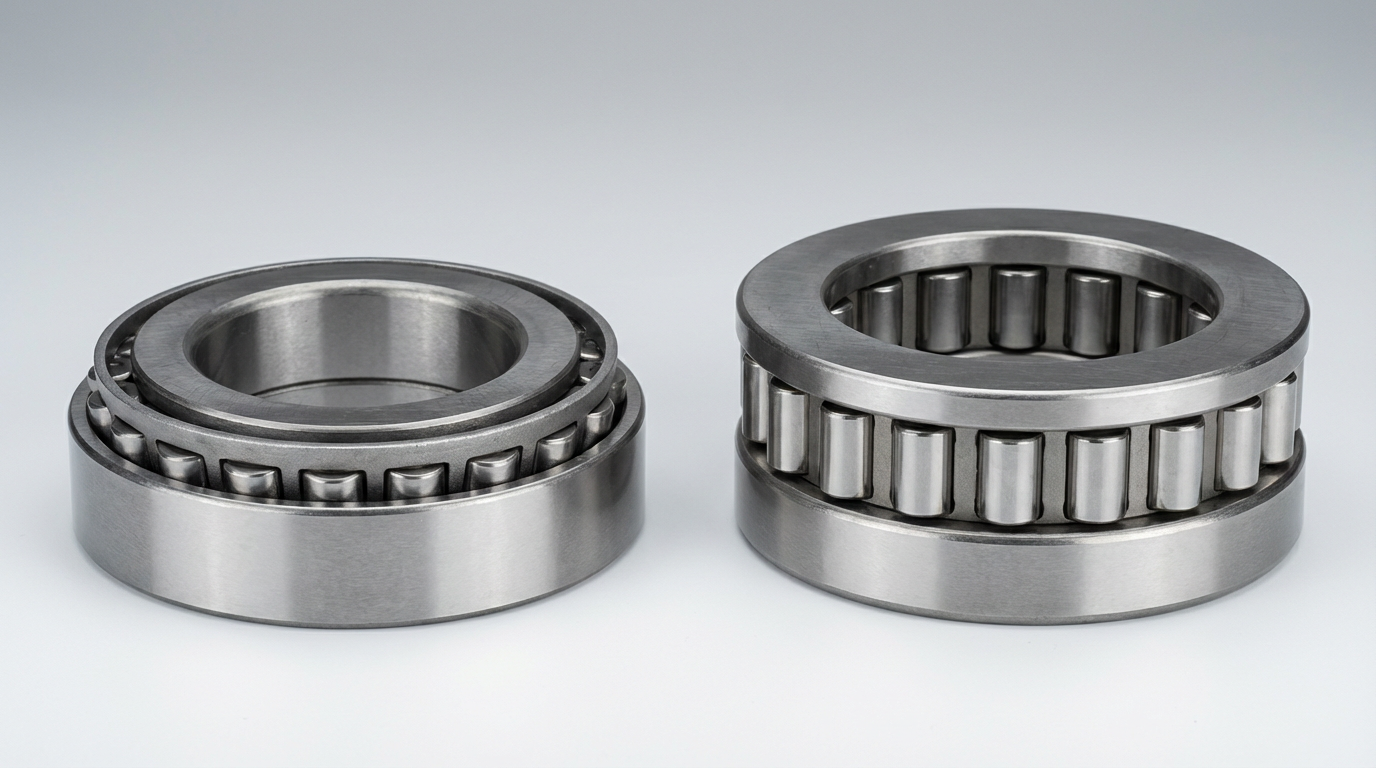
Video Guide: Animation-style explanation of load paths in tapered vs cylindrical roller bearings.
Load paths, internal geometry, and what changes in operation
Tapered roller bearings generate an axial force component internally due to their contact angle. That’s why they’re typically used:
- In pairs (back-to-back or face-to-face) to handle axial loads in both directions
- With controlled preload or endplay to tune stiffness, runout, and heat
Cylindrical roller bearings, by contrast, are frequently used as either:
- Locating bearings (axially constrained via flanges)
- Non-locating/floating bearings (allowing shaft thermal expansion)
- Typical TRB arrangement steps:
- Select bearing series based on radial + axial load and required contact angle.
- Choose pairing strategy (DB/DF) for bidirectional thrust.
- Set preload/endplay (spacer, shims, or nut torque + measurement).
- Validate temperature rise during trial run.
Haron Bearing Pro Tip: For assemblies with thermal growth, set one bearing position to “locate” and the other to “float.” Cylindrical bearings often work best as the float side, while poorly planned tapered pairs may overload as temperature changes.
When to use tapered roller bearings?
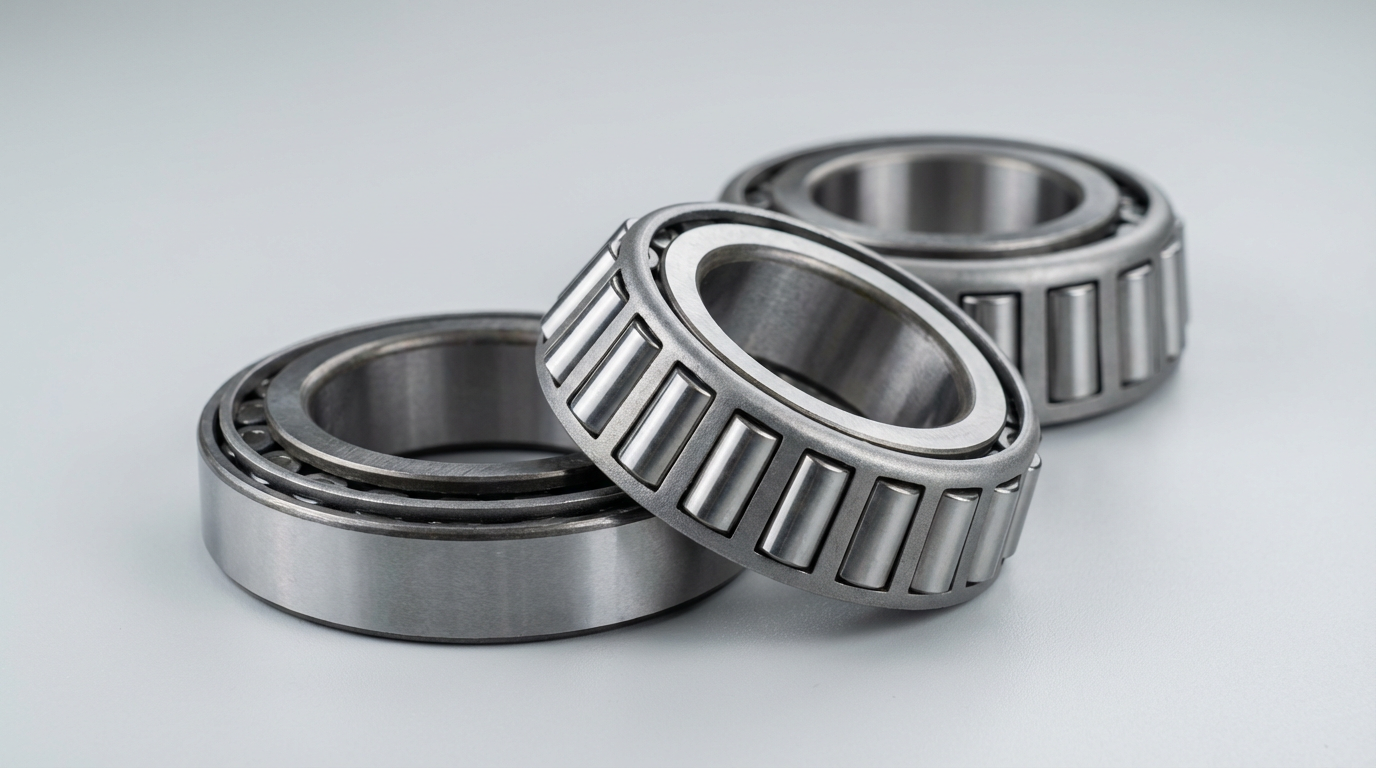
Use tapered roller bearings for combined radial/axial loads, high stiffness, or adjustable preload/endplay. They suit wheel hubs, gearboxes, and pinion supports, and handle shock loads well when correctly preloaded.
[Insert URL Here]
Video Guide: Practical example showing tapered bearing preload and typical automotive/gearbox use cases.
Best-fit applications and selection triggers
Tapered bearings shine when thrust is not optional, especially in gear meshes and wheel-end systems. They also support precise shaft positioning (critical for gear tooth contact pattern).
- Use TRBs when you have:
- Significant axial thrust in one or both directions (often via paired bearings)
- Need for preload tuning (stiffness, runout control, noise reduction)
- Shock loads and robust line-contact requirements
- Space allows for paired arrangement and adjustment hardware
- Common examples:
- Automotive wheel hubs (traditional designs)
- Differential pinion supports
- Heavy gearboxes and reducers
- Rolling mill equipment (in appropriate configurations)
Haron Bearing Pro Tip: I always verify that the preload method is measurable on the line (endplay gauge, torque-to-rotate, or axial displacement). A great bearing choice can fail early if preload is “set by feel.”
What are the disadvantages of cylindrical roller bearings?
Cylindrical roller bearings may have limited axial capacity, need good alignment, and are sensitive to misalignment. Poor shaft/housing geometry can cause edge stress, while weak lubrication or flange guidance may lead to smearing during rapid speed changes.
Where cylindrical bearings can surprise you
Cylindrical bearings are efficient, but they are less forgiving when axial forces, misalignment, or lubrication control are not managed.
- Typical disadvantages to plan around:
- Limited thrust capacity unless using specific guided/flanged designs
- Misalignment sensitivity → risk of edge loading and premature spalling
- Smearing risk in high acceleration or poor lubrication regimes
- Axial location complexity (may need separate thrust elements or locating ring/shoulder strategy)
- Noise/vibration issues if clearance, seat form, or roller guidance is marginal
- Mitigations (quick checklist):
- Confirm axial load direction/magnitude and choose NU/NJ/NUP accordingly.
- Control alignment (seat tolerances, shaft deflection, housing stiffness).
- Ensure correct viscosity and supply method for operating speed/temperature.
- Validate edge stress via contact pattern or simulation for heavy-duty cases.
Haron Bearing Pro Tip: If you’re seeing smearing on cylindrical rollers, I first look at lubrication film (viscosity and supply) and rapid transient events—not just “bearing quality.” Many issues are system-driven, not bearing-driven.
Which company is no. 1 in bearing?
There is no universal “No. 1” bearing company. The best choice depends on product type, region, certification, lead time, and application risk. Global brands fit critical OEM projects, while Haron Bearing offers flexible support, customization, and responsive supply.
How to choose a top supplier for your application
Instead of ranking brands broadly, define “No. 1” by measurable criteria tied to your operating conditions and quality requirements.
- Supplier evaluation criteria:
- Documented quality system (e.g., ISO 9001; industry-specific requirements if needed)
- Proven application references (similar loads, speeds, environment)
- Engineering support (fit/clearance, preload, lubrication guidance)
- Traceability and inspection (material certs, dimensional reports)
- Availability and lead time (risk of downtime vs cost)
- Warranty/FA process (failure analysis turnaround and accountability)
Haron Bearing Pro Tip: I recommend shortlisting suppliers by your risk profile: if downtime is expensive, pay more attention to traceability, consistency, and technical support than to unit price. That’s usually where total cost is won or lost.
Key Features & Comparison
To choose tapered roller bearings vs cylindrical roller bearings, first check load direction and stiffness, then speed, heat, and mounting. Tapered bearings suit combined loads and preload control, while cylindrical bearings fit heavy radial loads, higher speed, and lower friction.
Side-by-side engineering comparison
Based on our internal data and market analysis, here is the breakdown:
| Feature | Tapered Roller Bearings | Cylindrical Roller Bearings |
|---|---|---|
| Primary load strength | Combined radial + axial | High radial |
| Axial load capability | High (often needs paired arrangement for both directions) | Limited to moderate (design-dependent) |
| Stiffness | High; preload adjustable | High radial stiffness; axial stiffness depends on design |
| Speed capability | Moderate to high (depends on preload and lubrication) | High (generally lower friction) |
| Heat generation | Can be higher if over-preloaded | Typically lower under comparable radial load |
| Misalignment tolerance | Moderate; still needs alignment control | Generally more sensitive (edge loading risk) |
| Mounting complexity | Higher (preload/endplay setting) | Often simpler; must plan axial location/floating |
| Typical use cases | Wheel hubs, gearboxes, pinions, heavy-duty combined loads | Motors, gearboxes (radial), pumps, compressors, floating supports |
Haron Bearing Pro Tip: When both radial and axial loads exist, I start by calculating thrust share and required stiffness. If thrust is non-trivial, it’s usually cheaper to use the right tapered arrangement than to “patch” axial control with add-on parts around a cylindrical bearing.
Cost & Buying Factors
Cost depends more on size, precision, heat treatment, cage, sealing, and service level than “tapered vs cylindrical.” Tapered systems need preload setup, while cylindrical systems may need axial-location parts. Lowest unit price rarely means lowest lifecycle cost.
What actually drives price and total cost
Use these factors to compare quotes fairly—especially when evaluating tapered roller bearings vs cylindrical roller bearings across different suppliers.
- Cost drivers (bearing + system):
- Size series and load rating (mass and material)
- Precision and running accuracy (P0/P6/P5, etc.)
- Internal clearance/preload class and inspection requirements
- Cage type (steel, brass, polymer) and speed rating needs
- Lubrication method (grease vs oil, filtration, supply hardware)
- Mounting/maintenance labor (preload setting, heating tools, measurement)
- Downtime risk (lead time, spares strategy, supplier FA support)
- Buying checklist (practical):
- Confirm load cases (steady + peak + shock) and required life target.
- Decide locating/floating scheme and allowable axial movement.
- Specify fits, clearance/preload target, and lubrication method.
- Request traceability and inspection documents for critical equipment.
- Compare total cost: parts + assembly + expected life + downtime exposure.
Haron Bearing Pro Tip: I ask buyers to quote the system, not just the bearing: include preload spacers, locknuts, sleeves, and expected assembly time. That’s where tapered vs cylindrical economics often flip.
Conclusion
Choosing tapered roller bearings vs cylindrical roller bearings depends on combined-load capability, stiffness, speed, and thermal floating needs. Share load direction, speed, lubrication, and mounting limits—Haron Bearing can help select the safest specification.