
Precision systems in robotics, rotary tables, and metrology often fail not from motor choice but from bearing selection. Crossed roller bearings and angular contact bearings can both deliver high precision motion, yet they differ sharply in stiffness, load direction handling, envelope size, and integration complexity. The right choice comes down to how your loads combine (axial/radial/moment), your runout targets, and packaging constraints for the joint or table.
Video Guide: Use this overview to visualize how crossed roller bearings are built and why they’re favored for compact, high-stiffness rotary axes.
Which is better: crossed roller bearings or angular contact bearings?
Crossed roller bearings and angular contact bearings are both precision rotary bearings, but they’re optimized differently. Crossed rollers use alternating cylindrical rollers to carry radial, axial, and moment loads in one compact unit. Angular contact bearings use ball contact angles and are typically paired to manage combined loads with high speed capability.
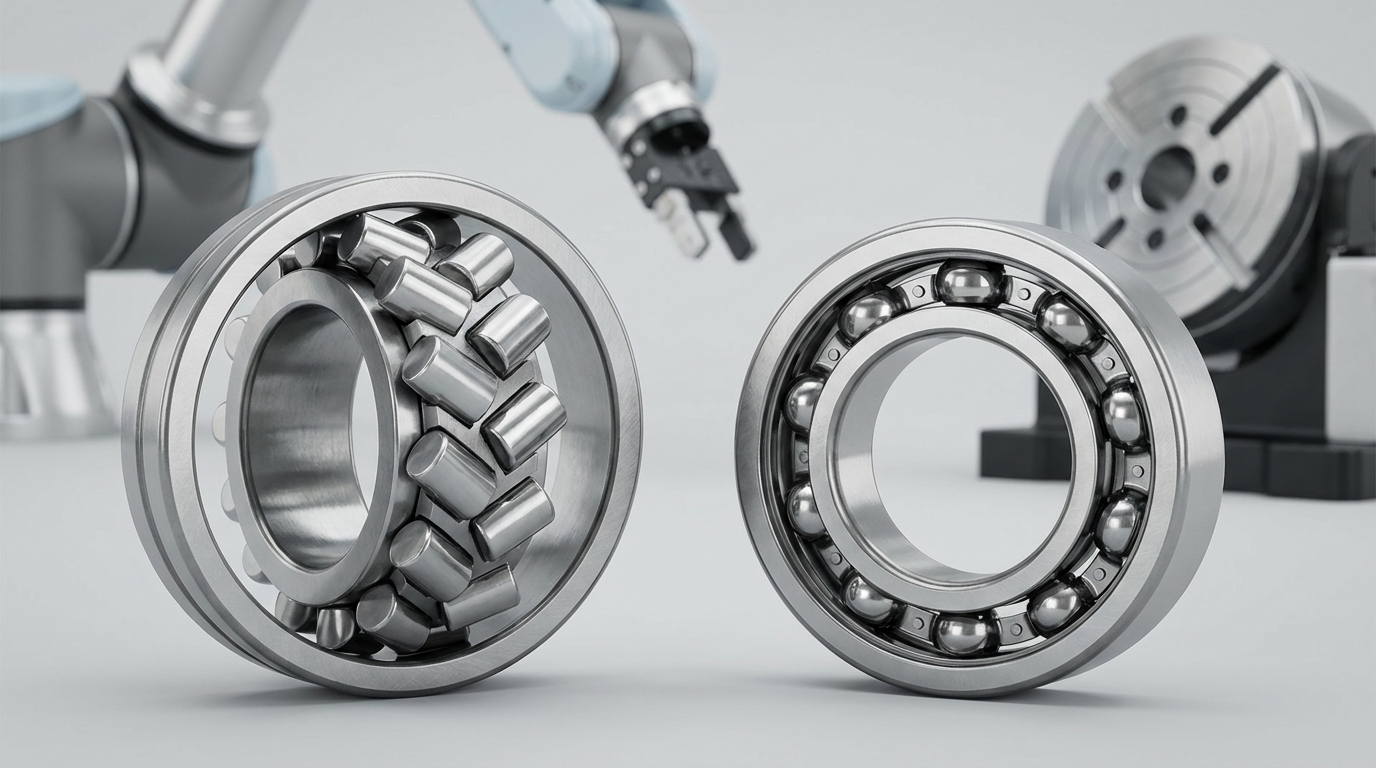
Definition, scope, and where the “comparison” really matters
In precision bearing selection, “crossed roller bearings vs angular contact bearings” is mainly a trade-off among stiffness, load-direction versatility, speed, and how many components you need to build a stable rotary axis.
- Crossed roller bearings: Cylindrical rollers are arranged orthogonally (crossed), allowing a single bearing to resist radial + axial + overturning moment loads with high rigidity. Common in bearing for robotic joints and bearing for rotary tables where compact stiffness dominates.
- Angular contact bearings: Balls run on raceways with a defined contact angle, enabling them to support combined radial and axial loads, usually best when used in matched pairs (DB/DF/DT) to handle axial load in both directions and improve moment capacity.
Key “comparison” decision points for robotics bearing comparison and high precision motion bearings:
- Stiffness and tilt under moment load
- Speed/heat limits and lubrication strategy
- Assembly stack-up (single unit vs paired arrangement)
- Runout, preload sensitivity, and mounting accuracy requirements
Haron Bearing Pro Tip: I treat this as a system question, not a catalog question—define your worst-case overturning moment and allowable tilt first, then pick the bearing type that meets stiffness with the simplest, most repeatable assembly.
How do crossed roller bearings and angular contact bearings compare?
Crossed roller bearings work by using perpendicular roller elements to share loads through line contact, creating high stiffness against moment loads in a compact envelope. Angular contact bearings work through angled ball contact that converts axial/radial loads into raceway reactions; paired sets and preload control stiffness, runout, and bidirectional axial capacity.
Video Guide: This explains how angular contact bearings carry axial load via contact angle—useful for understanding why pairing and preload matter.
Load paths, contact mechanics, and preload behavior
The “how it works” difference is fundamentally line contact vs point contact, and single-bearing moment capacity vs paired-bearing architecture.
- Crossed roller bearing load path
- Rollers provide line contact, which typically increases stiffness.
- Alternating roller orientation lets the bearing resist axial loads in both directions and overturning moments without needing a second bearing row elsewhere.
- Preload (or internal clearance selection) is often used to reduce play and improve repeatability in precision rotary bearings.
- Angular contact bearing load path
- Balls provide point/elliptical contact, often enabling higher speeds and lower friction.
- A single bearing supports axial load primarily in one direction; to support reversal and moment loads you typically use:
- DB (back-to-back) for high moment stiffness
- DF (face-to-face) for misalignment tolerance
- DT (tandem) for higher axial load in one direction
- Preload is critical: too low reduces stiffness; too high increases heat and reduces life.
Practical checklist (fast selection logic):
- High overturning moment in a tight joint/table: lean crossed roller
- High RPM with moderate combined loads: lean angular contact (paired)
- Need simplest BOM and minimal axial stack-up: crossed roller
- Need adjustable preload and standardized spindle-like architecture: angular contact
Haron Bearing Pro Tip: When customers report “mystery compliance,” I ask how they’re generating preload—springs, locknuts, or thermal fits. Angular contact sets are excellent, but stiffness collapses if preload isn’t controlled and repeatable.
Which is better roller bearing or angular contact bearing?
Neither is universally better; it depends on your load mix, stiffness target, and speed. Crossed roller bearings usually win for compact, high stiffness under moment loads (robot joints, rotary tables). Angular contact bearings usually win for higher speeds and tunable preload using matched pairs, especially in spindle-like assemblies.
Video Guide: Watch for how bearing geometry changes load capacity and why “cup-and-cone” style pairing concepts map to stiffness and alignment choices.
Selection matrix: “better” means better for the constraint
Use this short decision list to avoid over-specifying:
- Choose crossed roller when you need:
- High bearing stiffness comparison performance under moment load
- One bearing to carry radial + axial + moment
- Compact axis packaging (thin sections, short stack height)
- Choose angular contact (paired) when you need:
- Higher speed capability with manageable heat
- A proven architecture for precision shafts/spindles
- Preload tuning to balance stiffness vs friction
- Common pitfalls:
- Expecting a single angular contact bearing to handle axial reversal and moment well
- Underestimating housing/shaft geometry tolerances for crossed roller mounting accuracy
Haron Bearing Pro Tip: If your axis sees frequent direction reversals plus external cantilever load, I usually start with crossed roller—then only move to angular contact pairs if speed/heat becomes the dominant constraint.
What are the advantages of cross roller bearings?
Cross roller bearings excel in high precision motion bearings because they deliver high rigidity and low tilting under combined loads, especially overturning moments, in a compact package. They can simplify assemblies by replacing multiple bearings, improving stack-up accuracy and making them ideal for robotics bearing comparison cases like harmonic-drive joints and rotary tables.
Video Guide: This shows a practical crossed roller bearing presentation and helps connect the internal roller arrangement to stiffness and packaging benefits.
Why crossed rollers are favored in robotic joints and rotary tables
Based on our internal data and market analysis, here is the breakdown:
| Advantage | Why it matters in precision systems | Typical applications |
|---|---|---|
| High moment stiffness | Resists tilt under cantilever loads | Robot wrists, rotary tables, indexing heads |
| Compact “all-in-one” load handling | Often replaces paired bearings + spacers | Cobots, gimbals, inspection stages |
| High positioning repeatability | Low deflection supports servo stability | Metrology axes, optical alignment |
| Simplified assembly | Fewer parts reduces tolerance stack | Integrated joint modules |
| Good load capacity in tight envelope | Efficient use of cross-roller geometry | Medical robots, semiconductor tools |
Common cross roller bearing applications include: rotary tables, robotic joints, articulated arms, gear reducers output stages, and precision turntables where overturning moment dominates.
Haron Bearing Pro Tip: I recommend specifying mounting surface flatness and perpendicularity up front—crossed rollers can deliver excellent stiffness, but only if the housing/shaft geometry doesn’t introduce distortion.
Are angular contact bearings better?
Angular contact bearings are “better” when your system prioritizes speed, low friction, and a well-controlled preload strategy. In matched pairs, they can provide excellent stiffness and runout for precision rotary bearings, but they typically need more axial space and careful setup to match the moment rigidity a single crossed roller bearing can deliver.
Video Guide: Use this to reinforce how contact angle influences axial load handling and why pairing is central to angular contact performance.
Where angular contact bearings outperform—and where they don’t
Angular contact bearing applications are strongest in spindle-like designs:
- Strengths
- Higher speed potential (depending on series, cage, lubrication)
- Predictable performance with standardized matched sets
- Preload can be engineered for stiffness, thermal growth, and life
- Limitations
- Moment load capacity depends heavily on pairing arrangement and spacing
- Assembly sensitivity: preload, fits, and alignment can make or break performance
- More parts (pairs, spacers, locknuts) can increase variation in production
Common pairing options (quick guide):
- DB (back-to-back): best moment stiffness
- DF (face-to-face): better misalignment tolerance
- DT (tandem): higher axial load one direction
Haron Bearing Pro Tip: If you choose angular contact pairs, I always push for a defined preload class and a clear thermal plan—otherwise field temperature swings can turn a “perfect” preload into either looseness or overheating.
Key Features & Comparison
Crossed roller bearings generally deliver higher stiffness and moment resistance per package size, making them strong for rotary tables and robotic joints. Angular contact bearings generally deliver higher speed capability and flexible preload tuning, often requiring paired arrangements. For precision bearing selection, compare your moment load, allowable tilt, speed, and assembly tolerance capability.
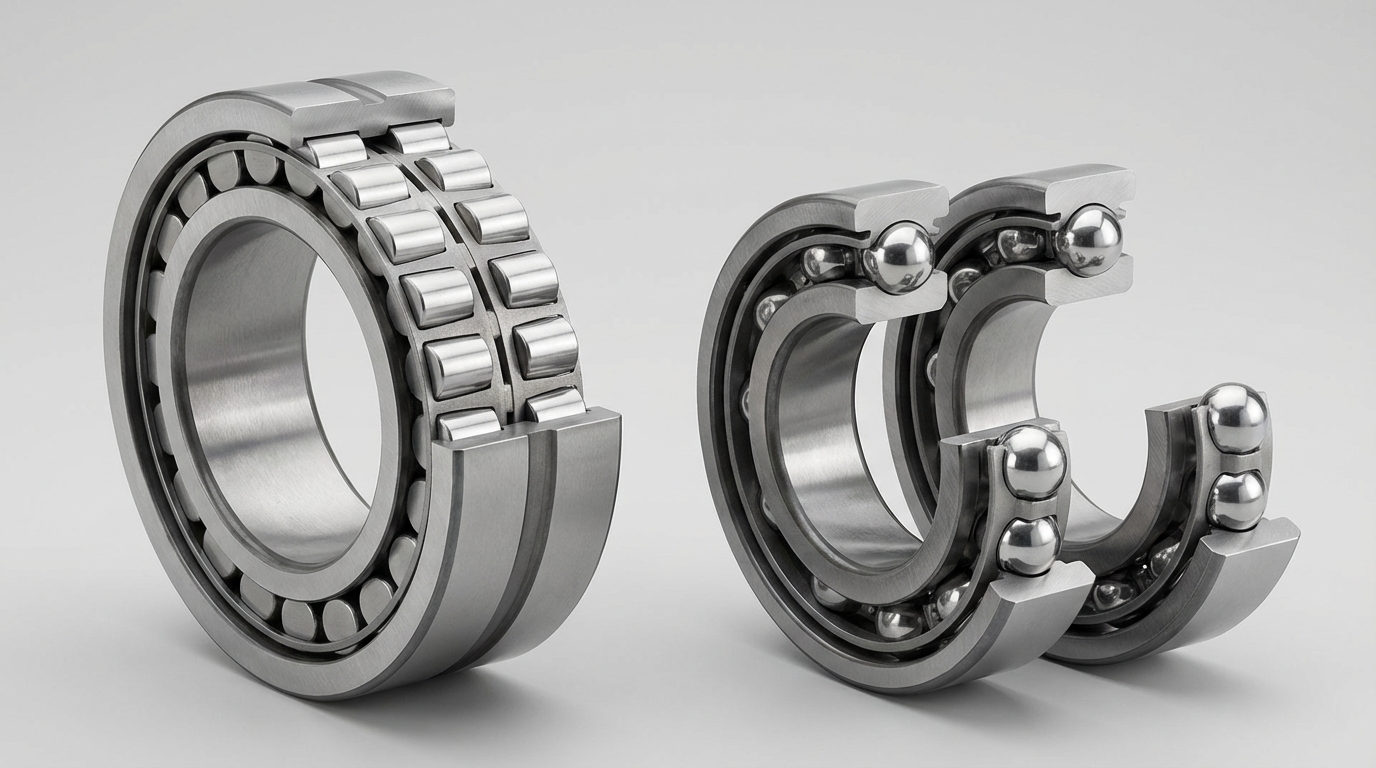
Feature-by-feature comparison for precision rotary bearings
Based on our internal data and market analysis, here is the breakdown:
| Feature | Crossed roller bearings | Angular contact bearings |
|---|---|---|
| Primary contact | Line contact (rollers) | Point/elliptical contact (balls) |
| Load handling (single unit) | Radial + axial (both) + moment | Radial + axial (typically one direction) |
| Moment stiffness | Very high in compact size | High with DB pairing and/or spacing |
| Axial space / packaging | Often compact for given stiffness | Often larger due to pairing and hardware |
| Speed capability | Moderate (application dependent) | Generally higher (application dependent) |
| Preload tuning | Available, but less “field adjustable” | Highly tunable via matched sets/spacers |
| Mounting sensitivity | High—needs good geometry | High—preload/fits/alignment critical |
| Common use cases | Rotary tables, robot joints, gimbals | Spindles, servo axes, gearboxes, pumps with axial load |
Rule of thumb for bearing stiffness comparison: if overturning moment and tilt are your #1 problem, crossed rollers often simplify the solution; if RPM and thermal management are #1, angular contact sets often fit better.
Haron Bearing Pro Tip: I ask teams to quantify tilt (µrad or arc-sec) at peak moment load—once that limit is clear, the bearing type choice usually becomes obvious.
Cost & Buying Factors
Total cost is driven less by bearing unit price and more by integration: required machining accuracy, preload method, assembly time, lubrication, and expected life. Crossed roller bearings can reduce BOM and assembly steps but demand precise mounting surfaces. Angular contact sets can be cost-effective and scalable, but require careful pairing, preload control, and more components.
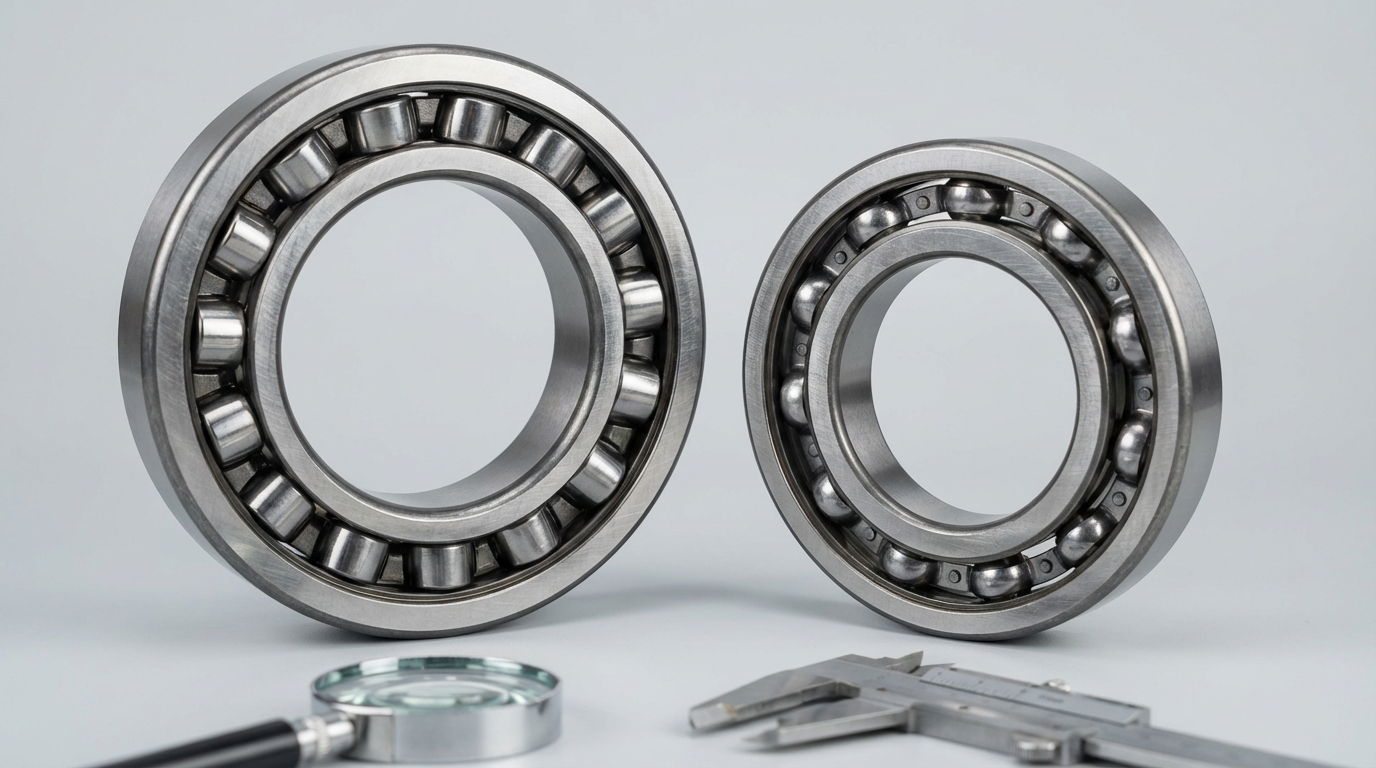
Practical buying checklist (what to price, not just what to buy)
- Define load cases: radial, axial (both directions), and overturning moment; include shock loads.
- Set precision targets: runout, tilt stiffness, repeatability, and backlash/play allowance.
- Account for packaging: axial stack height, bore size, and surrounding seals/gears.
- Compare system cost drivers:
- Crossed roller: higher demands on housing/shaft geometry and cleanliness; fewer parts
- Angular contact: costs in matched pairs, spacers, locknuts, preload verification, and thermal validation
- Lubrication & environment: grease vs oil, temperature range, contamination, corrosion protection.
- Supplier support: availability, preload classes, inspection data, and application review.
Typical cost pattern (general):
- Crossed roller: higher unit price, potentially lower assembly/BOM cost
- Angular contact: lower unit price, potentially higher integration and QA cost
Haron Bearing Pro Tip: I advise requesting inspection items up front (runout, preload/torque, noise) because the cheapest bearing becomes expensive when you have to debug stiffness and heat after assembly.
Conclusion
Selecting between crossed roller bearings and angular contact bearings is ultimately about matching stiffness, load direction, speed, and assembly repeatability to your precision system. For compact axes with high moment loads—like rotary tables and robotic joints—crossed roller bearing applications are often the cleanest path. For higher-speed assemblies with tunable preload, angular contact bearing applications are often stronger. Haron Bearing can help validate load cases and recommend a precision bearing selection that meets tilt, runout, and life targets.