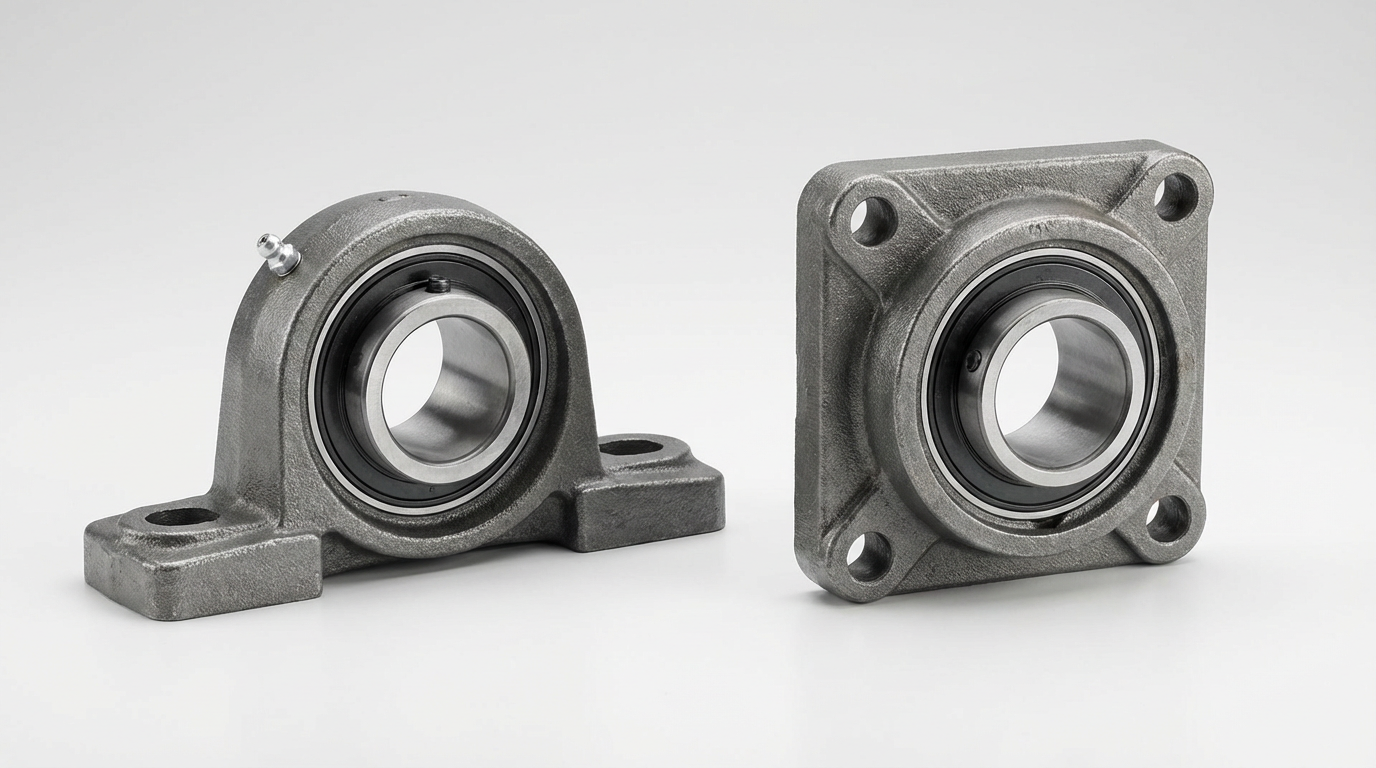
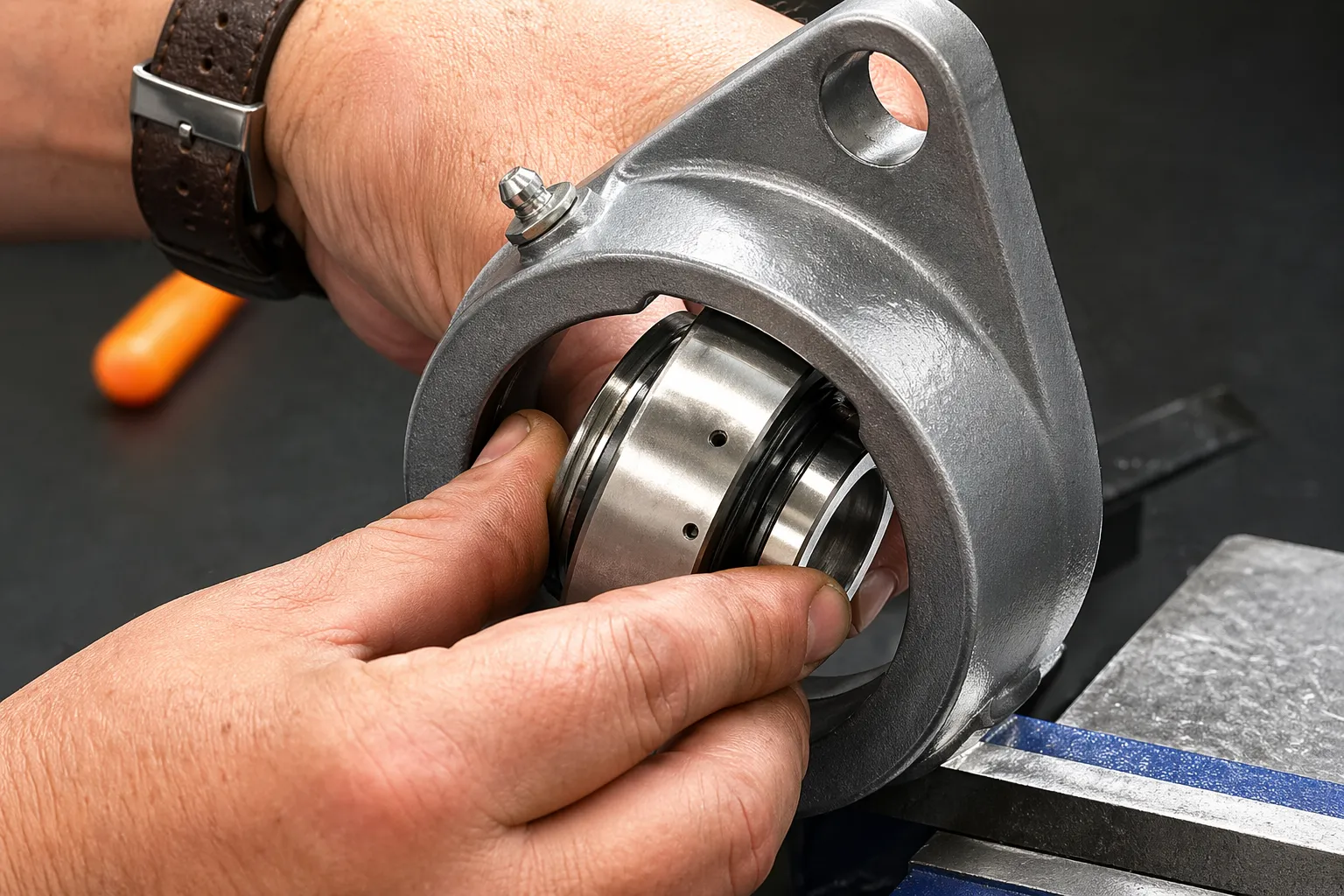
Choosing pillow block bearings vs flange bearings depends on mounting surface, load direction, alignment, and machine frame design. Both are mounted bearing units, but pillow block suits base mounting, while flange bearings fit wall or end-plate layouts.
Video Guide: Visual overview of pillow block and flange bearing housings, what’s inside, and how each mounts in real assemblies.
What’s the difference between pillow block bearings and flange bearings?
Pillow block bearings and flange bearings are mounted bearing units: a rolling bearing insert pre-fitted into a housing that bolts to equipment. A pillow block (plummer block) typically mounts on a flat base, while a flange bearing mounts to a vertical face via a round/oval flange, saving space and simplifying face-mounted layouts.
Video Guide: Quick demonstration of a pillow block bearing unit, housing form, and typical installation context.
Mounted bearing unit definitions you can use on a spec sheet
Pillow block bearings (also called plummer blocks in many regions) are bearing support units designed to sit on a machine base or frame rail. Flange bearings use a flanged housing (2-bolt, 3-bolt, 4-bolt, or cartridge styles) intended to fasten to a plate, wall, or gearbox face.
Key terms and what they mean in a mounted bearing comparison:
- Bearing insert: The actual rolling bearing (often a deep-groove ball bearing) with a locking method (set screw, eccentric collar, or adapter sleeve) to secure to the shaft.
- Housing: Cast iron, ductile iron, stainless, or pressed steel body that supports and protects the insert and provides mounting features.
- Misalignment capability: Many inserts are spherical OD, allowing small self-alignment within the housing.
- Sealing: Contact seals, labyrinth seals, or taconite-style options depending on contamination and washdown needs.
Haron Bearing Pro Tip: When customers ask “pillow block vs flange bearing,” I first confirm the mounting plane: if the shaft support must bolt to a base, start with pillow blocks; if it must bolt to a face/plate (and space is tight), start with a flange unit—then validate load direction and contamination before finalizing the housing and seal style.
Pillow Block Bearings vs Flange Bearings: How Do They Differ?
Both pillow block bearings and flange bearings work by supporting a rotating shaft with a bearing insert seated in a rigid housing. The housing mounts to the machine, the insert carries radial (and some axial) load, and the insert’s locking system holds position on the shaft while allowing limited self-alignment to reduce stress from small mounting errors.
Video Guide: Explains how pillow block bearing units function, where they’re used, and why mounted housings simplify machine assembly.
Load path, alignment, and locking—what actually happens in operation
A mounted bearing unit works as a system:
- The shaft rotates inside the bearing insert, typically using balls (common), rollers (less common in small units), and a grease-filled raceway.
- Loads transfer from shaft → inner ring → rolling elements → outer ring → housing → machine frame.
- Self-alignment occurs when the insert has a spherical outside diameter that can pivot slightly inside the housing bore, accommodating minor angular misalignment.
- The insert locks to the shaft via one of the following common methods:
- Set screws (economical, common for moderate speeds/loads)
- Eccentric collar (good holding for many conveyor duty cases)
- Adapter sleeve (best for higher loads and better concentricity on larger shafts)
Practical differences in how pillow block vs flange units “work” in a machine:
- Pillow block base mounting spreads forces into a foundation and is often easier to shim for alignment along long shafts.
- Flange face mounting is ideal when the bearing must be located precisely on a plate and when the machine design naturally provides a vertical mounting surface (fans, gear housings, augers).
Haron Bearing Pro Tip: I treat mounting rigidity as part of “how it works”—a thin, flexible mounting plate can undo the benefits of a good bearing. If your flange bearing sits on sheet metal, reinforce the plate or switch to a stiffer frame to prevent housing distortion and premature insert failure.
What are the advantages of pillow block bearings and flange bearings?
The biggest benefit of either unit is simplified installation: you get a pre-aligned housing-and-insert assembly with built-in sealing and easy relubrication options. Pillow block bearings excel on base rails for long shafts and conveyors, while flange bearings excel in compact face-mounted designs, often improving packaging and reducing bracket fabrication.
Video Guide: Shows flange bearing construction details and mounting style, helpful for understanding packaging advantages.
Benefits by application fit (what you gain in the real world)
Common benefits across both industrial housing bearings:
- Faster assembly and replacement compared with loose bearings + custom housings
- Better protection from dust and debris via integrated seals
- Misalignment tolerance in many designs, reducing installation sensitivity
- Standardized bolt patterns for repeatable maintenance
Where pillow block unit applications typically win:
- Conveyor head/tail shafts, idlers, and process lines with long shaft spans
- Easy base mounting on channels/rails and straightforward shimming
- Often more forgiving when you need to adjust bearing position along a base
Where flange bearing applications typically win:
- Tight equipment envelopes (fans, mixers, blowers, augers)
- Clean face-mounted layouts that reduce the need for separate brackets
- Better fit when the shaft exits a panel and the bearing must locate at that panel
Selection shortlist (benefit-driven):
- Choose pillow block if you need base mounting, frequent alignment adjustments, or long conveyor-style layouts.
- Choose flange if you need face mounting, compact packaging, or a simple plate-mounted design.
Haron Bearing Pro Tip: If downtime cost is high, choose the housing style that makes replacement easiest in your machine layout—not just the cheapest unit. The “best” mounted bearing is the one your maintenance team can swap without dismantling half the line.
How do you maintain pillow block bearings and flange bearings?
Maintain mounted bearing units by keeping lubrication correct, seals intact, and mounting bolts tight while preventing misalignment and contamination. Use the right regreasing interval and grease type, avoid overgreasing (which overheats and purges seals), and periodically inspect for vibration, noise, temperature rise, and shaft creep that can indicate locking or alignment issues.
Video Guide: General walkthrough of pillow-type bearing units and practical context that supports basic maintenance steps.
A practical maintenance routine for mounted bearing types
Use this checklist to extend bearing life:
- Confirm lubrication method
- Sealed-for-life units: do not add grease unless the design supports relubrication.
- Relubricatable units: use the specified grease and avoid mixing incompatible thickeners.
- Set a regreasing interval
- Base it on speed, temperature, contamination, and runtime (not just calendar time).
- Regrease correctly
- Clean the zerk and surrounding area first.
- Add small amounts while rotating slowly (if safe and permitted).
- Stop once fresh grease begins to purge at the relief path (if designed).
- Inspect mounting and alignment
- Check housing bolts for torque retention.
- Look for shimming needs (pillow block) or plate flatness issues (flange).
- Watch for early failure indicators
- Rising temperature, abnormal noise, grease discoloration, vibration changes, or shaft fretting near the locking device.
- Seal and contamination control
- Replace damaged end caps, seals, or guards.
- In washdown or abrasive environments, upgrade seal style rather than “grease harder.”
Haron Bearing Pro Tip: Overgreasing is one of the most common avoidable failures I see—especially on conveyors. If the housing runs hotter right after greasing or the seals start purging excessively, cut the grease volume and increase inspection frequency instead of adding more.
How much do pillow block bearings and flange bearings cost?
Pricing depends more on size, housing material, insert quality, sealing, and locking method than on pillow block vs flange form alone. As a rule, standard cast-iron units with basic seals are lowest cost, while stainless housings, premium seals, high-load inserts, or specialty flange patterns increase price significantly. Total cost should include downtime, labor, and relubrication needs.
Video Guide: Selection-focused guidance that helps connect performance requirements (fit, load, environment) to the right mounted unit level and cost.
What drives cost (and when paying more is cheaper)
Primary price drivers:
- Shaft size / bore (material and insert cost rise with size)
- Housing material (cast iron < ductile iron < stainless)
- Sealing package (standard contact seals vs heavy-duty labyrinth/taconite styles)
- Locking method (set screw vs eccentric vs adapter sleeve)
- Brand and quality grade (precision, heat treatment, consistency)
- Application conditions (washdown, abrasive dust, chemicals, high temperature)
A quick buying-oriented list:
- If your environment is clean and speed is moderate, standard units are usually adequate.
- If you have dust, water spray, or pulp/aggregate, upgrade seals and housing grade first.
- If you see shaft creep or fretting, upgrade the locking method and shaft tolerance/finish.
Haron Bearing Pro Tip: I recommend quoting two options: (1) a standard unit for baseline cost and (2) an upgraded sealing/locking package for your real environment. The second option often wins once maintenance labor and unplanned downtime are priced in.
Key Features & Comparison
Based on our internal data and market analysis, here is the breakdown:
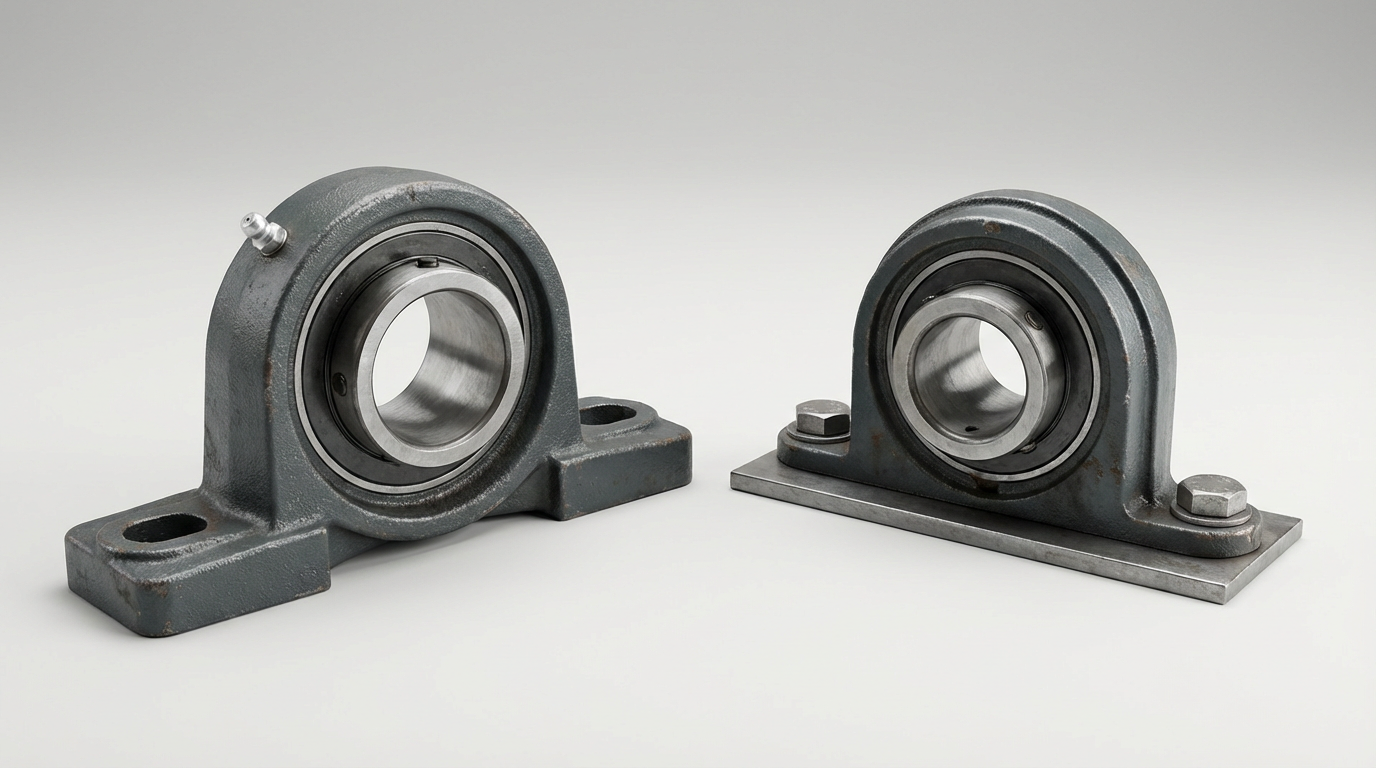
| Feature | Pillow Block Bearings (Plummer Block) | Flange Bearings |
|---|---|---|
| Primary mounting | Base/foot mounting on horizontal surface | Face/plate mounting (vertical surface) |
| Common flange/foot patterns | 2-bolt base slots/holes | 2-bolt oval, 3-bolt triangular, 4-bolt square/round, cartridge |
| Best-fit layouts | Long shafts, conveyors, base rails, adjustable alignment | Compact machinery, panel-mounted shafts, fans, mixers, gearcase faces |
| Alignment adjustment | Easy to shim and slide along base | Depends on plate machining; position is more fixed |
| Space requirement | Needs base footprint | Often more compact in one axis; needs face area |
| Load handling (typical) | Strong for radial loads; some axial depending on insert | Similar insert capabilities; housing geometry supports face mounting |
| Maintenance access | Often easier from above/sides on open frames | Can be tight behind panels; plan access for grease fittings |
| Typical housing materials | Cast iron, ductile iron, stainless, pressed steel | Same options; flange style often selected for packaging/material needs |
| Selection focus | Base rigidity, shaft span, take-up/alignment needs | Plate flatness, bolt pattern, face rigidity, shaft exit geometry |
Cost & Buying Factors
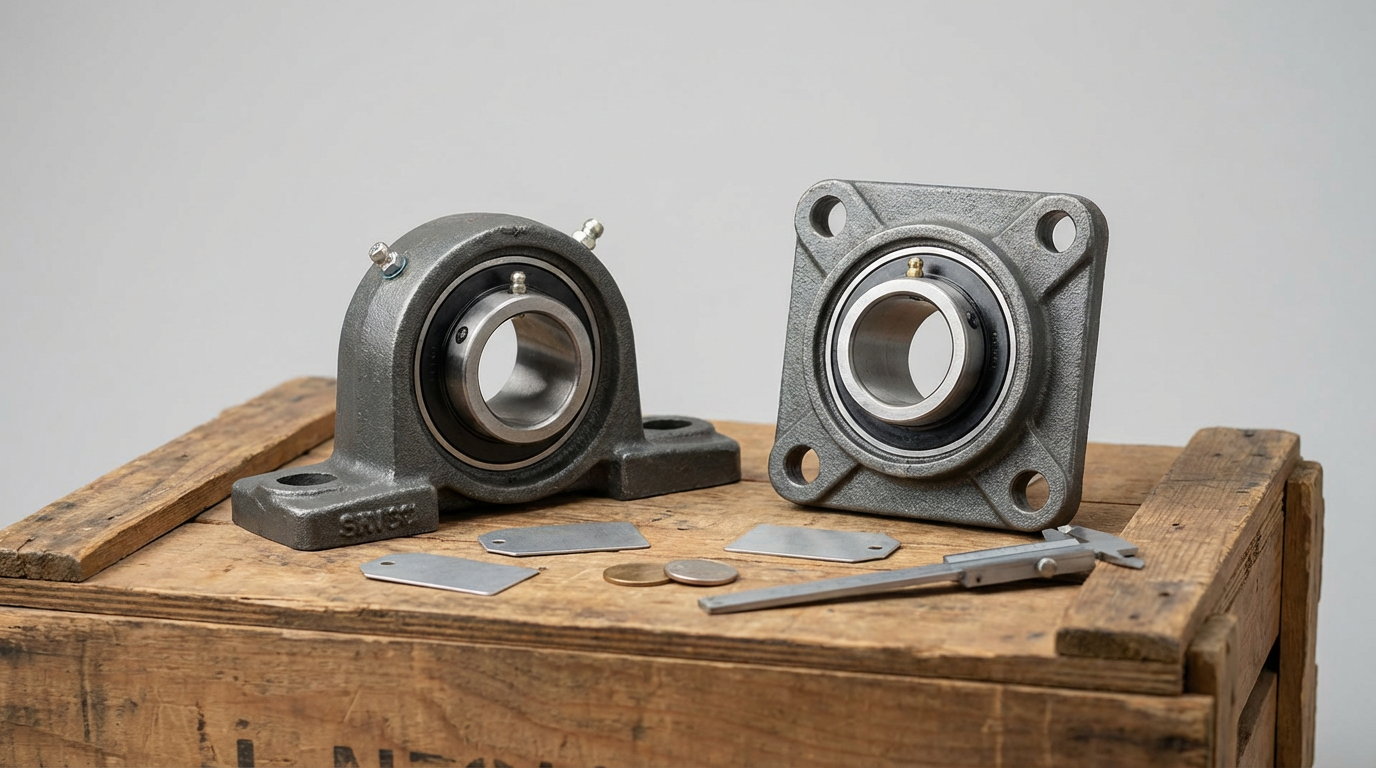
Select the bearing unit by working backward from your real operating conditions:
- Loads and speed: confirm radial/axial loads, RPM, duty cycle, shock loading.
- Mounting constraints: base vs face, available bolt pattern, ability to shim, plate thickness/flatness.
- Environment: dust, water, chemicals, washdown, temperature extremes.
- Lubrication strategy: sealed vs relubricatable; grease compatibility and interval.
- Locking requirement: set screw for general duty, eccentric collar for many conveyors, adapter sleeve for higher load/better concentricity.
- Housing material: cast iron for general use; stainless or coated options for corrosion/washdown.
- Lifecycle cost: include maintenance time, accessibility, and downtime risk—not just unit price.
If you share shaft diameter, RPM, load direction, contamination level, and mounting plane, Haron Bearing can recommend a matched insert, seal, and housing style for your application.
Conclusion
Pillow block bearings suit base-mounted shafts, conveyors, and frames with easy alignment and service access. Flange bearings fit face-mounted, compact layouts on plates or walls. For reliable selection, match mounting geometry first, then check load, sealing, lubrication, and locking.