
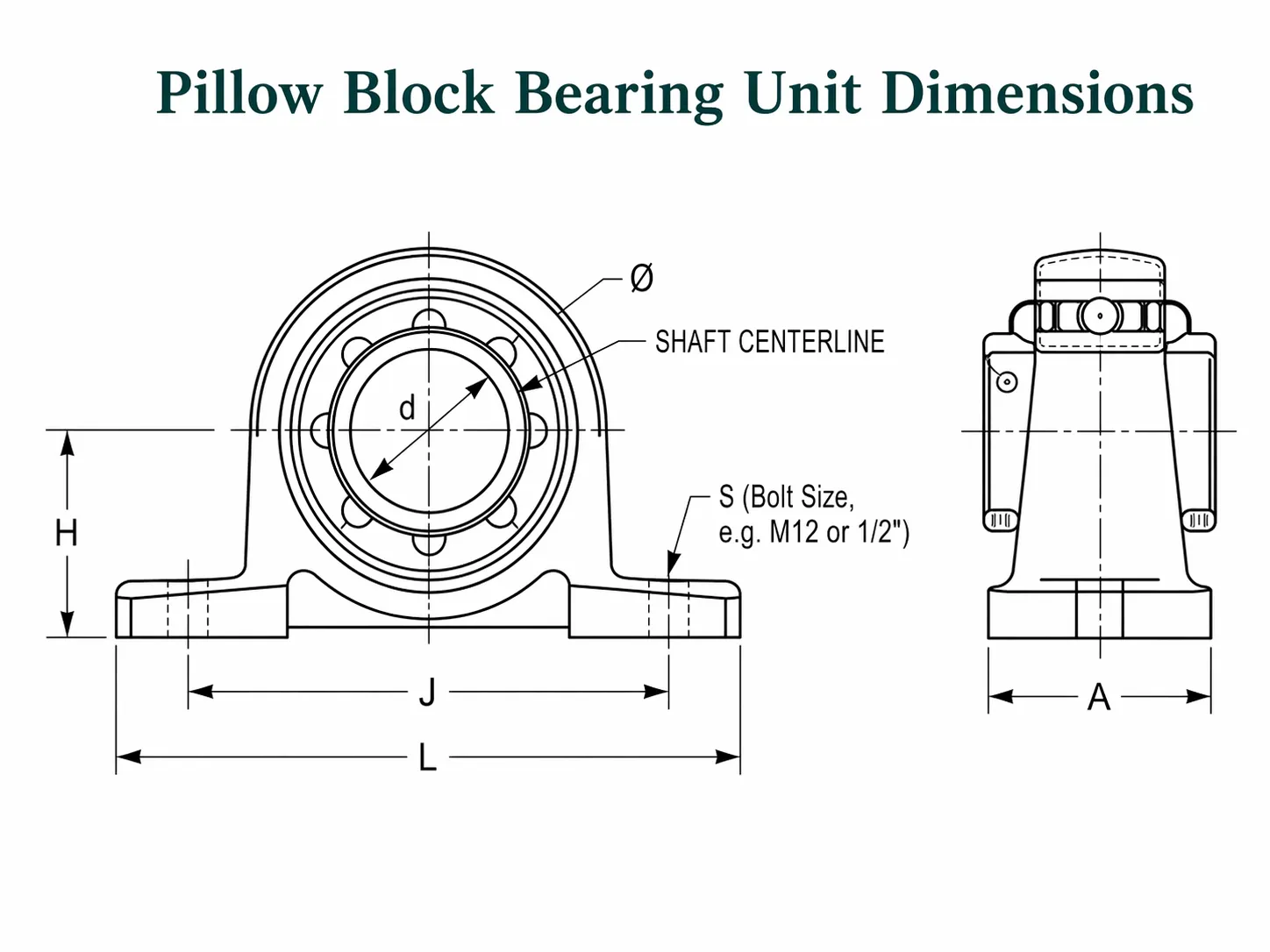
Selecting the right mounted unit starts with a clear reading of the pillow block bearing size chart: bore (shaft size), housing footprint, pillow block bolt spacing, and pillow block center height. For UCP dimensions in particular, matching shaft tolerance, load, and mounting space prevents misalignment, premature wear, and costly rework—especially when swapping between brands or upgrading seals and lubrication options.
Video Guide: A practical overview of pillow block bearings to help you understand the unit, housing, and insert before using a size chart.
How do you read a pillow block bearing size chart?
A pillow block bearing size chart is a dimensional reference that links a mounted bearing unit (such as pillow block / UCP) to its key fit and mounting dimensions—especially bore size (shaft size), bolt-hole spacing, overall housing size, and center height. It ensures the insert bearing and housing match your shaft, load, and available mounting footprint.
Video Guide: Quick visual examples of pillow block bearing sizes to relate common unit numbers to physical dimensions.
What the chart typically includes (and why it matters)
A “mounted bearing size chart” is used to translate a unit designation (example: UCP205) into measurable installation constraints. While exact values vary by series and sometimes by manufacturer, most charts provide the same core fields so you can confirm interchangeability and avoid fit-up surprises.
Key dimensions you’ll see on a UCP bearing size chart or housing bearing size guide:
- Pillow block bore size (d): The insert’s bore, which must match the shaft size (metric or inch).
- Pillow block bolt spacing (J): Center-to-center distance of base mounting holes; critical for retrofits.
- Pillow block center height (H): Distance from mounting base to shaft centerline; impacts alignment with pulleys/couplings.
- Base length/width (L/W): Overall footprint; checks interference and mounting plate size.
- Bolt-hole diameter/slot (N): Determines hardware size and adjustability.
- Plummer block dimensions (split housings): Often larger, serviceable housings; dimensions focus on pedestal footprint and cap/base geometry.
Haron Bearing Pro Tip: I always verify J (bolt spacing) and H (center height) before ordering—those two dimensions cause most “it doesn’t fit the base” issues during field replacement, even when the bore size is correct.
How does a pillow block bearing size chart work?
The chart works by mapping a unit code (like UCP205) to standardized dimensional fields—bore, center height, and mounting-hole spacing—so you can confirm the shaft fit and the housing footprint. By comparing these values to your shaft and machine base, you avoid misalignment, bolt pattern mismatches, and clearance conflicts.
Video Guide: Demonstrates sizing considerations on pillow block components, reinforcing why measuring and confirming dimensions matters before installation.
How to use a mounted bearing size chart in practice
Treat the chart as a translation tool between what you have (shaft and base) and what you need (unit code that fits).
A reliable workflow:
- Identify shaft size and type (metric/inch; round; tolerance/finish).
- Read bore size (d) from the chart to match the shaft exactly.
- Confirm center height (H) so the shaft centerline stays aligned with the driven components.
- Match bolt spacing (J) and hole size/slot (N) to your base or adapter plate.
- Check overall envelope (L/W and protrusions) for guards, frames, and lubrication access.
- Validate insert type and locking method (set screw vs eccentric collar vs adapter sleeve) for your speed/torque/vibration.
- Select seals and relubrication features based on contamination and maintenance intervals.
Haron Bearing Pro Tip: I recommend recording four numbers from the old unit before removal: d, H, J, and L. With those, you can usually cross-check a replacement unit even if the casting code is worn or painted over.
How to determine pillow block bearing size?
Determine pillow block bearing size by measuring the shaft diameter (to set the bore), then measuring the base mounting pattern—bolt spacing and hole size—plus the center height from base to shaft centerline. Finally, confirm the overall housing footprint and locking style so the replacement matches both the machine geometry and operating conditions.
Field measurement checklist (fast and repeatable)
Use calipers/tape and measure the old unit or the machine interface. If the old bearing is damaged, measure the shaft and base directly.
- Shaft diameter (bore size, d): Measure in several places; note wear or undersize.
- Bolt spacing (J): Measure center-to-center of mounting holes (or slot centers).
- Center height (H): Measure from the mounting surface to shaft centerline (use a straightedge + half shaft diameter method).
- Mounting hole diameter/slot width (N): Ensures correct bolt size and adjustment range.
- Housing envelope (L/W): Confirms clearance to adjacent parts.
- Insert locking method: Set-screw, eccentric collar, or adapter sleeve affects shaft prep and reliability.
Common pitfalls to avoid:
- Assuming “close enough” bore fit (leads to fretting / creep).
- Ignoring center height (creates misalignment and belt tracking issues).
- Only matching bore and forgetting bolt spacing (forces drilling/modifying bases).
Haron Bearing Pro Tip: If you’re between two unit sizes because of a worn shaft, I prefer fixing the shaft (sleeve/repair) rather than “downsizing” the bore—undersize bores often create chronic slip and heat.
How to select a pillow block bearing?
Select a pillow block bearing by matching bore size to the shaft, then verifying bolt spacing and center height to fit the machine base. Next, size for loads and speed, choose the right locking method, and specify seals/lubrication for the environment. A correct selection balances fit, life, maintenance, and interchangeability.
Video Guide: Walks through choosing a pillow block style, helping connect application needs (loads, mounting) to the correct unit choice.
Selection steps that prevent premature failures
Use this practical decision path when working from a pillow block bearing selection chart:
- Fit first: bore (shaft size) + bolt spacing + center height.
- Load direction: predominantly radial load (belts) vs combined radial/axial (thrust); confirm insert series suitability.
- Speed and temperature: higher speed needs better balance of lubrication, sealing, and internal clearance.
- Environment: dust/washdown/chemicals → choose seal type and housing material/coating.
- Locking method:
- Set screw: quick install; best for moderate loads and good shaft hardness.
- Eccentric collar: improved holding in vibration/rotation direction.
- Adapter sleeve: best concentricity and heavy-duty retention (common in plummer blocks).
- Maintenance strategy: relubrication access, grease type, interval, and purge path.
- Interchangeability: confirm UCP dimensions against the brand’s drawing before ordering.
Haron Bearing Pro Tip: When contamination is your #1 issue, I’d rather upgrade sealing (and commit to correct greasing) than jump to an oversized unit—oversizing often doesn’t solve ingress, it just delays the same failure mode.
Are all 6203 bearings the same size?
Most 6203 deep-groove ball bearings share the same standardized boundary dimensions (17 mm ID × 40 mm OD × 12 mm width). However, they are not “the same” in performance: internal clearance, cage material, sealing (open/ZZ/2RS), grease, and precision class vary widely and change speed capability, heat, and service life.
What can differ even when the size is identical
Two bearings can be dimensionally interchangeable but not application-equivalent. Check these specification differences:
- Sealing/shielding: open vs ZZ vs 2RS affects contamination resistance and speed.
- Internal clearance: C0 vs C3 changes running temperature and fit tolerance.
- Material and heat treatment: impacts fatigue life under load.
- Precision class: affects vibration/noise and high-speed behavior.
- Grease fill and type: affects temperature range and relube intervals.
A quick comparison list you can use when specifying inserts inside mounted units:
- Need higher contamination resistance? Choose sealed options and verify temperature limits.
- Need higher speed? Consider shields/open with controlled lubrication and clean environment.
- Press fits or hotter running? Consider appropriate clearance (often higher).
Haron Bearing Pro Tip: I treat “same size” as only step one—before approving a substitute, I confirm seal type + clearance + grease because those three drive most unexpected heat and early noise complaints.
Key Features & Comparison
A good housing bearing size guide compares bore, bolt spacing, and center height across unit series so you can swap or standardize without changing the machine base. UCP units are compact and common for general-duty mounting, while heavier housings and plummer block dimensions suit higher loads and easier maintenance via replaceable components and better alignment control.
Comparison of common mounted housing options
Based on our internal data and market analysis, here is the breakdown:
| Housing / Unit Type | Typical Use Case | Strengths | Trade-Offs | Key Dimensions to Verify |
|---|---|---|---|---|
| UCP (Pillow Block) | General conveyors, fans, light process lines | Easy mounting, common availability, compact footprint | Limited for severe shock or very high misalignment | d (bore), H (center height), J (bolt spacing), L/W (footprint) |
| UCT (Take-Up Unit) | Belt/chain tensioning | Built-in adjustment for tension | Requires slide frame; space for travel | Bore + adjustment travel + mounting pattern |
| UCF (4-Bolt Flange) | End-of-shaft supports, compact frames | Good for face mounting, rigid location | Different mounting interface than base-mounted | Bore + bolt circle/spacing + pilot/OD |
| UCFL (2-Bolt Flange) | Light-duty face mounting | Simple and compact | Lower rigidity vs 4-bolt | Bore + hole spacing + clearance |
| Plummer Block (Split Housing) | Heavier loads, easier inspection/maintenance | Serviceable, robust, supports larger shafts | Larger footprint and higher cost | Pedestal footprint, center height, shaft seat system |
Haron Bearing Pro Tip: If you’re standardizing across a plant, I pick a “base” UCP family and lock down H and J across equipment—then you can keep fewer spare bases/plates and still cover most shaft sizes by changing only the inserts.
Cost & Buying Factors
Costs for pillow block units are driven less by the casting and more by insert quality, sealing, and brand consistency. To buy confidently, match UCP dimensions to your base, then choose seals and locking for your environment, and finally validate load/speed needs. Paying slightly more for the right sealing often reduces total cost the most.
Video Guide: An 8-step selection framework that helps prioritize application requirements (load, speed, environment) before purchase.
What to evaluate before purchasing (practical pricing guide)
Use these factors to compare quotes apples-to-apples:
- Dimensional interchangeability: confirm bore, pillow block bolt spacing, and pillow block center height against drawings.
- Insert bearing grade: steel quality, heat treatment, precision, noise/vibration expectations.
- Sealing package: single-lip vs triple-lip, flingers, contact seals; washdown-ready options.
- Lubrication features: grease fitting quality, purge path, grease type compatibility.
- Locking method: set-screw vs eccentric vs adapter sleeve (impacts reliability and shaft preparation).
- Housing material/coating: cast iron vs stainless; paint/coating for corrosion.
- Operating conditions: shock loads, misalignment, temperature, contamination.
- Supply chain: lead time, unit consistency, availability of inserts and replacement seals.
A simple buying checklist:
- Confirm fit dimensions from your mounted bearing size chart (d, H, J, L/W).
- Specify environment (dust, water, chemicals) → choose seals/housing accordingly.
- Specify duty level (load/speed/shock) → choose insert and locking method.
- Choose a consistent supplier (e.g., Haron Bearing) for repeatability and spares control.
Haron Bearing Pro Tip: When comparing prices, I ask suppliers to state the insert series, seal type, and clearance explicitly—otherwise two “UCP205” quotes can look identical but behave very differently in service.
Conclusion
Correct selection starts with the chart: match pillow block bore size to the shaft, then confirm pillow block bolt spacing and pillow block center height so the unit fits and aligns without modification. Use UCP dimensions to validate interchangeability, then finalize seals, locking, and lubrication for the environment.
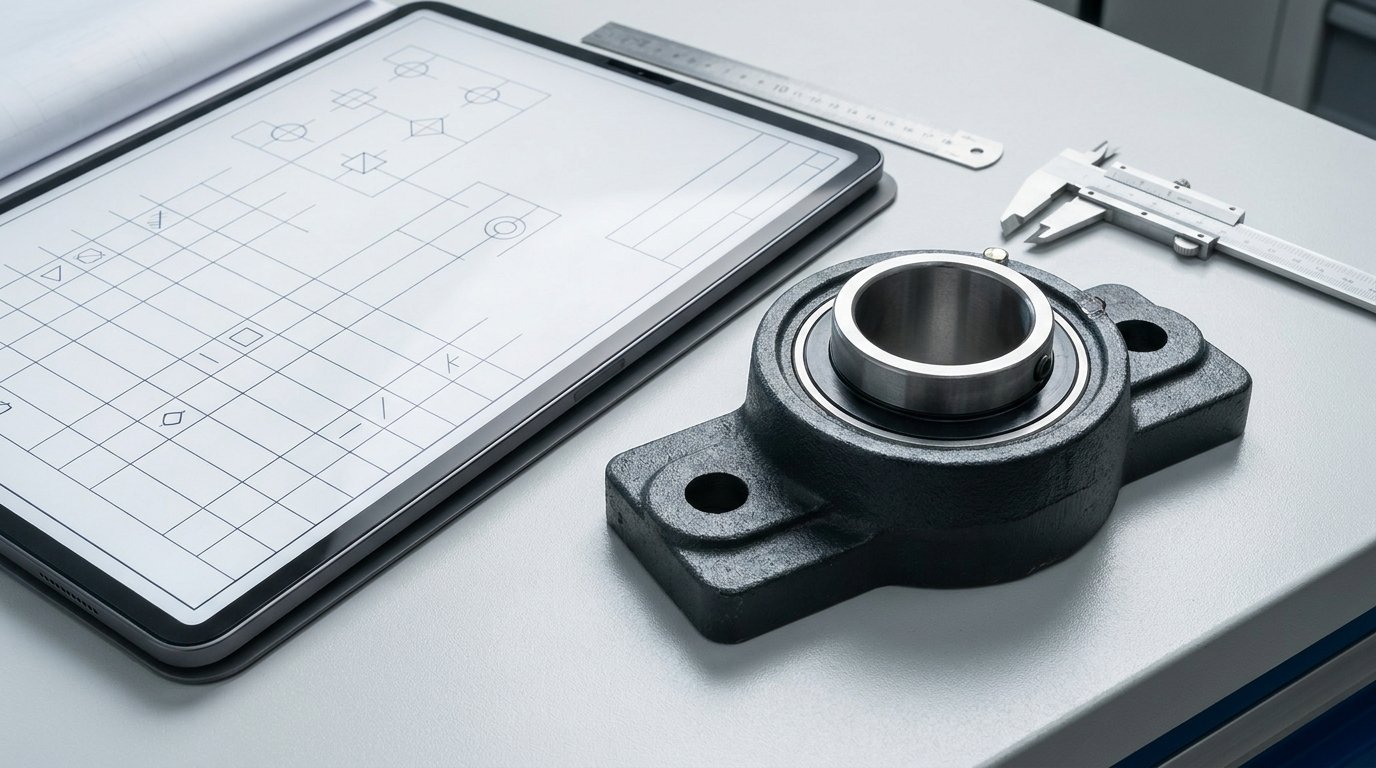
If you share your shaft diameter and two measurements (bolt spacing and center height), Haron Bearing can help you cross-reference the right mounted unit quickly and accurately.