
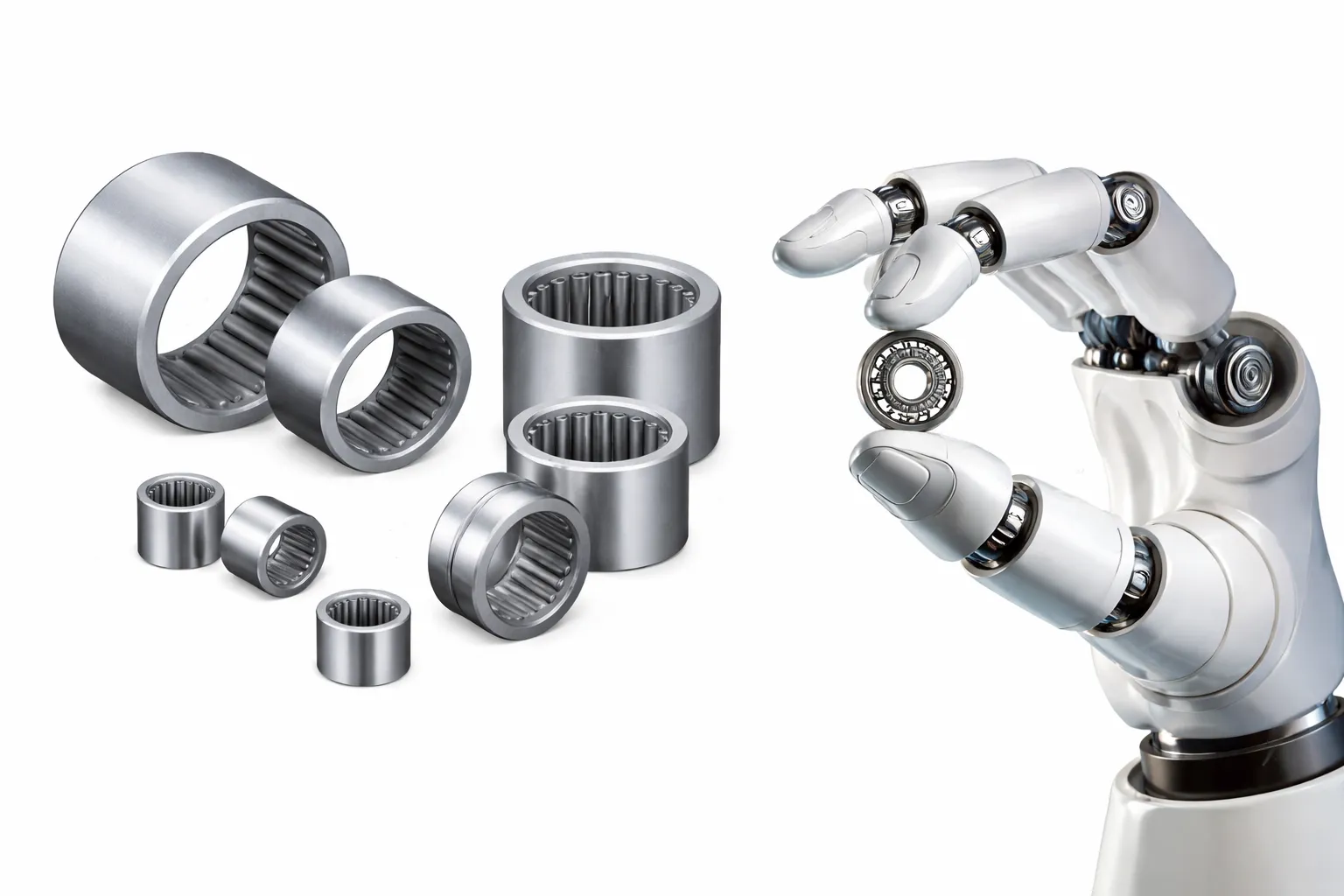
Torque density in robotics is often limited by how much load you can support inside a tight joint envelope. Needle roller bearings in robotics address this by using long, thin rollers that deliver high radial load capacity with minimal cross-section. The result is more compact actuators, thinner joints, and better packaging without sacrificing stiffness and life.
Video Guide: This overview explains what needle roller bearings are and why their geometry enables high load capacity in compact designs.
What is needle roller bearings in robotics?
Needle roller bearings in robotics are compact rolling-element bearings that use slender cylindrical rollers to carry high radial loads in tight spaces, commonly inside robotic joints, gearboxes, and end-effectors. They help increase torque density by reducing bearing envelope size while maintaining stiffness, accuracy, and durability under repetitive motion.

Where they fit in a robot joint
Needle bearings are typically selected when the design is constrained radially (small joint diameter) but must carry meaningful radial loads from gears, belts, or eccentric forces.
- Common robotics placements:
- Harmonic/planetary gearbox supports (input/output shafts)
- Joint modules where thin bearing cross-sections are required
- Idlers, cam followers, and compact linkages
- End-effector pivots with high side loads
Haron Bearing Pro Tip: I always start by mapping the dominant load direction (radial vs. axial). Needle rollers excel at radial load in minimal space—but if your joint sees significant axial load, plan a dedicated thrust solution instead of “hoping the needles handle it.”
How Does needle roller bearings in robotics Work?
Needle roller bearings in robotics work by replacing balls with long, small-diameter rollers that create a larger contact line with the raceway. This line contact spreads radial load over more area, reducing stress per unit area and allowing higher capacity in a thinner cross-section—ideal for compact joints that must still deliver high torque.

Load transfer and motion mechanics
A needle bearing supports a shaft by rolling contact between the needle rollers and raceways, minimizing sliding friction while carrying radial forces.
- Radial load enters through the shaft or inner ring.
- Load is transmitted to multiple needle rollers.
- Rollers distribute force along a line contact on the outer race/housing.
- A cage (if present) spaces rollers to reduce friction and heat.
- Lubrication film prevents metal-to-metal contact and manages wear.
Haron Bearing Pro Tip: I treat the housing bore as a “raceway” only when the material hardness and finish are truly controlled—otherwise, use a bearing with an outer ring to avoid premature spalling and inconsistent torque in the joint.
What is the advantage of needle roller bearings?
Needle roller bearings in robotics are valued for high radial load capacity, high stiffness, and very small radial thickness, which directly supports higher torque density in compact joints. They also deliver low friction versus plain bushings at higher speeds and can improve positional repeatability when properly preloaded and lubricated.

Why they improve torque density
Torque density improves when you can shrink the joint while keeping load capacity and stiffness. Needle bearings help by freeing radial space for larger gears, stronger shafts, or higher-torque motors.
- Key advantages in robotic applications:
- High radial load capacity in limited radial space
- High stiffness supporting better gearbox meshing and accuracy
- Suitable for oscillating motion common in robot joints
- Lower friction than many sliding bearings at moderate speeds
- Multiple configurations (caged, full complement, drawn cup) for packaging
Haron Bearing Pro Tip: I use needle bearings to “buy back” radial space, then reinvest it where torque is made—bigger pitch diameter gears, thicker output shafts, or improved seals. That’s how the bearing choice translates into real torque density gains.
What are the disadvantages of needle bearings?
Needle bearings trade compactness for stricter requirements on alignment, lubrication, and raceway quality. They are primarily radial-load bearings, so axial loads require separate thrust elements. In robotics, they can be sensitive to housing distortion and shaft finish; poor lubrication or contamination can quickly raise torque and wear.
Practical limitations to account for
Needle bearings can fail early or cause torque ripple if the surrounding design doesn’t support them.
- Typical disadvantages:
- Limited axial load capability (needs thrust bearing/washer)
- Sensitive to misalignment and shaft/housing deflection
- Raceway hardness/finish requirements can increase machining cost
- Contamination sensitivity (small clearances, line contact)
- Full-complement designs can have higher friction and heat at speed
Haron Bearing Pro Tip: I never sign off a needle-bearing joint until we’ve reviewed housing stiffness and seal strategy. A slightly oval bore or marginal sealing can turn a “high torque density” design into a high-friction, short-life joint.
When to use needle roller bearings?
Use needle roller bearings in robotics when radial space is constrained but radial loads and stiffness requirements are high—such as compact joint modules, gearbox supports, and high side-load pivots. They are especially useful when torque density matters and you need thin bearings without sacrificing load capacity, provided lubrication and alignment can be controlled.
Selection checklist for robotics
Use needle bearings when most of the answers below are “yes”:
- Is radial packaging space tight (thin joint wall, compact gearbox)?
- Is radial load significant (gear mesh forces, belt tension, eccentric loads)?
- Do you need higher stiffness for accuracy/repeatability?
- Can you control shaft/housing hardness and surface finish?
- Can you ensure reliable lubrication (grease/oil) and sealing?
- Is axial load handled elsewhere (thrust bearing, angular contact pair, etc.)?
Haron Bearing Pro Tip: I recommend needle bearings when the joint architecture is already “stiff-first” (rigid housing, controlled fits). If the structure is flexible, you’ll spend more time chasing noise, torque ripple, and wear than you save in package size.
Key Features & Comparison
Needle roller bearings in robotics stand out for delivering high radial capacity and stiffness in a thin cross-section, enabling compact joints and improved torque density. The right variant depends on speed, lubrication method, raceway quality, and whether the housing can serve as a raceway. Comparing bearing types clarifies where needle rollers outperform—and where alternatives win.
Robotics-focused bearing comparison
Based on our internal data and market analysis, here is the breakdown:
| Bearing Type | Radial Load Capacity (per envelope) | Axial Load Capacity | Stiffness | Speed Capability | Packaging Efficiency (thin radial section) | Typical Robotics Use |
|---|---|---|---|---|---|---|
| Needle Roller (caged) | High | Low (needs thrust) | High | Medium-High | Excellent | Joint modules, gearbox shaft support |
| Needle Roller (full complement) | Very High | Low (needs thrust) | Very High | Medium | Excellent | High-load compact supports, oscillating motion |
| Deep Groove Ball | Medium | Low-Medium | Medium | High | Good | Motor bearings, general supports |
| Angular Contact Ball | Medium | High (one direction) | Medium-High | High | Moderate | Preloaded precision joints, combined loads |
| Cylindrical Roller | Very High | Low | Very High | Medium-High | Moderate | Rigid gear supports (more space available) |
| Plain Bushing | Medium (material-dependent) | Medium (design-dependent) | Medium | Low-Medium | Excellent | Low-speed pivots, cost-sensitive joints |
Haron Bearing Pro Tip: I choose caged needle bearings when speed and efficiency matter, and full-complement when capacity and stiffness dominate. In both cases, I validate with a friction/temperature estimate because torque rise can erase the benefits of compactness.
Cost & Buying Factors
The cost of needle roller bearings in robotics is driven by bearing style (drawn cup vs. machined ring), roller complement, precision class, and whether an inner ring is required. Total cost also includes machining/heat-treat needs for raceways, lubrication hardware, and sealing. Buying decisions should prioritize life, torque consistency, and manufacturability—not unit price alone.
What most affects price and total installed cost
- Bearing configuration:
- Drawn cup: compact and often economical, but demands good housing control
- Machined ring: more robust, typically higher unit cost, easier to integrate reliably
- With inner ring: higher cost, but reduces shaft hardening/grinding requirements
- Precision and noise/torque requirements:
- Tighter tolerances cost more but help repeatability and torque stability
- Materials and coatings:
- Corrosion resistance, special steels, or surface treatments can raise cost
- Supply chain and quality documentation:
- Traceability, PPAP/FAI, and consistent lot quality matter in robotics production
Haron Bearing Pro Tip: I advise customers to quote the bearing and the “raceway plan” together. If you save $2 on the bearing but add grinding, hardening, and rework risk to the shaft/housing, your joint cost and lead time usually go up—not down.
Conclusion
Needle roller bearings in robotics are a direct enabler of torque density because they deliver high radial load capacity and stiffness in an exceptionally thin package. When paired with the right raceway strategy, lubrication, and sealing, they improve joint compactness and repeatability without sacrificing durability.
If you’re sizing a compact joint or gearbox support and want a reliable selection path, Haron Bearing can help you match bearing type, fits, and lubrication to your robot’s duty cycle and torque targets.