
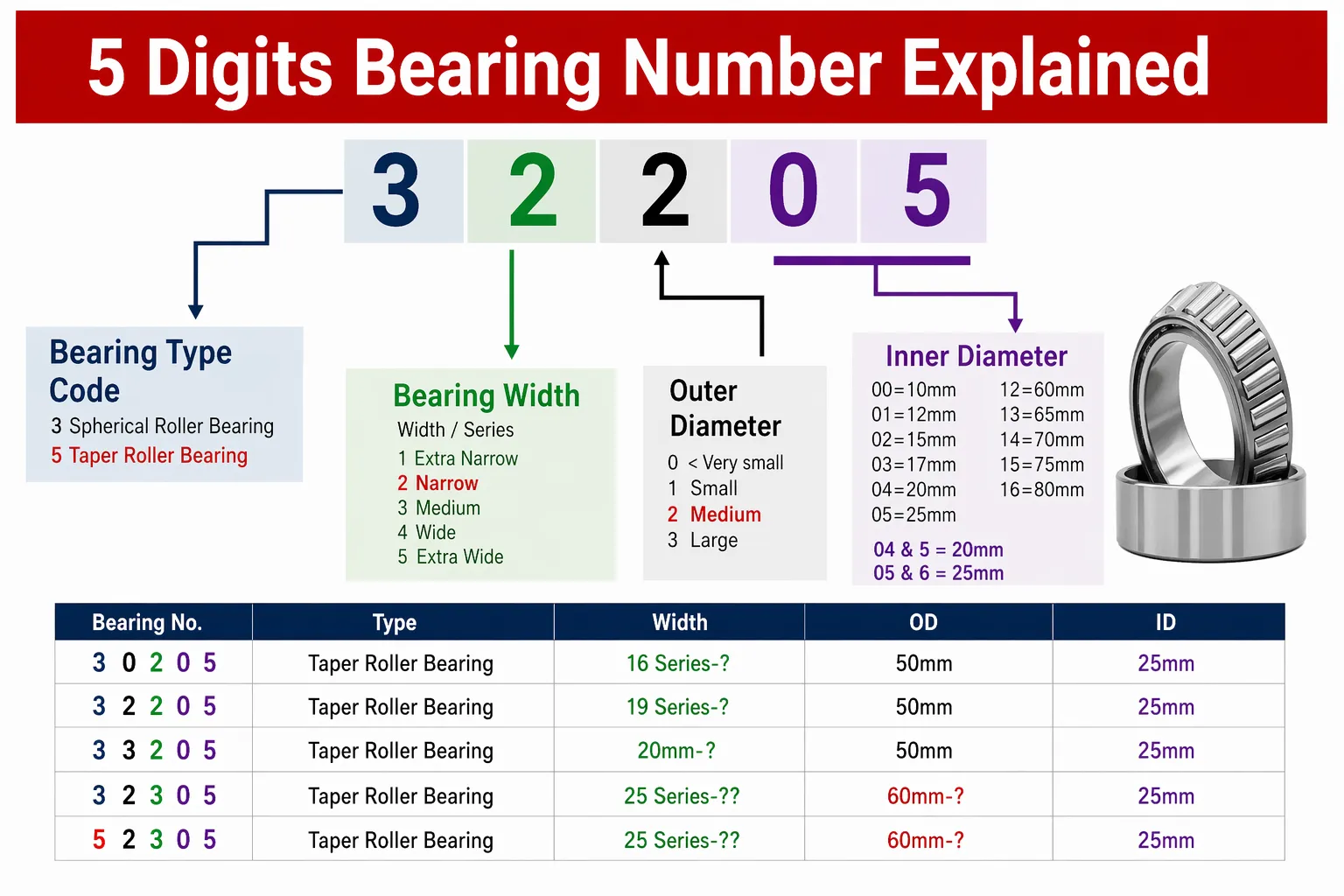
Bearing numbers and bearing model codes are the fastest way to confirm bearing type, dimensions, internal design, accuracy, and mounting details—without guessing or measuring. Once you know how the bearing numbering system is structured (basic designation + prefixes/suffixes), you can match replacements correctly, avoid costly misfits, and standardize purchasing across brands and factories with confidence.
Video Guide: This overview introduces common bearing types and explains how numbering systems are generally organized across industrial bearings.
How do you read bearing numbers and model codes?
Bearing numbers (bearing designation) are standardized codes that describe a bearing’s type, size series, bore (ID), and often design details via prefixes and suffixes. The bearing model code helps you identify the exact part for interchange, ordering, and troubleshooting—turning a short code into clear information about dimensions, construction, and application limits.
Video Guide: This video explains what bearing designation numbers represent and how to interpret the key parts of a typical code.
What a bearing designation typically contains (and why it matters)
A complete bearing identification guide usually includes three layers: a basic designation (series + bore), plus optional prefixes (special bearing type or variant) and suffixes (internal design, sealing, clearance, tolerance, cage, lubrication, etc.). While exact syntax varies by manufacturer, the logic is consistent enough to decode most industrial bearing code chart listings.
Key elements you’ll see in bearing part number explanation work:
- Bearing type / series (e.g., deep groove ball, angular contact, tapered roller; dimensional series such as 62, 63, 72, etc.)
- Bore code (commonly maps to the bearing’s ID; many metric series use a 2-digit bore code rule)
- Prefixes (less common; can indicate special designs or assemblies)
- Suffixes (very common; specify execution details like seals, clearance, cage, accuracy, stabilization)
Common bore code pattern used in many metric deep-groove ball bearings (brand-specific exceptions exist):
- Identify the last 2 digits (the bore code).
- If bore code is 04 and above, the bore is often bore code × 5 mm (e.g., 05 → 25 mm, 08 → 40 mm).
- Special small bores often use fixed mapping: 00=10 mm, 01=12 mm, 02=15 mm, 03=17 mm.
- Confirm OD/width by checking the series (e.g., 62 vs 63) in a catalog table.
Haron Bearing Pro Tip: When cross-referencing brands, decode the basic designation first (type + series + bore), then validate suffix meanings in that specific manufacturer’s legend—suffixes are where interchange mistakes happen most.
How do bearing numbers and model codes work?
A bearing designation system works by encoding “what it is” (bearing type/series) and “what size it is” (bore code), then refining “how it’s built” (seals, clearance, cage, tolerance, lubrication) through suffixes/prefixes. You decode it left-to-right (or core-to-ends) to confirm the bearing dimensions by number and the exact execution needed.
Video Guide: This walkthrough demonstrates how to identify a bearing by reading the designation and mapping it to size and design features.
A practical decoding workflow you can use on any bearing code
Use this repeatable process to turn bearing numbers into a verified spec:
- Copy the full code exactly (include dashes, spaces, and all suffixes like “2RS”, “C3”, “ZZ”).
- Find the basic designation core (usually the largest numeric block, e.g., 6205, 6310, 7212).
- Identify bearing type/series from the first digits (catalog family).
- Decode the bore (ID) using the bore code rule (often last two digits).
- Determine OD and width from the dimensional series table (the same bore can have different OD/width across series).
- Interpret suffixes/prefixes (sealing, clearance, cage, accuracy, heat stabilization, matched sets).
- Confirm application fit: load rating, speed, temperature, contamination, and mounting arrangement.
Typical suffix themes you’ll encounter (examples vary by brand):
- Seals/shields: 2RS (two rubber seals), ZZ/2Z (two metal shields)
- Internal clearance: C3 (greater than normal), C4 (even greater)
- Cage/material: TN9 (polyamide cage in some systems), M (brass cage)
- Tolerance/precision: P6, P5, ABEC classes (system-specific)
Haron Bearing Pro Tip: If the code is partially worn off, measure the bore (ID) and OD, then infer the likely series from OD/width proportions—use the suffixes only after the base size is confirmed.
What are the benefits of understanding bearing numbers?
Reading bearing model codes correctly reduces replacement errors, shortens downtime, and improves reliability by ensuring the right internal clearance, sealing, and precision class—not just the right size. It also standardizes procurement, makes cross-brand equivalents easier to validate, and helps maintenance teams spot performance risks (speed, heat, contamination) from suffix information alone.
Video Guide: This video explains how to read and identify bearing numbers and highlights what different parts of the designation indicate.
Operational and purchasing advantages (where the savings come from)
Correct bearing identification isn’t only about matching dimensions; it ensures the bearing’s execution matches the environment and duty cycle. Key benefits include:
- Fewer wrong-part installs: Avoids “same size, wrong clearance/seal/cage” failures.
- Faster spares management: Codes enable clean ERP naming and storeroom bin control.
- Better root-cause analysis: Suffixes reveal whether the bearing was intended for heat, high speed, contamination, etc.
- Easier cross-referencing: You can map equivalent options (with verified suffix parity) instead of guessing.
- Improved reliability planning: Selecting proper clearance and sealing reduces overheating, grease purge issues, and ingress wear.
Typical problems prevented by decoding suffixes correctly:
- Overheating from using normal clearance instead of C3 in hot running fits.
- Contamination failures from using open bearings instead of sealed/shielded variants.
- Premature wear from an unsuitable cage at speed/temperature.
Haron Bearing Pro Tip: The “right bearing” is often decided by one or two suffix characters—when reliability matters, treat suffix matching as mandatory, not optional.
How do you manage and maintain bearing numbering systems?
Maintain bearing identification accuracy by standardizing how you record and verify bearing numbers: capture the full designation, confirm dimensions from the core code, and document all suffixes (seals, clearance, tolerance). In practice, good “code maintenance” pairs with physical bearing maintenance—proper handling, lubrication discipline, contamination control, and condition monitoring.
Video Guide: This first-part guide focuses on bearing number codes and helps you avoid common misreads when documenting or selecting replacements.
Maintenance checklist for both the bearing and its designation record
A strong program prevents two failure modes: mechanical failure and administrative misidentification. Use this checklist:
- Create a master naming standard (e.g., always store as “BasicDesignation + Suffixes”, no abbreviations).
- Photograph the box label and laser marking at receiving; attach to your CMMS/ERP item.
- Verify dimensions from a catalog for every new SKU (ID/OD/width), especially for first-time buys.
- Control suffix selection by application rules:
- Dust/washdown → prefer sealed options where appropriate.
- Hot running fits/high temperature → evaluate clearance (often C3/C4).
- High speed → verify cage type and lubrication strategy.
- Handling and installation: keep bearings packaged until use; prevent brinelling and contamination.
- Lubrication discipline: correct grease type, quantity, and relube interval; avoid mixing incompatible greases.
- Condition monitoring: vibration/temperature trending; tag readings to the exact model code for better comparisons.
Haron Bearing Pro Tip: I recommend printing the decoded fields (type, ID/OD/width, sealing, clearance, cage) on the storeroom bin label—technicians stop relying on memory and mistakes drop immediately.
What is the cost of a bearing numbering system?
The “price” isn’t for the numbering system itself, but the bearing defined by its code. Cost varies mainly by bearing type/series (load capacity), size (bore/OD/width), brand, and suffixes like seals, higher precision, or special cages. For the same size, upgraded suffix options can change price meaningfully.
Video Guide: This video explains bearing designation reading, which helps you understand why suffix differences often drive pricing differences.
What drives bearing price changes when the basic size looks “the same”
Two bearings can share the same core dimensions yet differ in execution and cost. The largest pricing drivers:
- Type and load design: tapered roller and spherical roller typically cost more than deep groove ball for comparable sizes.
- Dimensional series: heavier series (e.g., 63 vs 62 with same bore) usually costs more.
- Sealing: 2RS/low-friction seals, contact seals, or special seal materials add cost.
- Precision/tolerance: higher precision classes generally increase cost.
- Internal clearance: special clearance selections can add cost (and lead time).
- Cage and heat stabilization: brass cages, high-temp stabilization, or special materials raise price.
- Supply chain factors: steel costs, origin, certifications, and MOQ all influence final pricing.
Quick purchasing checklist to quote accurately:
- Provide full designation including all suffixes.
- Provide application details (speed, temperature, contamination, load) to validate suffix choice.
- Ask for equivalent alternatives only after confirming suffix parity.
Haron Bearing Pro Tip: When comparing quotes, I always force a “designation match” line-by-line—most low quotes come from dropping a suffix (like 2RS or C3) that you actually need.
Key Features & Comparison
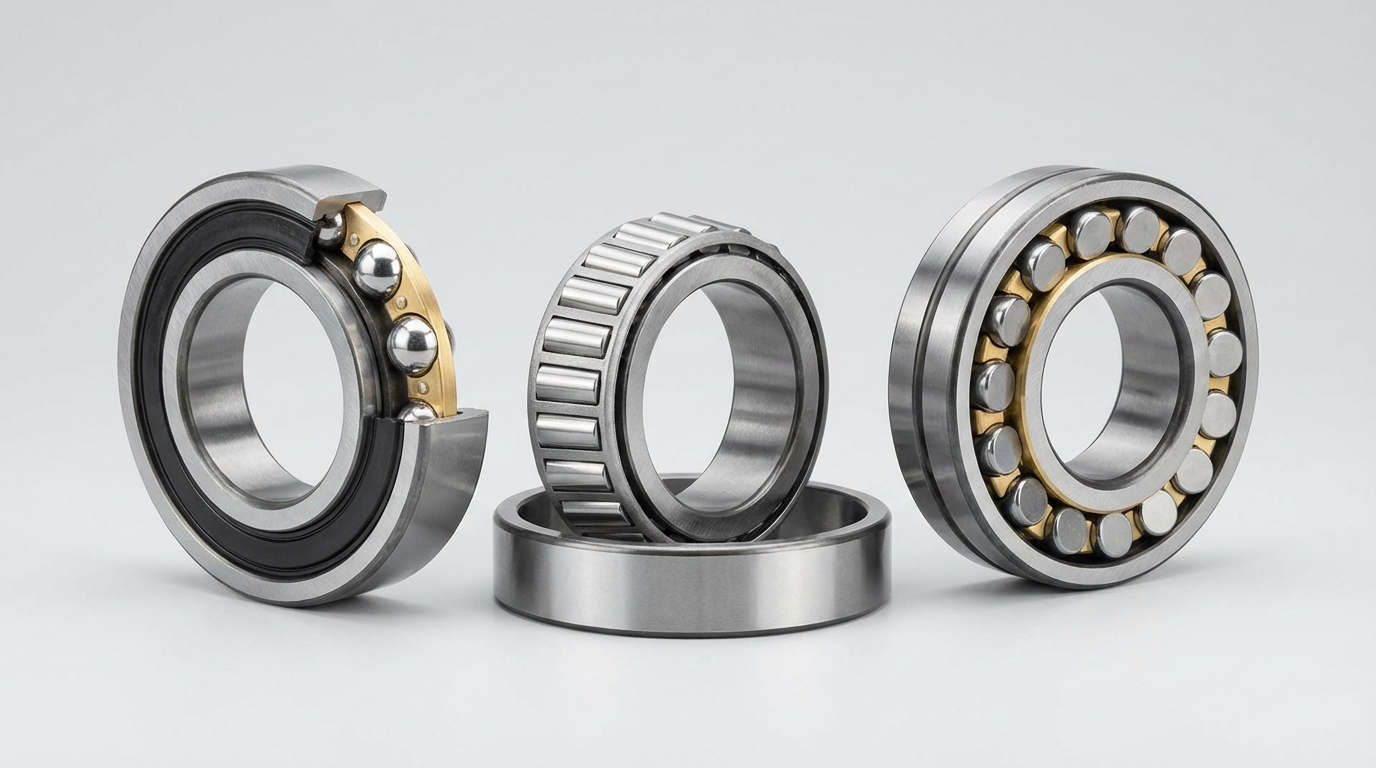
Based on our internal data and market analysis, the breakdown below shows how bearing designation elements map to real-world selection decisions and common code patterns, helping you interpret bearing series numbers, bore codes, and suffix/prefix details quickly. Use it as an industrial bearing code chart to reduce misorders and standardize cross-references.
Based on our internal data and market analysis, here is the breakdown:
| Designation Element | What It Usually Indicates | Why It Matters in Service | Common Examples (May Vary by Brand) | Typical Risk if Misread |
|—|—|—|—|—|
| Basic series (e.g., 62/63/72) | Bearing family + dimensional series | Determines OD/width and load capacity trend | 6205, 6305, 7205 | Wrong OD/width or load capacity |
| Bore code (last digits) | Bearing ID (often via code-to-mm rule) | Ensures correct shaft fit | 05→25 mm, 08→40 mm; 00=10 mm | Wrong shaft fit, creep, heat |
| Prefix | Variant, assembly, or special design | Identifies non-standard configurations | Manufacturer-specific | Ordering incompatible design |
| Seal/Shield suffix | Sealing execution | Controls contamination and grease retention | 2RS, ZZ/2Z | Early failure in dirty/wet zones |
| Clearance suffix | Internal clearance | Affects heat, preload, and life | C3, C4 | Overheating or excessive play |
| Tolerance/precision suffix | Accuracy class | Impacts runout, noise, spindle performance | P6, P5 | Vibration, poor accuracy |
| Cage suffix | Cage type/material | Influences speed and temperature capability | TN9, M | Cage failure or speed limit issues |
| Special features suffix | Stabilization, noise, grease fill, matched sets | Tailors bearing to duty cycle | “S1”, “VT”, matched pair marks | Unstable operation or poor life |
Cost & Buying Factors
Pricing is primarily determined by bearing type, size series, and suffix requirements (seals, clearance, precision, cage), plus availability and certification needs. For controlled buying, standardize the way you specify codes, confirm equivalency rules across brands, and decide which suffixes are mandatory by application rather than preference or habit.
Video Guide: This video shows how to identify bearings by designation, which supports cleaner RFQs and more accurate cross-brand comparisons during purchasing.
A practical buying guide for consistent, comparable quotes
Use these steps to control total cost (not just unit price):
- Define the operating conditions (speed, load, temperature, contamination, lubrication method).
- Lock the non-negotiables (e.g., 2RS vs open, C3 vs CN, precision class).
- Request a complete cross-reference that lists:
- Basic designation match (type/series/bore)
- OD/width confirmation
- Suffix mapping and any deviations
- Compare lead time and MOQ alongside price; special suffixes can add weeks.
- Validate supplier quality signals (traceability, inspection reports, packaging authenticity, warranty terms).
- Total-cost check: consider downtime risk, relube interval changes, and failure history per location.
Haron Bearing Pro Tip: I treat “open vs sealed” and “CN vs C3” as application-engineering decisions—if a supplier can’t justify a suffix change with operating conditions, I don’t approve the substitution.
Conclusion
Accurately reading bearing numbers and bearing model codes turns a short designation into verified bearing type, dimensions, and execution details—so you can replace parts correctly, prevent repeat failures, and buy consistently across suppliers. If you want a faster cross-reference process or help standardizing suffix rules, Haron Bearing can support selection, equivalency checks, and documentation for your maintenance and purchasing teams.