
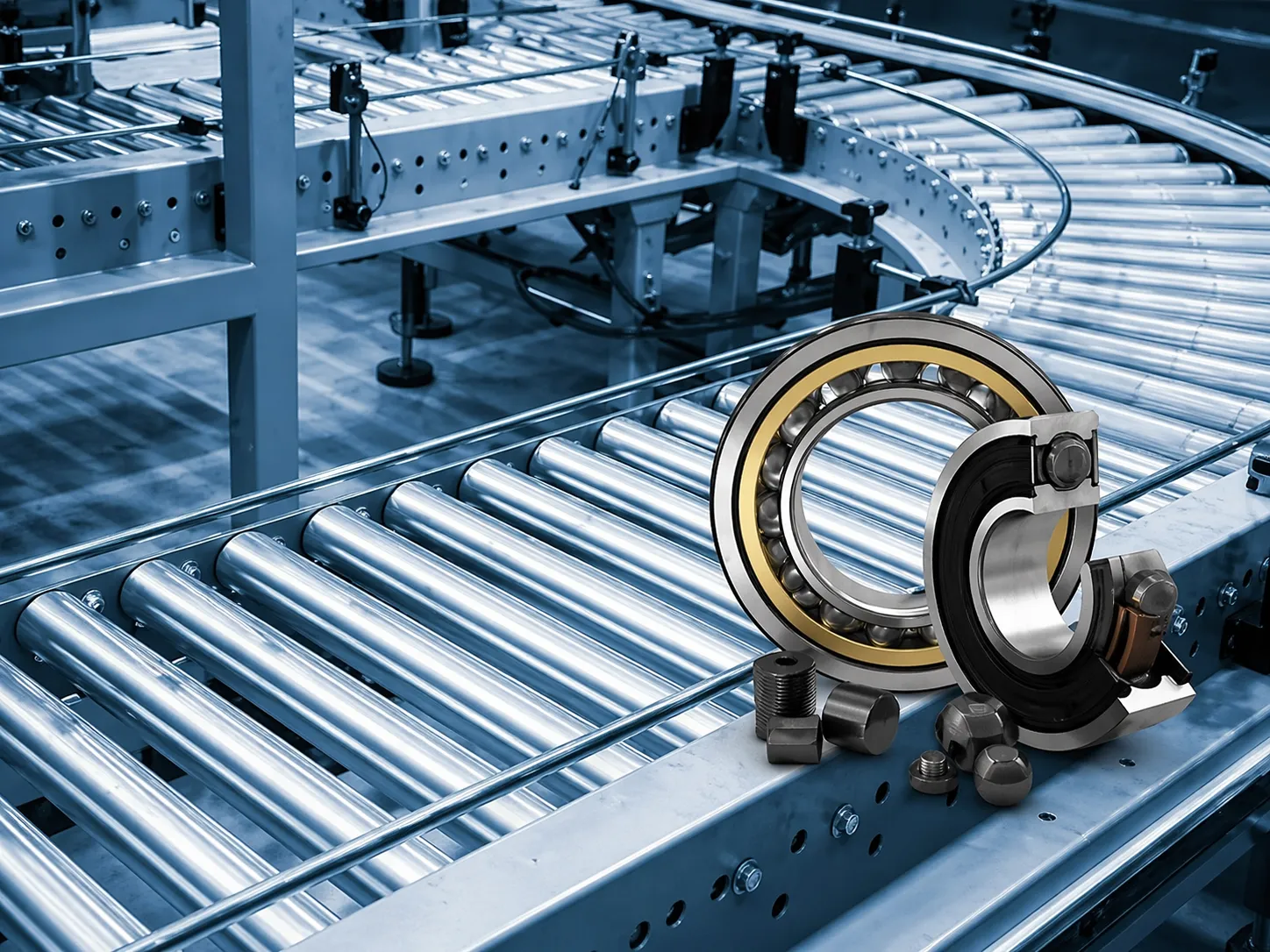
Selecting the right conveyor bearings is one of the fastest ways to improve uptime, reduce energy loss, and extend roller and idler life in warehouse and industrial lines. The best choice balances load direction, speed, contamination, washdown needs, mounting accuracy, and maintenance intervals. Below is a practical framework used for bearings for conveyor systems and bearing for material handling equipment, aligned with real-world failure modes.
Video Guide: This 8-step method is a solid general checklist you can map to industrial roller bearings used in conveyors.
What is conveyor bearings bearings for conveyor systems material handling bearings roller conveyor bearings industrial conveyor bearing selection heavy duty conveyor bearings bearings for rollers warehouse conveyor bearings conveyor idler bearings bearing for material handling equipment industrial roller bearings conveyor bearing maintenance?
Conveyor bearings are rolling-element bearings (ball or roller) used in rollers, idlers, pulleys, and drives to support radial and/or axial loads while minimizing friction. In material handling bearings, sealing, lubrication, and misalignment tolerance are often as important as load rating due to dust, washdown, shock loading, and long duty cycles.

Where they sit in a conveyor and what they actually do
Conveyor bearings typically appear in three places: roller ends (roller conveyor bearings), idler assemblies (conveyor idler bearings), and drive/drum supports. Their job is to keep rotation stable, reduce heat, and maintain alignment so the belt/rollers track correctly.
Key sub-types you’ll see in industrial conveyor bearing selection:
- Deep groove ball bearings (e.g., 62xx series): common for bearings for rollers at moderate loads/speeds.
- Spherical roller bearings: preferred for heavy duty conveyor bearings and misalignment.
- Tapered roller bearings: handle combined radial + axial loads (e.g., pulleys, certain drives).
- Mounted units (pillow block/flange): easier installation; sealing options vary.
Typical spec fields that matter most:
- Bore/OD/width and fit class
- Dynamic/static load rating (C/C0)
- Speed capability and temperature
- Internal clearance (e.g., C3)
- Seal type (ZZ, 2RS, contact/non-contact, labyrinth)
- Lubrication type (grease type, relube interval, or sealed-for-life)
Haron Bearing Pro Tip: I treat sealing as a “load multiplier” in dirty conveyors—upgrade from basic shields to proper contact seals/labyrinth and you often prevent the real killer: contamination-driven grease failure long before load rating is reached.
How Does conveyor bearings bearings for conveyor systems material handling bearings roller conveyor bearings industrial conveyor bearing selection heavy duty conveyor bearings bearings for rollers warehouse conveyor bearings conveyor idler bearings bearing for material handling equipment industrial roller bearings conveyor bearing maintenance Work?
Conveyor bearings work by rolling (not sliding) between inner and outer rings, using balls or rollers to carry load while a grease film limits metal-to-metal contact. In conveyors, the bearing must also resist contamination, tolerate some misalignment, and stay lubricated over long intervals to prevent heat buildup, vibration, and premature spalling.
Video Guide: This explains how different bearing types carry load, which helps match roller conveyor bearings to radial vs combined loading.
Load paths, lubrication film, and why conveyors fail differently
In a typical roller, the inner ring is fixed to the shaft and the outer ring rotates with the roller (or vice versa). The rolling elements distribute load through contact zones. Two realities make material handling bearings unique:
- Contamination ingress (dust, fibers, water) breaks down grease, causing wear and corrosion.
- Misalignment and shaft deflection create edge loading, increasing stress dramatically.
Common failure modes (and what they usually mean):
- Overheating early in life: wrong clearance, overtight fits, over-greasing, seal drag.
- Rust or pitting: moisture ingress, washdown without correct sealing/grease.
- Spalling/flaking: fatigue from overload, misalignment, or vibration.
- Noise and cage damage: high speed, poor lubrication, contamination.
Haron Bearing Pro Tip: If your conveyor bearing maintenance shows repeating failures on the same roller position, I first check alignment and housing squareness—fixing geometry often doubles life even with the same bearing.
How to determine what bearing to use?
Determine the bearing by confirming dimensions and fits, then calculating loads (radial/axial), speed, and duty cycle, and finally selecting sealing and lubrication for the environment. For industrial conveyor bearing selection, prioritize contamination resistance and misalignment tolerance, then validate life (L10) and maintenance capability before finalizing the bearing series and seal type.
A selection checklist that works on real conveyors
Use this stepwise process to choose warehouse conveyor bearings and heavy duty conveyor bearings correctly:
- Identify the location: roller end, idler, pulley, drive shaft, take-up, etc.
- Lock the envelope: bore, OD, width, shoulder height, housing constraints.
- Define loads:
- Radial load (belt tension + material weight + roller/shaft weight)
- Axial load (mis-tracking forces, helical drives, pulley thrust)
- Shock loads (impacts, start/stop, jam conditions)
- Define speed & temperature: rpm range, ambient + heat sources.
- Assess misalignment: shaft deflection, frame flex, mounting tolerances.
- Choose bearing type:
- Deep groove ball for general rollers
- Spherical roller for misalignment/heavy loads
- Tapered roller for combined loads
- Choose sealing & lubrication: 2RS vs labyrinth vs bearing isolators; grease type and relube interval.
- Verify life & safety factor: check L10 life, static safety (C0), and creep risk.
- Confirm installation: fits, locking method, torque, lubrication procedure.
Haron Bearing Pro Tip: I never pick a bearing “by size only” for conveyors—two bearings with the same dimensions can behave very differently once you account for seal drag, clearance, and grease suited for your temperature and washdown routine.
What is the 2 1 bearing rule?
The “2:1 bearing rule” is a guideline for paired bearings: the spacing between two bearings should be at least about twice the shaft diameter (or, in many designs, aim for a wide-enough span that reduces bending and improves stability). In conveyor shafts, more span generally lowers bearing loads and reduces misalignment sensitivity.

When the rule helps—and when it doesn’t
This guideline is most useful for short conveyor shafts supporting pulleys or drive components where shaft bending can dominate bearing life.
Practical design implications:
- Wider bearing spacing reduces shaft deflection at each bearing and lowers edge loading.
- Better stability improves belt tracking and reduces vibration.
- But too wide spacing can increase housing alignment error sensitivity and complicate sealing.
A quick applicability check:
- Use it when you have two bearings supporting one shaft (e.g., pulley/drum).
- It’s less relevant for individual roller conveyor bearings that are self-contained at each roller end.
- If alignment cannot be controlled, consider self-aligning solutions (e.g., spherical roller bearings or self-aligning ball bearings in appropriate housings).
Haron Bearing Pro Tip: I use the 2:1 rule as a first pass, then validate with shaft deflection—if deflection pushes misalignment beyond what a deep groove ball bearing likes, I switch to a bearing/housing that tolerates misalignment rather than forcing perfect machining.
What is the difference between 6203 and 6204 bearings?
6203 and 6204 are both deep groove ball bearings in the 62 series, but they differ in size and load capacity: 6204 is larger (20 mm bore) than 6203 (17 mm bore), so it typically carries higher loads and can offer longer life—if the shaft and housing allow the larger OD/width.
Video Guide: This explains bearing numbering basics, useful for decoding 6203 vs 6204 and selecting bearings for rollers.
Size, capacity, and what changes in a conveyor roller
Key dimensional differences (typical ISO values):
| Bearing | Bore (d) | OD (D) | Width (B) | Practical impact in conveyors |
|---|---|---|---|---|
| 6203 | 17 mm | 40 mm | 12 mm | Common in lighter rollers; smaller shafts and housings |
| 6204 | 20 mm | 47 mm | 14 mm | Higher capacity; better for heavier loads or longer life targets |
Selection notes for roller conveyor bearings:
- If you upsize from 6203 to 6204, you must confirm shaft diameter, housing bore, and shoulder/retention.
- Seal variants matter as much as size (e.g., 6204-2RS vs 6204-ZZ) for dusty warehouse conveyor bearings.
- If your issue is contamination, upsizing alone may not solve it—improved sealing and grease often will.
Haron Bearing Pro Tip: When a 6203 keeps failing in the same application, I don’t automatically jump to 6204—I first check if the failure is fatigue (load-driven) or contamination (seal/grease-driven). The fix is different, and contamination is more common in conveyors.
Key Features & Comparison

Conveyor bearings should be compared by load handling, misalignment tolerance, sealing effectiveness, speed capability, and maintenance approach. For most bearings for conveyor systems, the best “value” is the bearing that survives the environment with minimal intervention—not the one with the highest catalog load rating.
Feature-by-feature comparison for conveyor duty
Based on our internal data and market analysis, here is the breakdown:
| Bearing/Unit Type | Best for | Misalignment tolerance | Sealing options | Maintenance style | Typical conveyor use |
|---|---|---|---|---|---|
| Deep groove ball (62 series) | General rollers, moderate loads | Low | ZZ / 2RS / custom seals | Sealed-for-life or periodic relube | Roller conveyor bearings, light-to-medium duty |
| Self-aligning ball | Light loads with misalignment | Medium | Limited vs heavy-duty units | Periodic relube | Light idlers, tolerant frames |
| Spherical roller | Heavy loads + misalignment | High | Strong (often with housings) | Relubrication common | Heavy duty conveyor bearings, harsh-duty idlers |
| Tapered roller | Combined radial + axial loads | Low-Medium | Depends on arrangement | Relube + preload/endplay control | Pulleys, drives, thrust conditions |
| Mounted ball bearing unit (UC/insert) | Fast installation | Low-Medium | Common seals, some labyrinth | Relube depending on unit | Warehouse conveyor bearings, light industrial |
| Mounted spherical roller unit | Harsh environment, heavy loads | High | Excellent (labyrinth/isolators) | Relube | Conveyor idler bearings in mining/aggregate |
Haron Bearing Pro Tip: If you’re choosing between “better bearing” and “better sealing,” I usually spend on sealing first for material handling bearings—keeping contaminants out beats adding load rating that you may never actually use.
Cost & Buying Factors
Cost-effective industrial roller bearings selection comes from matching bearing type and sealing to the environment, then buying for total lifecycle cost (downtime, labor, spares), not unit price. In conveyors, the biggest cost drivers are sealing level, housing style, grease/lube system compatibility, and whether you need heavy duty conveyor bearings for shock and misalignment.
What most affects price—and what to specify on RFQs
Buying factors to include in your specification (and why they matter):
- Bearing type and series (deep groove vs spherical/tapered): drives base cost and capacity.
- Seal design (ZZ vs 2RS vs labyrinth/isolator): major lever for uptime in dusty/wet conveyors.
- Internal clearance (CN vs C3): affects heat and life under tight fits/temperature.
- Cage/material and heat treatment: relevant for speed, shock, and temperature.
- Lubrication:
- Sealed-for-life: lower maintenance, higher sensitivity to seal/grease choice
- Relubricatable: higher upkeep, better for harsh duty if maintained correctly
- Housing and mounting (insert units, pillow blocks, flanges): affects alignment tolerance and install time.
- Quality level and traceability: important for repeatability across many rollers.
A simple purchasing framework:
- Define environment (dust/water/washdown/chemicals).
- Define load & speed class (light warehouse vs heavy bulk).
- Choose sealing and lubrication strategy (sealed vs relube).
- Standardize part numbers where possible to reduce spares complexity.
- Qualify supplier support for failure analysis and consistency (e.g., Haron Bearing application support).
Haron Bearing Pro Tip: On RFQs, I always specify the exact seal type, clearance, and grease requirement—if you only list the bearing number, you can still receive multiple variants that look identical but behave very differently in conveyor bearing maintenance cycles.
Conclusion
Choosing conveyor bearings is ultimately a reliability decision: match load direction, speed, and mounting accuracy with the right bearing type, then prioritize sealing and lubrication for your operating environment. If you want help narrowing down roller conveyor bearings, conveyor idler bearings, or a bearing for material handling equipment, Haron Bearing can review your loads, speeds, contamination level, and target service interval to recommend a standard, repeatable solution.