
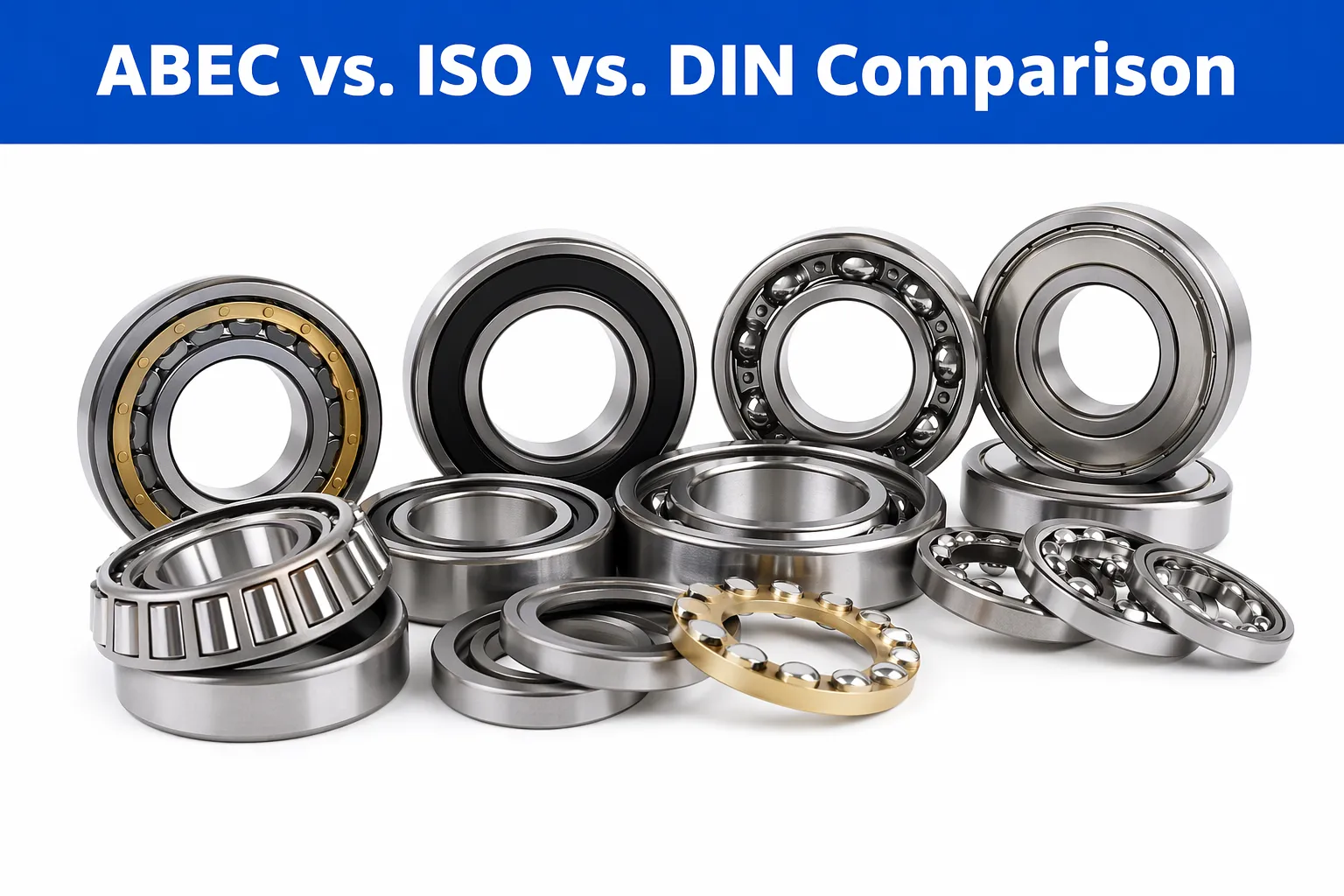
Bearing certifications and standards verify supplier quality, tolerances, and traceability. ISO 9001, IATF 16949, and AS9100 cover quality systems, while ABEC, JIS, and DIN define bearing tolerances and interchangeability.
Video Guide: This bearing designation overview helps you connect what’s on a bearing/box label to the standard, tolerance class, and configuration you’re trying to certify.
Bearing Manufacturer Certifications: What Standards Matter?
Bearing manufacturer certifications verify a supplier’s audited quality system (e.g., ISO 9001, IATF 16949, AS9100), while bearing standards (e.g., ABEC, JIS, DIN) define dimensional tolerances and interchangeability for specific bearing types. Together, they form bearing compliance standards used to qualify industrial bearing certification and reduce performance and warranty risk.
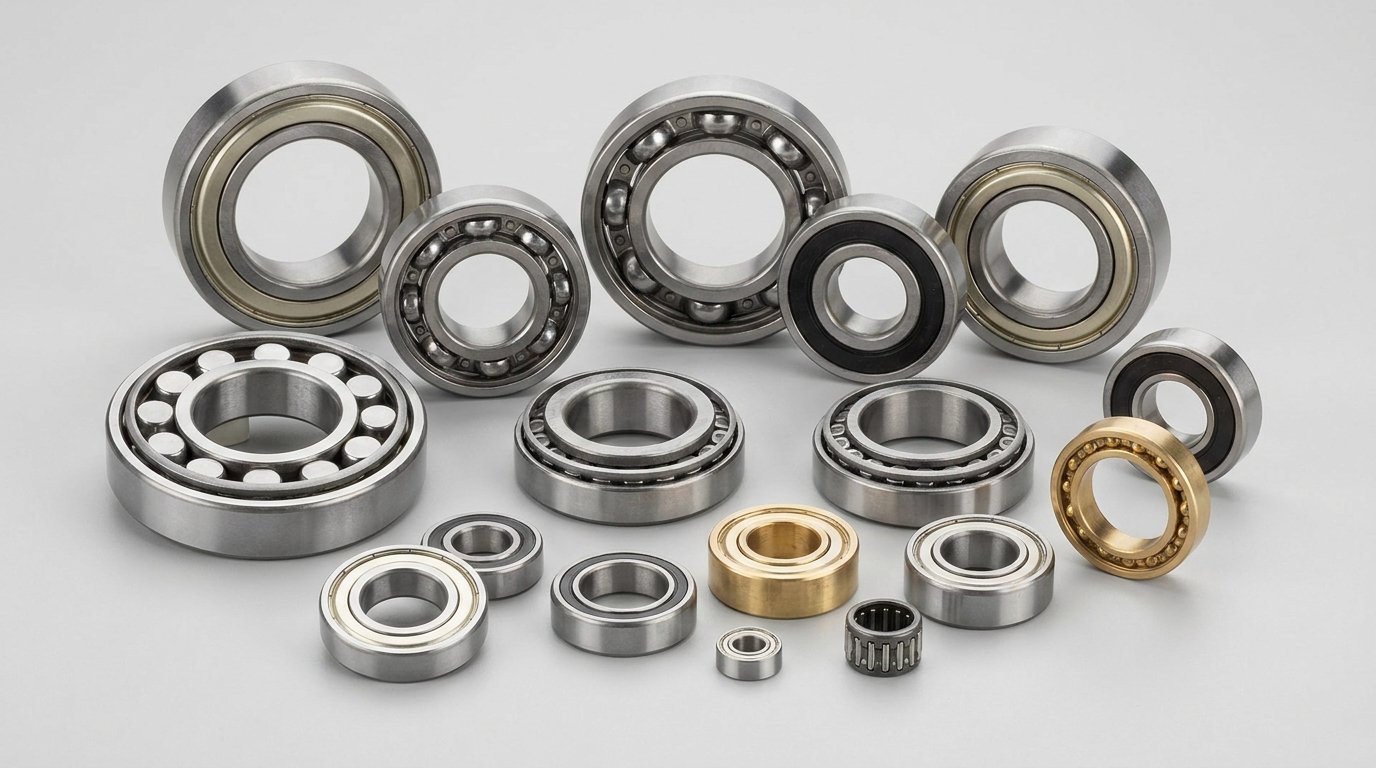
Certification vs. Standard: what each actually proves
A common sourcing mistake is treating “ABEC” like a factory certification. It is not. ABEC bearing standards (and comparable JIS bearing standards / DIN bearing standards) specify tolerance classes for certain rolling bearings, while ISO/IATF/AS9100 certify the management system used to design, produce, inspect, and trace product.
Key terms to keep straight:
- ISO bearing manufacturer certification (ISO 9001): Demonstrates a documented, audited quality management system (QMS), including corrective actions, calibration control, and process consistency.
- IATF 16949 bearings: Automotive-focused QMS requirements layered on ISO 9001, emphasizing APQP/PPAP, supplier development, risk prevention, and statistical controls.
- AS9100 bearings: Aerospace-focused QMS requirements emphasizing configuration management, risk management, product safety, counterfeit parts prevention, and enhanced traceability.
- ABEC bearing standards (ANSI/ABMA): Primarily dimensional tolerance classes for certain inch-series ball bearings; it does not define material quality, lubrication, noise, or life.
- JIS bearing standards / DIN bearing standards: National/regional standards that define dimensions, tolerances, and sometimes fits or verification methods for bearings used in those markets.
Practical verification steps used in bearing quality certification programs:
- Ask for current certificates (scope, issuing body, validity dates).
- Confirm scope includes bearing manufacturing (not only “trading” or “assembly”).
- Require inspection documentation (COC/COA, dimensional reports, gauge calibration evidence).
- Validate traceability (heat/lot, production batch, inspection records).
Haron Bearing Pro Tip: When auditing a certified bearing supplier, I always check the certificate scope first—if the scope excludes “manufacturing” and only lists “distribution” or “warehousing,” treat it as a red flag and require deeper process and traceability evidence.
How Do Bearing Manufacturer Certifications Work?
These frameworks work by defining requirements, then verifying compliance through audits and measurable evidence. ISO/IATF/AS9100 certify the factory’s processes (document control, calibration, training, traceability, corrective action). ABEC/JIS/DIN define measurable product tolerances, verified through inspection and test methods, then documented on reports and certificates.
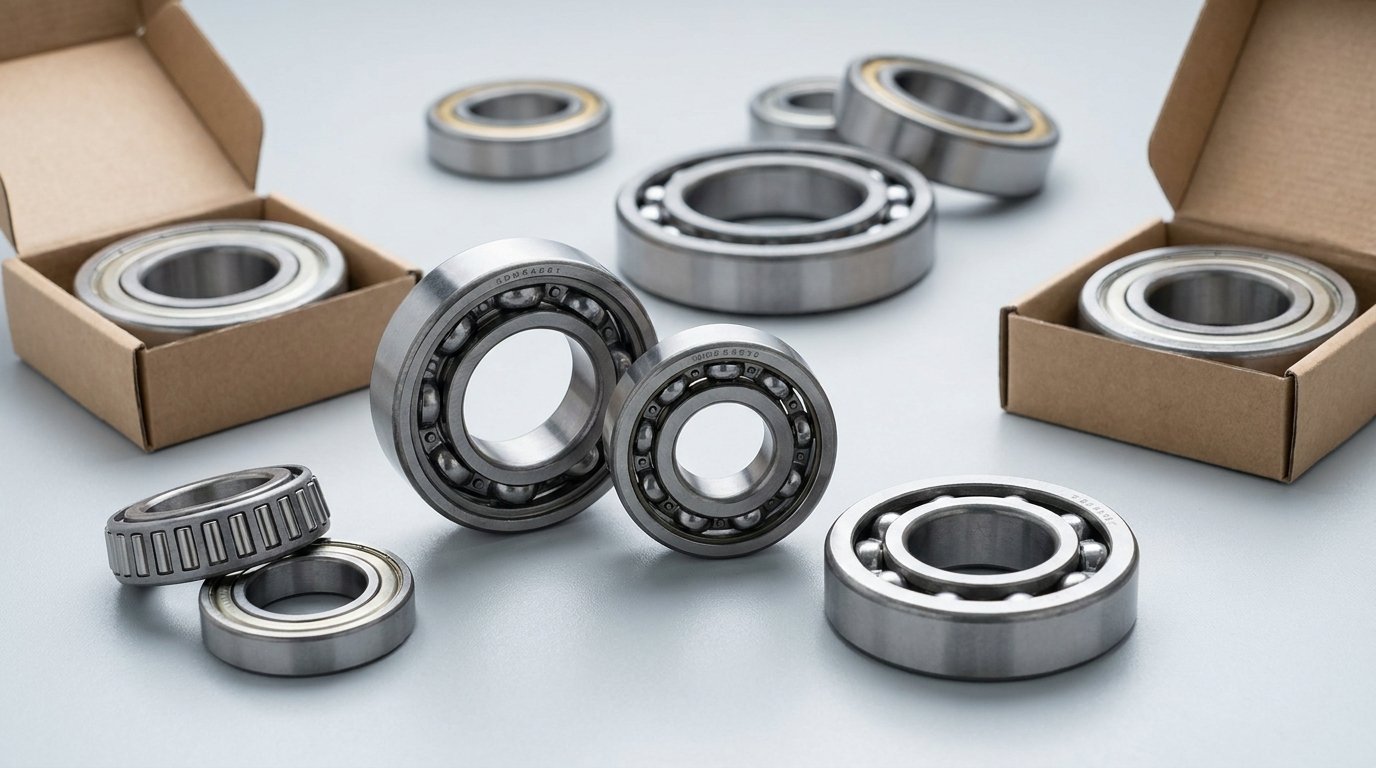
The compliance flow from design to shipment
A robust bearing compliance standards program links three layers: (1) QMS certification, (2) product standard/tolerance class, and (3) shipment-level evidence.
Typical workflow in industrial bearing certification environments:
- Requirement definition: Specify bearing type, size series, tolerance class (ABEC/JIS/DIN/ISO class), material, heat treatment, cage, seals, grease, noise/vibration limits (if applicable), and traceability level.
- Process control: The manufacturer’s ISO 9001 / IATF 16949 / AS9100 system controls documents, supplier qualification, incoming inspection, in-process control plans, and final inspection.
- Measurement & verification: Dimensional checks (bore/OD/width, runout), geometry (roundness), functional checks (torque), and optional performance checks (noise/vibration, cleanliness).
- Release documentation: CoC/CoA, inspection records, lot/serial traceability, and labeling that aligns to the ordered bearing manufacturing standards.
- Audit & continual improvement: Internal audits + third-party audits, plus CAPA when nonconformances occur.
What “works” in practice is the evidence chain—your PO requirements must map to measurable checks and to controlled records.
- QMS certification evidence: Certificate + audit history + calibration records + control plan.
- Product standard evidence: Inspection reports showing tolerance compliance; gage capability and method.
- Shipment evidence: Lot traceability on packaging and documentation.
Haron Bearing Pro Tip: I recommend writing the tolerance class and the required inspection deliverables on the PO (e.g., “ABEC 7 with runout report per lot”)—otherwise suppliers may default to “commercial acceptance” without the records you need.
Which is better, ABEC 7 or ABEC 9?
ABEC 9 is “tighter” than ABEC 7 in dimensional tolerances, but it is not automatically “better” for most applications. ABEC only addresses certain precision tolerances, not material quality, lubrication, noise, or bearing life. Choose ABEC 9 mainly when your spindle speed, runout sensitivity, and assembly precision justify the added cost and sourcing limits.
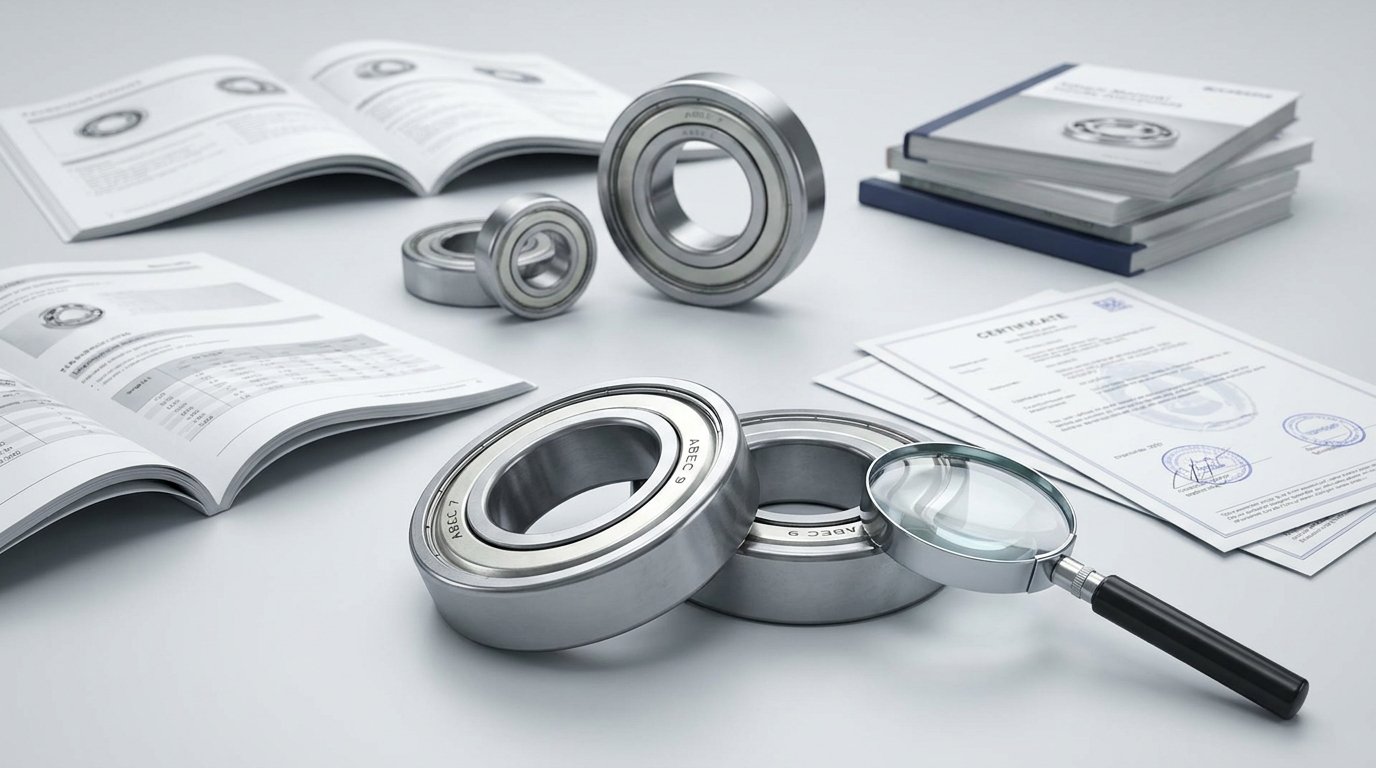
When tighter tolerances actually matter
ABEC affects allowable variation in key dimensions and running accuracy, which can influence runout, heat generation, and achievable speed—if the rest of the system (shaft, housing, preload, lubrication, cleanliness) is designed to match.
Use this decision checklist:
- Choose ABEC 7 when you need high precision but still want broader availability and practical cost control (common in many precision motion systems).
- Choose ABEC 9 when you have an ultra-precision spindle or metrology-grade requirement where incremental runout improvements are measurable and valuable.
- Avoid over-specifying ABEC when your limiting factors are lubrication, contamination, misalignment, mounting fits, or heat dissipation.
Common “hidden constraints” that can negate ABEC 9 benefits:
- Shaft/housing geometry not held to matching precision
- Poor cleanliness during assembly
- Inadequate lubrication regime at speed
- Incorrect preload causing heat and premature wear
Haron Bearing Pro Tip: I only recommend ABEC 9 after reviewing the full tolerance stack (shaft/housing + preload method + thermal growth). If you can’t control those, ABEC 7 usually delivers the best real-world performance per dollar.
What are the four types of bearings?
The four commonly referenced bearing categories are ball bearings, roller bearings, thrust bearings, and plain (sleeve) bearings. Ball and roller bearings are rolling-element designs suited to low friction and higher speed; thrust bearings focus on axial loads; plain bearings prioritize simplicity and shock tolerance. Selection depends on load direction, speed, misalignment, and lubrication.
Core bearing families and where they fit
Here’s a practical way to map “type” to application needs:
- Ball bearings: Good for moderate radial/axial loads, high speed, low friction; many variants (deep groove, angular contact).
- Roller bearings: Higher load capacity than balls; types include cylindrical, tapered, spherical, needle; often used for heavy radial loads or combined loads (tapered).
- Thrust bearings: Designed primarily for axial load; can be ball or roller thrust designs; speed capability varies widely.
- Plain (sleeve) bearings: No rolling elements; rely on boundary/hydrodynamic lubrication; tolerant of shock and contamination in some designs; used in engines, pumps, and heavy equipment.
Quick selection steps:
- Identify load direction (radial, axial, combined).
- Determine speed and temperature.
- Check misalignment and deflection.
- Decide lubrication method (grease/oil/oil-air).
- Apply environmental constraints (corrosion, cleanliness, washdown).
Haron Bearing Pro Tip: If the application has unavoidable misalignment, I prioritize spherical roller or self-aligning designs before chasing tighter ABEC classes—alignment errors can destroy “precision” benefits fast.
What’s better, ABEC 5 or 9?
ABEC 9 is tighter than ABEC 5, but “better” depends on what limits your system. ABEC 5 is often sufficient for many industrial motors, gearboxes, and general precision assemblies. ABEC 9 is typically reserved for ultra-high precision spindles and controlled assemblies. ABEC does not guarantee quieter operation or longer life by itself.
Matching ABEC class to application reality
ABEC class should be driven by measurable needs (runout, speed, thermal stability), not as a marketing shorthand.
A practical rule-of-thumb selection list:
- ABEC 5: General precision industrial use; good balance of cost and tolerance control.
- ABEC 7: High-precision motion/spindle applications where runout and speed are more critical.
- ABEC 9: Ultra-precision assemblies where you can verify benefits with metrology and control the full tolerance chain.
If your goal is longer life, focus first on:
- Correct load rating and safety factor
- Proper fits and internal clearance/preload
- Adequate lubrication and contamination control
- Correct sealing and handling/storage
Haron Bearing Pro Tip: When customers ask for ABEC 9 “for longer life,” I redirect them to lubrication cleanliness and correct preload—those typically deliver bigger life gains than moving up multiple ABEC grades.
Key Features & Comparison
The most important “features” of certification and standards are what they let you verify: process control, traceability, risk management, and measurable dimensional conformity. ISO/IATF/AS9100 primarily reduce supplier and process risk, while ABEC/JIS/DIN primarily reduce interchangeability and tolerance risk. The best results come from combining both with shipment-level inspection evidence.
Side-by-side view of common frameworks
Based on our internal data and market analysis, here is the breakdown:
| Framework | Type | Applies to | What it assures (in practice) | What it does not assure |
|---|---|---|---|---|
| ISO 9001 | QMS certification | Most industries | Controlled processes, document control, calibration, CAPA, consistent production | Specific bearing tolerance class, material grade, noise/vibration, bearing life |
| IATF 16949 | QMS certification | Automotive supply chain | Prevention-focused quality, PPAP/APQP mindset, stronger supplier controls, traceability expectations | Automatic “premium” performance; still depends on design/spec and verification |
| AS9100 | QMS certification | Aerospace/defense | Strong traceability, risk management, configuration control, product safety focus | A specific ABEC/JIS/DIN tolerance class unless specified and verified |
| ABEC (ANSI/ABMA) | Product tolerance standard | Certain ball bearings (inch series commonly) | Dimensional/running accuracy tolerance class | Material, heat treatment quality, lubrication, cleanliness, noise, fatigue life |
| JIS | Product standard | Bearings in JIS scope | Dimensions/tolerances and related verification methods | QMS maturity of the factory; shipment traceability unless required |
| DIN | Product standard | Bearings in DIN scope | Dimensions/tolerances and related verification methods | Same: not a factory certification; does not guarantee life/noise |
Haron Bearing Pro Tip: I treat “certification” as supplier qualification and “standard/tolerance class” as product qualification—then I require a CoC plus at least one measurable inspection report per lot for critical bearings.
Cost & Buying Factors
Certification level, inspection depth, and traceability requirements are the biggest drivers of total bearing cost—not just the bearing size. ISO-certified supply is often baseline; IATF 16949 and AS9100 typically add documentation, controls, and lead-time constraints. Higher tolerance classes (e.g., ABEC 7/9) increase cost due to process capability, scrap risk, and verification time.
What to specify to control price without adding risk
Key cost drivers to evaluate and negotiate:
- Certification scope: ISO 9001 vs IATF 16949 vs AS9100 (audit burden and documentation intensity).
- Tolerance class: ABEC/JIS/DIN class; tighter tolerance increases inspection time and yield loss.
- Material and heat treatment: Bearing steel grade, cleanliness, special heat treat, corrosion resistance.
- Sealing and lubrication: Contact seals, low-torque seals, special greases (high-speed, low-noise, food-grade).
- Documentation package: CoC only vs CoA + dimensional/runout reports + gauge calibration certificates.
- Traceability level: Lot traceability vs serial traceability; packaging and labeling requirements.
- MOQ/lead time: Precision classes and certified production often have longer lead times.
Practical buying checklist:
- Define the actual functional requirement (speed, runout, noise, temperature, environment).
- Specify the exact compliance standard (ABEC/JIS/DIN/ISO tolerance class) and inspection deliverables.
- Confirm certificate scope matches manufacturing, not only distribution.
- Align acceptance criteria (AQL, sampling plan, critical dimensions).
- Require traceability proportional to risk (industrial vs automotive vs aerospace).
Haron Bearing Pro Tip: To keep costs down while staying compliant, I often recommend ISO 9001 + targeted critical-dimension reporting, instead of upgrading to a tighter ABEC class that your assembly and housing tolerances can’t realistically leverage.
Conclusion
Choosing bearing certifications means separating factory capability from product tolerance compliance. Specify tolerance class, traceability, and inspection documents upfront. Haron Bearing helps align specs, certification scope, and compliance evidence for regulated or high-risk applications.