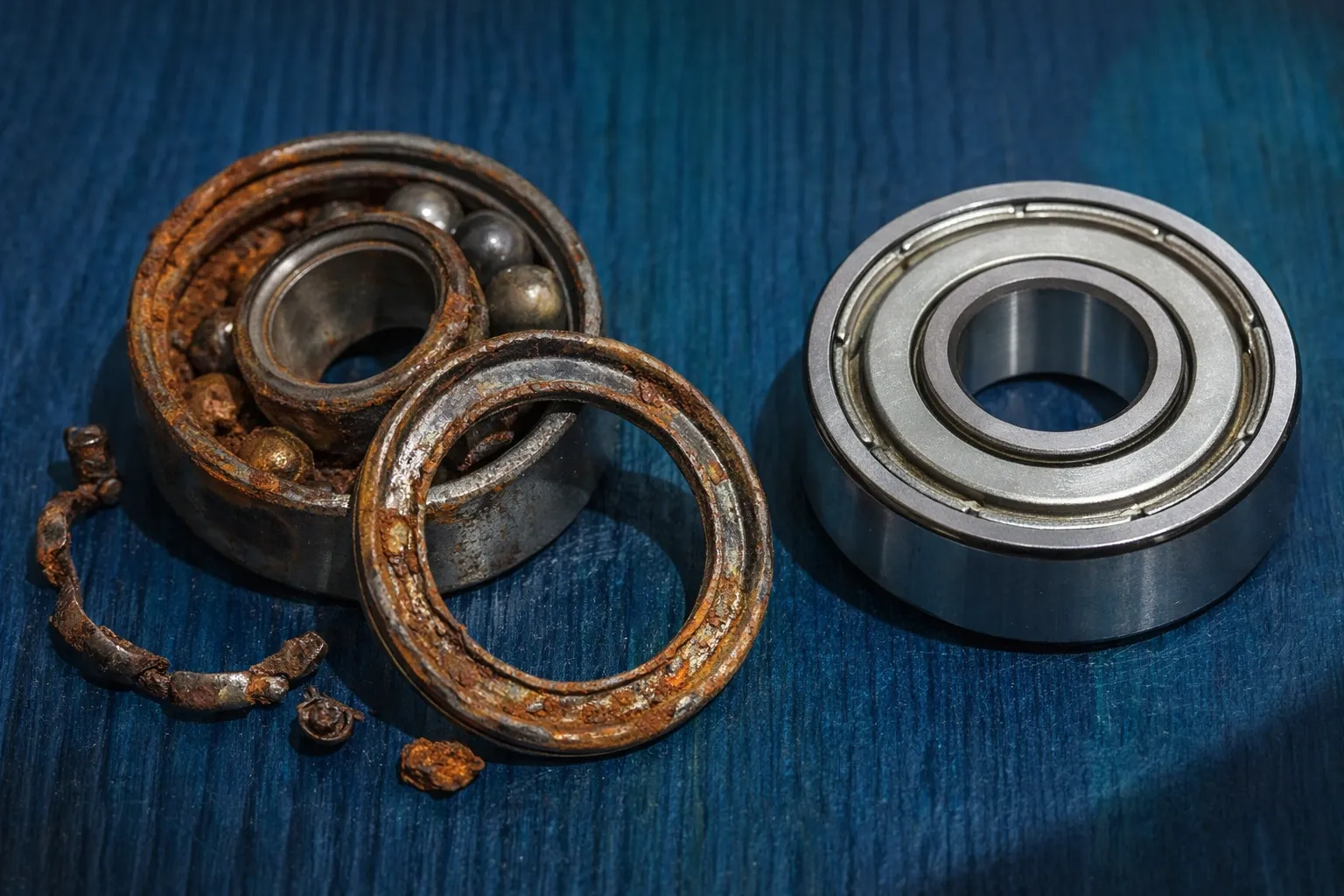
Bearing failure analysis helps identify root causes like contamination, lubrication breakdown, misalignment, overload, and poor installation. This guide explains common bearing failures, including overheating, spalling, and wear, with practical steps to prevent premature failure.
What causes bearing failure, and how can it be analyzed, prevented, and troubleshot in industrial applications?
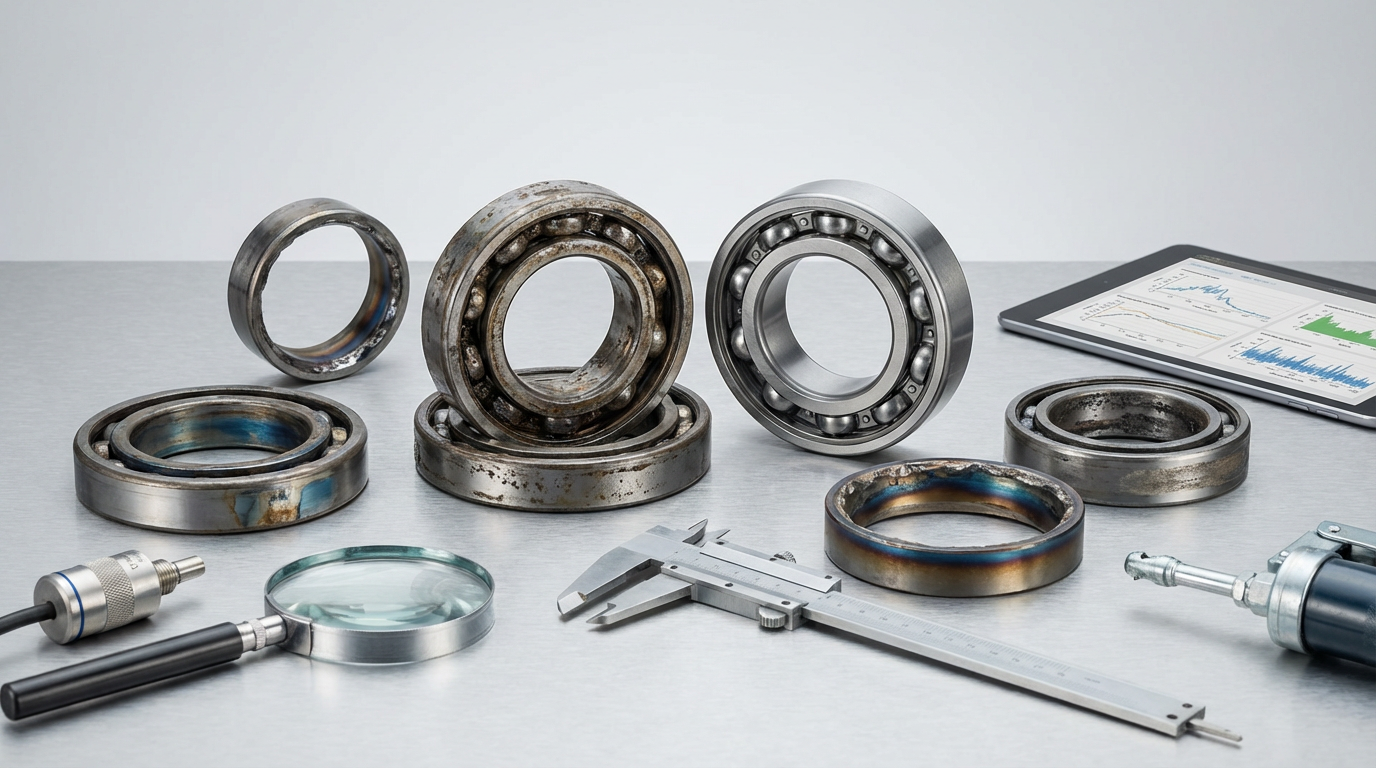
Bearing failure analysis is a structured method to determine why a bearing failed by combining symptom review, operating conditions, and physical damage evidence (tracks, discoloration, spalling, wear, debris). Its purpose is to pinpoint the true bearing failure causes—often lubrication, contamination, fit, or alignment—and prevent repeat failures.
Practical definition and what “good” analysis includes
Bearing failure analysis connects three layers of evidence: what the machine did, what the bearing looks like, and what the environment/maintenance history reveals. Done correctly, it does more than label damage—it assigns a mechanism and a corrective action.
Common bearing failures you’ll see during bearing damage analysis include overheating discoloration, micropitting, spalling, false brinelling, cage damage, abrasive wear, and corrosion.
A simple field workflow is:
- Capture symptoms: noise, vibration, temperature, power draw, lubricant appearance.
- Lock in operating context: load, speed, duty cycle, ambient temperature, washdowns, sealing type.
- Preserve evidence: don’t wipe parts; bag the bearing and grease/oil samples separately.
- Inspect systematically: raceways, rolling elements, cage, seals, fits, shafts/housings.
- Identify mechanism: contamination vs. lubrication failure vs. misalignment vs. electrical damage, etc.
- Implement prevention: changes to sealing, lubricant, relube method, handling, fits, alignment, filtration.
Haron Bearing Pro Tip: I treat every failed bearing like a “crime scene”—if you clean it before documenting tracks, heat tint, and debris, you erase the fastest path to the real root cause and risk repeating the same premature bearing failure.
How does bearing failure analysis work, and how can it help prevent common bearing failures?
It works by correlating operating symptoms (vibration, heat, lubricant condition) with physical damage patterns on the raceways, rolling elements, cage, and seals. By mapping each pattern to a failure mechanism—like contamination, lubrication starvation, overload, or misalignment—you can confirm root cause and define prevention actions that stop recurrence.
Evidence-to-mechanism mapping you can apply on the shop floor
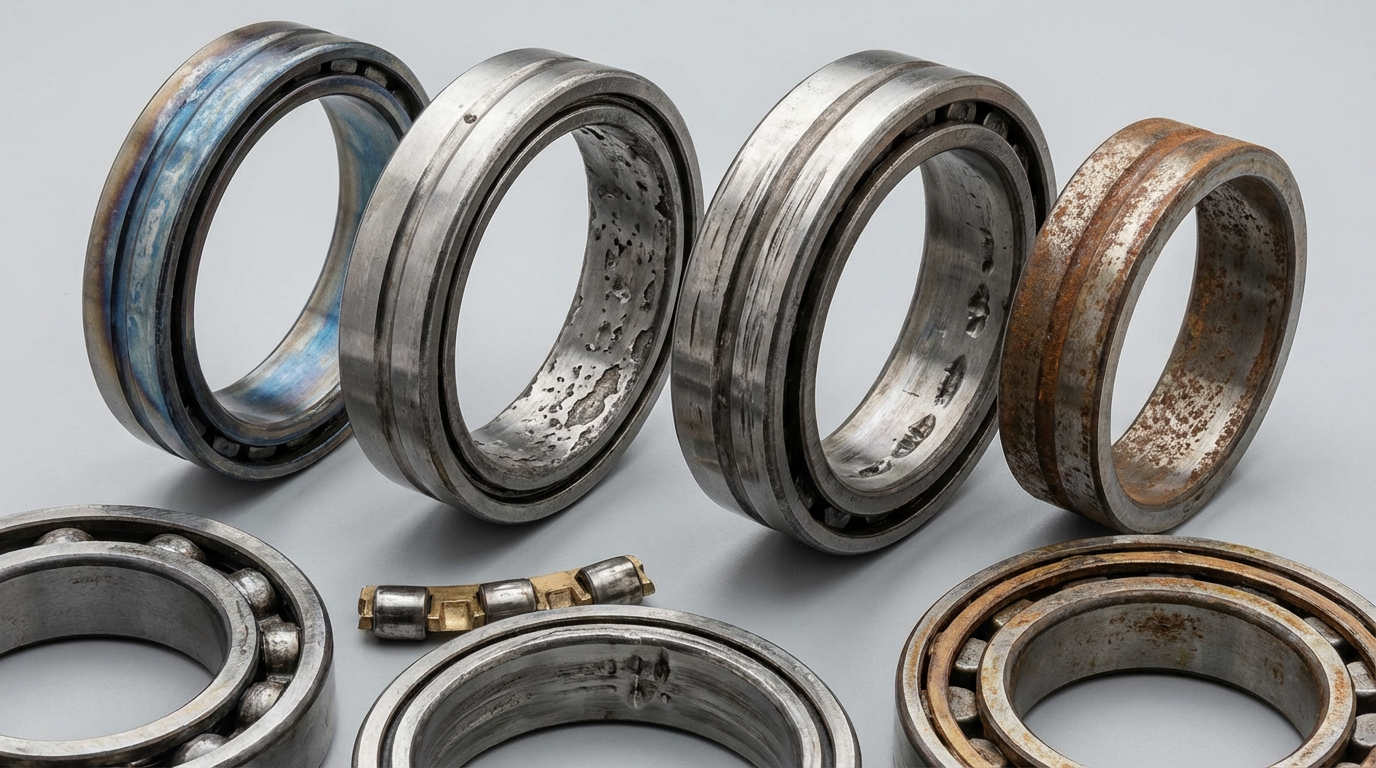
Most industrial bearing troubleshooting becomes faster when you map “what you see” to “what caused it” and “what to change.” The ten most common bearing failure causes below cover the majority of premature bearing failure cases:
- Contamination (solid particles) → abrasive wear, scratched raceways, dull/grey tracks.
- Moisture/chemical ingress → corrosion, etching, hydrogen-related damage in severe cases.
- Lubrication starvation (too little/too infrequent) → overheating, smearing, blue/brown heat tint.
- Wrong lubricant (viscosity/thickener/additives) → film collapse, wear, temperature rise.
- Over-lubrication → churning, overheating, seal blowout, grease purge blockage.
- Misalignment → edge loading, uneven spalling bands, rapid temperature increase.
- Improper fits/clearance (too tight/loose) → creep, fretting, abnormal preload, early spalling.
- Overload/shock load → brinelling, early fatigue, cracked rings/rollers.
- Electrical discharge (VFD currents) → EDM-like fluting, pitting, washboard raceways.
- Improper installation/handling → denting, false brinelling, cage damage, cracked rings.
Haron Bearing Pro Tip: I always force a “one-change confirmation”: after you identify the top suspected mechanism, make one targeted corrective action (e.g., seal upgrade or relube interval change) and track temperature/vibration—if the trend doesn’t improve, revisit the mechanism before replacing more bearings.
What are the benefits of bearing failure analysis, and how does it help prevent premature bearing failure?
The main benefits are fewer repeat failures, lower downtime, and longer bearing and lubricant life. A solid bearing failure analysis program converts failure patterns (overheating, spalling, contamination wear) into actionable controls—better sealing, correct lubrication, improved alignment and fits—so reliability improves and maintenance becomes planned instead of reactive.
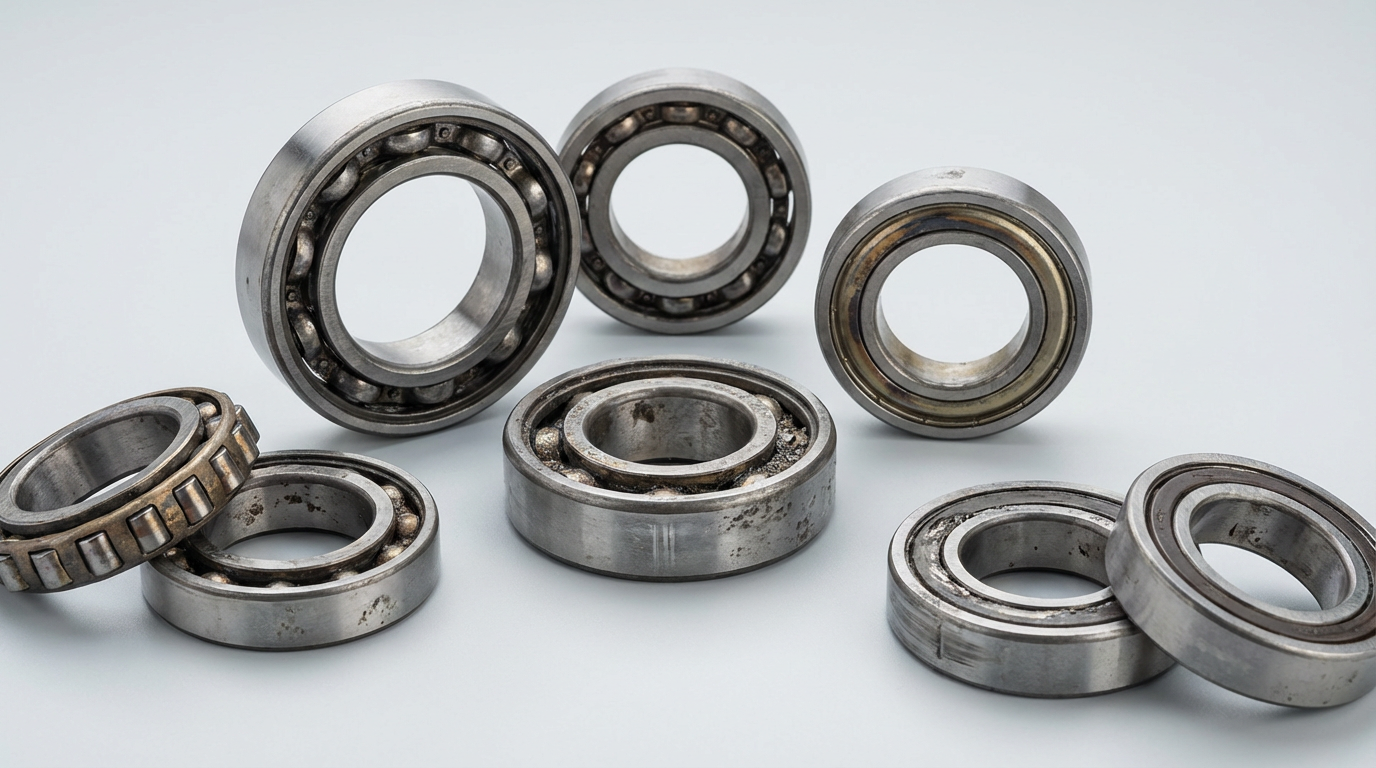
Operational gains you can measure
When you consistently apply bearing damage analysis, you move from “replace and hope” to “replace and improve.” That typically reduces emergency work orders and protects adjacent components (shafts, housings, gearboxes, motors).
Key benefits to track:
- Reduced unplanned downtime through earlier detection and corrected root causes.
- Lower MRO spend by preventing premature bearing failure and secondary damage.
- Improved safety by avoiding catastrophic seizure or overheating events.
- Better lubrication control (right grease/oil, right amount, right interval).
- Standardized troubleshooting so different technicians reach consistent conclusions.
Haron Bearing Pro Tip: I recommend setting three KPIs per asset: bearing temperature trend, vibration velocity trend, and relube compliance—when all three improve after corrective actions, you know your failure analysis is actually preventing recurrence.
How should bearings be maintained to prevent common failures and extend service life?
Maintain the program by standardizing inspection, lubrication, and contamination control while documenting every failure with photos, measurements, and lubricant data. The goal is to prevent the dominant causes—contamination and lubrication failure—then validate results using temperature/vibration trends, grease condition, and post-run inspections so improvements are sustained across shifts and sites.
A maintenance playbook to prevent premature bearing failure
Use this repeatable checklist to reduce common bearing failures across most industrial applications:
- Lubrication discipline
- Choose correct base oil viscosity for speed/load/temperature.
- Set relube quantity by bearing size and free volume; avoid “until it purges” habits.
- Control mixing (thickener compatibility) and storage cleanliness.
- Contamination control
- Upgrade seals (labyrinth/contact) to match environment.
- Keep breathers/vents filtered; use closed transfer for oils.
- Clean tools, grease guns, and fittings; cap ports.
- Installation and fits
- Use correct mounting methods (heaters/press tools) and avoid impact through rolling elements.
- Verify shaft/housing tolerances, surface finish, and internal clearance selection.
- Condition monitoring
- Trend vibration and temperature; investigate step-changes quickly.
- Sample lubricant where practical; watch for particles, water, oxidation.
- Failure documentation
- Photograph raceways/rollers/cage/seals, note orientation, record hours and operating conditions.
Haron Bearing Pro Tip: I standardize relube using measured shots or grams—once you remove “feel-based lubrication,” bearing overheating causes drop dramatically and grease-related seal failures almost disappear.
What does bearing failure analysis cost, and what factors affect the price?
Pricing depends on depth and tooling: basic in-house analysis costs mainly labor, while advanced analysis adds instruments and lab services. Typical expenses include inspection tools, vibration/temperature monitoring, lubricant sampling, and occasional metallurgical checks. The biggest cost driver is whether you need root-cause confirmation (lab) or practical corrective actions (field).
Typical cost components (what you’re really paying for)
Common price elements for industrial bearing troubleshooting and failure analysis programs:
- In-house time: teardown, inspection, documentation, and corrective-action planning.
- Tools: micrometers, surface comparison, borescopes, torque tools, induction heaters.
- Condition monitoring: portable vibration meter to full online systems.
- Lubricant analysis: particle count, water content, viscosity, FTIR/oxidation.
- External lab (as needed): microscopy, hardness, metallography, electrical discharge confirmation.
Haron Bearing Pro Tip: I only send bearings to a lab when the corrective action is expensive (e.g., redesigning sealing or changing fits); for routine failures, a disciplined photo + measurement checklist usually gets you to the right prevention step faster.
Key Features & Comparison
A high-quality bearing failure analysis approach combines standardized inspection, lubrication control, contamination management, and condition monitoring. The best programs prioritize repeatability: the same symptoms lead to the same diagnosis and corrective action, regardless of technician. Comparing methods side-by-side helps you choose the right level of analysis for each asset’s criticality and cost of downtime.
Comparison of analysis approaches and when to use them
Based on our internal data and market analysis, here is the breakdown:
| Approach | Best for | What you get | Limitations | Typical prevention outcomes |
|---|---|---|---|---|
| Visual + photo documentation | Most maintenance teams | Fast pattern recognition (wear, overheating, corrosion, spalling) | Can miss subtle mechanisms (EDM, microstructure issues) | Better lubrication/sealing/handling decisions |
| Dimensional checks (fits/clearance) | Repeat spalling, overheating, creep | Confirms misfit, preload/clearance errors | Requires correct measurement practice | Reduced early fatigue and ring creep |
| Vibration + temperature trending | Critical rotating assets | Early warning and severity tracking | Needs baselines and alarm discipline | Prevents catastrophic failures, improves planning |
| Lubricant/grease analysis | Contamination and lube failure cases | Particle/water/oxidation evidence | Sampling quality matters | Targets filtration, relube intervals, lubricant selection |
| Advanced lab (metallurgy/EDM) | High-cost failures, warranty disputes | Mechanism confirmation, material insights | Higher cost and lead time | Confident root cause for major corrective actions |
Haron Bearing Pro Tip: I classify assets by downtime cost and only apply “advanced lab” to the top tier—most plants get the biggest ROI from tightening lubrication, sealing, and installation controls first.
Cost & Buying Factors
Total cost is driven less by the bearing itself and more by downtime, labor, collateral damage, and whether failures repeat. Buying decisions should focus on application fit (load, speed, temperature), sealing and contamination exposure, lubrication strategy, and installation constraints. Investing in the right sealing and lubricant control often prevents the most expensive failure modes.
What to evaluate before you spend money
Key buying factors that reduce common bearing failures:
- Environment & contamination risk: sealing type, IP rating needs, washdown, dust, chemicals.
- Load/speed/temperature: correct bearing type and internal clearance; cage material selection.
- Lubrication method: grease vs. oil, relube access, automatic lubricators, compatibility.
- Shaft/housing fits: tolerances, surface finish, thermal growth, fretting risk.
- Electrical risk: VFD-driven motors may require insulated bearings/shaft grounding.
- Supplier support: failure documentation process, lead times, quality traceability.
Haron Bearing Pro Tip: I budget first for sealing and lubrication improvements (they solve the majority of bearing contamination failure and bearing lubrication failure cases) and only then upgrade bearing “spec”—a premium bearing in a dirty, poorly lubricated system still fails early.
Conclusion
Preventing premature bearing failure starts with disciplined bearing failure analysis: document symptoms, preserve evidence, identify the damage mechanism, and implement one clear corrective action tied to contamination control, lubrication, fits, alignment, or electrical mitigation. When you standardize this process across your plant, bearing overheating causes, spalling, and abnormal wear drop sharply—and reliability becomes predictable.
If you want Haron Bearing support aligning bearing selection, sealing, and lubrication strategy to your operating conditions, build your troubleshooting checklist around the ten causes above and apply trend-based validation after every fix.