
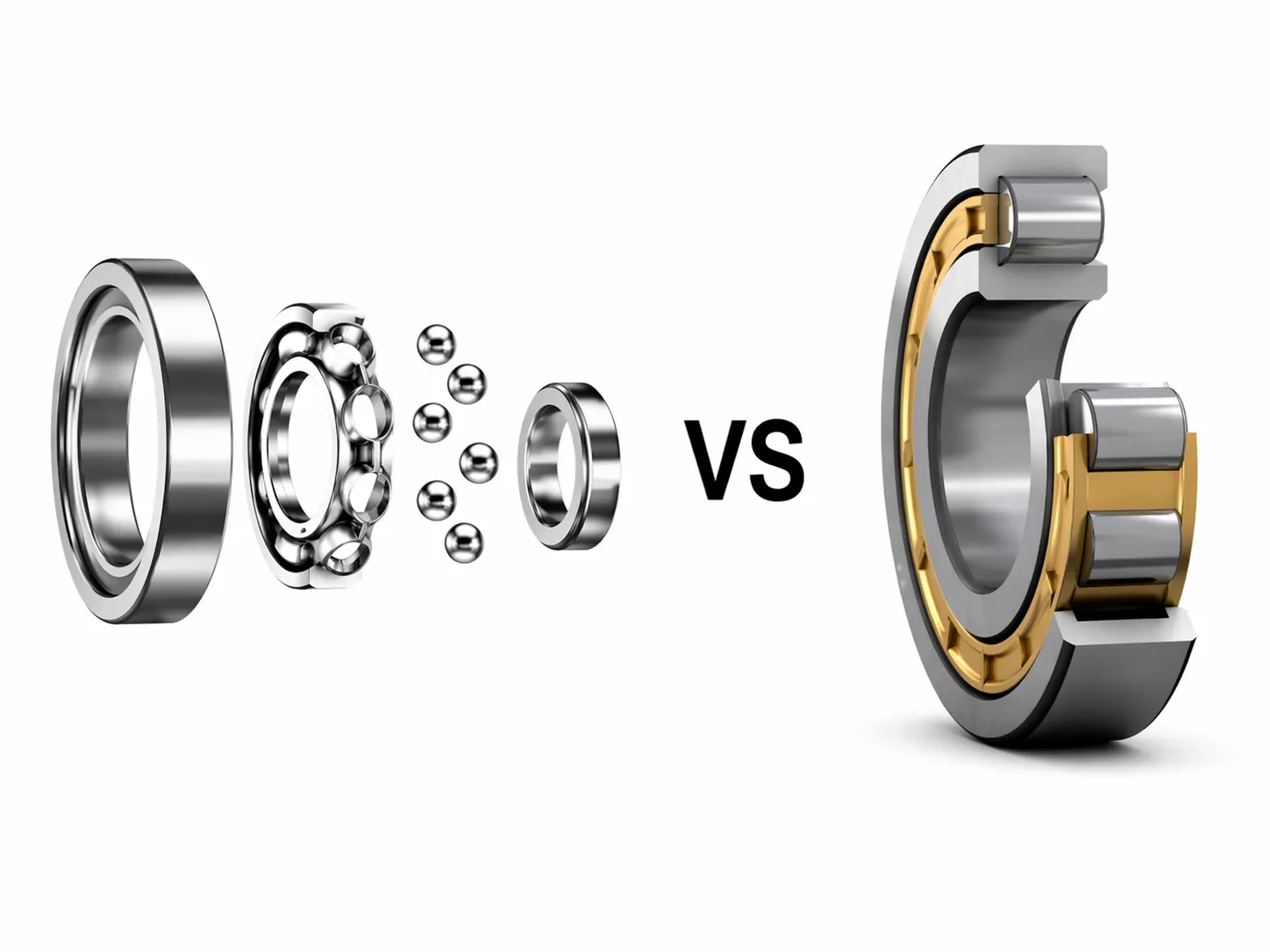
Choosing between ball vs roller bearing uses comes down to load type, speed, stiffness, and expected life. Ball bearings excel as a bearing for high speed with low friction and good radial-plus-moderate axial load capacity. Roller bearings are often the bearing for heavy load applications, offering higher radial load capacity and robustness. This guide clarifies mechanical bearing differences for confident industrial bearing selection.
What is ball bearings vs roller bearings ball bearing vs roller bearing bearing comparison difference between ball and roller bearings roller bearing applications ball bearing applications bearing for high speed bearing for heavy load industrial bearing selection bearing load comparison ball vs roller bearing uses mechanical bearing differences?
Ball bearings use spherical rolling elements (balls) to reduce friction, making them ideal for high-speed, low-to-moderate load operation and mixed radial/axial loads. Roller bearings use cylindrical, tapered, or needle rollers that spread load over a larger contact area, making them better for heavier radial loads and higher stiffness.
Video Guide: Shows the core bearing comparison—why balls favor speed and rollers favor load capacity and stiffness.
Definitions, contact geometry, and what “load capacity” really means
Ball bearings support loads through point contact (ball-to-raceway), while roller bearings support loads through line contact (roller-to-raceway). That single geometry difference drives most of the difference between ball and roller bearings: friction, heat generation, stiffness, wear sensitivity, and bearing load comparison results in real machines.
- Ball bearing (deep groove / angular contact): Best for low friction and high RPM; handles radial loads well and axial loads to a moderate (or high, for angular contact ball bearings) degree.
- Roller bearing (cylindrical / tapered / needle / spherical): Best for high radial load, shock resistance, and stiffness; tapered roller bearings and spherical types can also handle meaningful axial loads.
- Selection shortcut: If speed dominates, start with balls; if load/stiffness dominates, start with rollers—then refine by axial load, misalignment, lubrication, and mounting constraints.
Haron Bearing Pro Tip: When customers ask for “the strongest bearing,” I first separate static load, dynamic load, and shock loading. Roller bearings often win in pure radial capacity, but the “best” choice can flip once you add high RPM, heat limits, or tight torque requirements.
How Does ball bearings vs roller bearings ball bearing vs roller bearing bearing comparison difference between ball and roller bearings roller bearing applications ball bearing applications bearing for high speed bearing for heavy load industrial bearing selection bearing load comparison ball vs roller bearing uses mechanical bearing differences Work?
Both bearing types reduce sliding friction by replacing it with rolling motion between inner/outer rings and rolling elements. Ball bearings roll with lower contact area, minimizing friction and heat at high speed. Roller bearings distribute force across line contact, reducing contact stress and enabling heavier loads, but often at higher friction and lower speed limits.
Video Guide: Demonstrates how each bearing type carries load and why durability and speed ratings differ in practice.
Load transfer, friction sources, and failure drivers
In operation, the shaft load passes from the inner ring to the rolling elements and into the outer ring/housing. The bearing cage keeps rolling elements spaced to prevent rubbing and skidding.
Key mechanics that change performance:
- Contact type: Point (ball) vs line (roller) changes stress distribution and elastic deformation.
- Internal geometry: Raceway curvature (ball) vs roller length/diameter and crowning (roller) influences stress peaks and edge loading.
- Friction components: Rolling resistance, cage drag, lubricant churning, and seal friction (if sealed).
- Heat balance: Higher friction or poor lubrication increases temperature, reduces viscosity, and accelerates wear/fatigue.
Common mismatch patterns (why bearings “mysteriously” fail early):
- Ball bearings at heavy radial load + shock: Brinelling/indentation and early fatigue.
- Roller bearings at very high RPM with marginal lubrication: Heat rise, smearing, and cage distress.
- Any bearing with misalignment beyond tolerance: Edge loading and rapid spalling (especially for rollers without self-aligning capability).
Haron Bearing Pro Tip: I treat lubrication as part of the “bearing design.” If the application has high RPM and small housings, I bias toward ball bearings or optimized roller designs because grease life and heat dissipation, not catalog load rating, usually becomes the limiting factor.
What are the benefits of ball bearings vs roller bearings ball bearing vs roller bearing bearing comparison difference between ball and roller bearings roller bearing applications ball bearing applications bearing for high speed bearing for heavy load industrial bearing selection bearing load comparison ball vs roller bearing uses mechanical bearing differences?
Ball bearings deliver low friction, high speed capability, quieter operation, and flexible handling of combined loads in compact packages. Roller bearings deliver higher radial load capacity, greater stiffness, and improved performance under shock and heavy-duty conditions. The best choice depends on speed, load direction, rigidity requirements, misalignment, and maintenance strategy.
Video Guide: Walks through the parts and practical pros/cons, helping connect geometry to real-world performance.
Practical advantages by application need
Use this benefit-oriented checklist to tie bearing type to machine goals:
- When ball bearing applications shine
- High RPM and low torque loss (fans, small motors, spindles with moderate loads)
- Low noise/vibration targets
- Mixed radial + axial loading (especially with angular contact pairs)
- Compact designs where a small bearing must run fast
- When roller bearing applications shine
- Heavy radial loads (gearboxes, conveyors, rollers, industrial drives)
- High stiffness/low deflection needs (precision positioning, heavy rotating drums)
- Shock and impact loading (material handling, crushers—depending on bearing style)
- Longer fatigue life in load-dominant duty cycles (when properly lubricated/aligned)
- Special cases
- Misalignment: spherical roller bearings tolerate more misalignment than most ball/roller types
- Axial load: tapered rollers handle combined loads well; angular-contact balls handle high axial loads at speed
- Space-limited heavy load: needle roller bearings provide high radial capacity in thin cross-sections
Haron Bearing Pro Tip: If your KPI is energy efficiency, I usually start with a ball bearing option and only move to rollers if the bearing load comparison shows inadequate life or unacceptable shaft deflection—power loss from extra friction can be a hidden long-term cost.
How to maintain a ball bearings vs roller bearings ball bearing vs roller bearing bearing comparison difference between ball and roller bearings roller bearing applications ball bearing applications bearing for high speed bearing for heavy load industrial bearing selection bearing load comparison ball vs roller bearing uses mechanical bearing differences?
Maintain both bearing types by controlling contamination, lubrication condition, mounting accuracy, and operating temperature. Ball bearings are especially sensitive to contamination at high speed, while roller bearings are sensitive to misalignment and edge loading under heavy load. A simple routine—correct grease/oil, proper seals, and vibration/temperature checks—prevents most premature failures.
Video Guide: Connects bearing types to load handling and durability, which helps frame what maintenance must protect against.
Maintenance checklist that prevents the common failures
- Lubrication
- Match lubricant type/viscosity to speed and load.
- Avoid over-greasing (heat and churning) and under-greasing (metal contact).
- Refresh grease based on temperature, RPM, contamination, and duty cycle—not calendar time alone.
- Contamination control
- Use appropriate seals/shields for environment (dust, water, chemicals).
- Keep assembly clean; tiny particles can start fatigue spalls early.
- Mounting and fits
- Verify shaft/housing tolerances and surface finish.
- Avoid hammering; use proper heaters/press tools and correct mounting force paths.
- Alignment and preload/clearance
- Confirm alignment in housings; check for soft foot and distortion.
- Apply correct internal clearance/preload (critical for high-speed ball bearings and tapered rollers).
- Condition monitoring
- Trend temperature, vibration, and noise.
- Investigate early signs: rising temperature, tonal noise, or increasing vibration at bearing defect frequencies.
Haron Bearing Pro Tip: In the field, the fastest win is usually sealing. I’ve seen “bearing problems” disappear after upgrading seals and improving washdown protection—especially for high-speed ball bearing applications where contamination quickly turns into heat and noise.
What is the price of ball bearings vs roller bearings ball bearing vs roller bearing bearing comparison difference between ball and roller bearings roller bearing applications ball bearing applications bearing for high speed bearing for heavy load industrial bearing selection bearing load comparison ball vs roller bearing uses mechanical bearing differences?
Pricing varies by size, precision grade, material, sealing, and brand, but ball bearings are often lower-cost for common sizes and high-volume designs. Roller bearings can cost more due to larger load-capacity components and tighter geometry requirements (especially tapered/spherical styles). Total cost should include service life, lubrication needs, downtime risk, and energy loss.
Video Guide: Reviews bearing types and where they’re used, helping relate “price” to design complexity and duty demands.
What drives bearing cost in real procurement
Key price drivers to evaluate during industrial bearing selection:
- Bearing type and geometry: deep-groove ball < cylindrical roller < tapered roller < spherical roller (typical trend, not absolute)
- Size and load rating: larger OD/width and higher dynamic rating generally cost more
- Precision class and noise grade: higher-speed, lower-vibration bearings require tighter tolerances
- Materials and heat treatment: standard steel vs specialty steels; corrosion-resistant options
- Seals and lubrication pack: contact seals, low-torque seals, high-temp grease, food-grade grease
- Quantity and availability: catalog stock vs engineered-to-order
A practical buying lens:
- If failure causes high downtime, pay for life margin, better sealing, and known-quality heat treatment.
- If energy use matters, compare torque/friction and expected temperature rise, not just unit price.
Haron Bearing Pro Tip: When comparing quotes, I ask suppliers to confirm the precision class, radial internal clearance (C0/C3, etc.), seal type, and grease specification. Those “small” details often explain why two bearings with the same size have very different prices and lifetimes.
Key Features & Comparison

Based on our internal data and market analysis, here is the breakdown:
| Factor | Ball Bearing | Roller Bearing |
|---|---|---|
| Contact type | Point contact | Line contact (or near-line) |
| Best for | Bearing for high speed, low friction | Bearing for heavy load, high stiffness |
| Radial load capacity | Moderate to high (by design) | High to very high |
| Axial load capacity | Moderate (deep groove) to high (angular contact) | Varies: tapered/spherical handle combined loads well |
| Speed capability | Typically higher | Typically lower (depends on type and lubrication) |
| Friction/heat | Lower | Higher (especially under heavy load) |
| Stiffness/deflection | Lower stiffness | Higher stiffness |
| Misalignment tolerance | Limited (except self-aligning ball) | Better in spherical roller types |
| Typical failure sensitivity | Contamination at high RPM; lubrication breakdown | Misalignment/edge loading; lubrication starvation under load |
| Common uses | Motors, fans, pumps, light gearboxes, spindles | Conveyors, heavy gearboxes, wheel hubs (tapered), mills, heavy drums |
Cost & Buying Factors

Select using a short, decision-first process rather than picking purely by catalog rating.
- Define loads precisely
- Radial vs axial components, duty cycle, shock events, and required life (L10/L10h targets).
- Set speed and temperature limits
- High RPM often favors ball bearings; heavy-load low-speed favors rollers.
- Check stiffness/deflection requirements
- If shaft deflection affects seals, gear mesh, or accuracy, roller bearings may be necessary.
- Evaluate environment and sealing
- Dust/water/washdown can dominate selection and total cost of ownership.
- Confirm mounting space and fits
- Needle rollers for thin sections; paired angular contact balls or tapered rollers for combined loads and controlled axial positioning.
- Compare total cost of ownership
- Unit price + lubrication + energy loss + planned maintenance + downtime risk.
For engineered selection support and equivalent cross-references, Haron Bearing can help match bearing type, clearance, and sealing to your specific duty profile.
Conclusion

Ball bearings vs roller bearings is fundamentally a trade-off between speed/efficiency and load/stiffness. Use ball bearings when high RPM, low torque loss, and quiet running matter; use roller bearings when heavy radial loads, stiffness, and durability under demanding duty cycles matter. For the best industrial bearing selection, validate loads, alignment, lubrication, and sealing—then choose the bearing family that best matches the real operating conditions.