
Lightweight bearings reduce inertia, energy consumption, and structural mass—three constraints that directly limit speed, precision, and payload in modern robots. When bearing weight is optimized without sacrificing stiffness, robots accelerate faster, hold position more accurately, and run cooler with longer service intervals. For automation teams, this translates into higher throughput, cleaner motion, and more predictable maintenance planning.
Video Guide: This video gives a practical overview of how weight reduction choices (including drivetrain components) unlock faster, more capable robots.
What is lightweight bearings for robots?
Lightweight bearings for robots are rolling or plain bearing designs engineered to reduce mass while maintaining stiffness, accuracy, and life under robotic duty cycles. They commonly use thin-section rings, optimized race geometries, lighter cages, and materials like stainless steel, aluminum housings, or hybrid ceramic bearings to cut inertia and improve responsiveness.
Video Guide: This video explains why bearings are used in robotics/automation and what performance roles they fill in joints and actuators.
Common Designs Used in Robotic Joints
Lightweight designs focus on lowering rotating mass and friction while preserving rigidity and repeatability in compact envelopes—especially in arms, cobots, humanoids, AGVs/AMRs, and end-effectors. Selection is less about “lightest possible” and more about the best mass-to-stiffness and life-to-friction balance for the joint architecture.
- Thin-section ball bearings: Reduce radial/axial cross-section while keeping bore size, ideal for wrist joints and compact axes.
- Cross-roller bearings: High stiffness and moment-load capacity in a slim package, common in rotary joints.
- Hybrid ceramic bearings: Ceramic balls + steel rings to reduce mass, friction, and electrical damage risk.
- Integrated bearing units: Bearing + seal + preload built-in to simplify assembly and reduce extra hardware mass.
Haron Bearing Pro Tip: I treat “lightweight” as a system target—bearing + housing + preload method. If you cut bearing mass but compensate with a heavy adapter plate or overly stiff preload hardware, you lose the inertia advantage and often add heat.
How Does lightweight bearings for robots Work?
Lightweight bearings for robots work by supporting rotating or oscillating joints with minimal friction and inertia while maintaining controlled clearances and preload. Rolling elements (balls/rollers) separate raceways to reduce sliding losses, and optimized thin rings/cages reduce rotating mass so motors can accelerate faster, stop cleaner, and consume less power per cycle.
Video Guide: This video helps frame how bearing quality and friction relate to speed/efficiency—useful when deciding if higher-grade bearings are justified in a robot axis.
Load Paths, Preload, and Why Inertia Matters
In robots, bearings rarely see steady RPM like a fan motor; they see start/stop, reversal, micro-motions, and combined loads (radial + axial + moment). Lightweight designs improve dynamic behavior, but only if the bearing still controls deflection under moment loads and maintains preload across temperature changes.
- Load transfer: External loads enter the housing and transfer through the outer ring → rolling elements → inner ring → shaft/joint.
- Preload control: Light, consistent preload reduces backlash and improves repeatability, but excessive preload increases heat and wear.
- Friction management: Lower friction reduces motor current and heat, improving torque margin for payload.
- Inertia reduction: Lower rotating mass improves acceleration/deceleration and reduces overshoot in servo control.
Haron Bearing Pro Tip: I always validate preload at operating temperature. A “perfect” room-temperature preload can become excessive once the joint warms up, especially when aluminum housings expand faster than steel rings.
What bearings does NASA use?
NASA commonly uses high-reliability aerospace bearings selected for extreme environments: vacuum compatibility, wide temperature swings, radiation exposure, and long life with minimal maintenance. Depending on the mechanism, this can include precision angular-contact bearings, cross-roller bearings, and hybrid ceramic bearings, paired with special lubricants like dry films or space-grade greases.
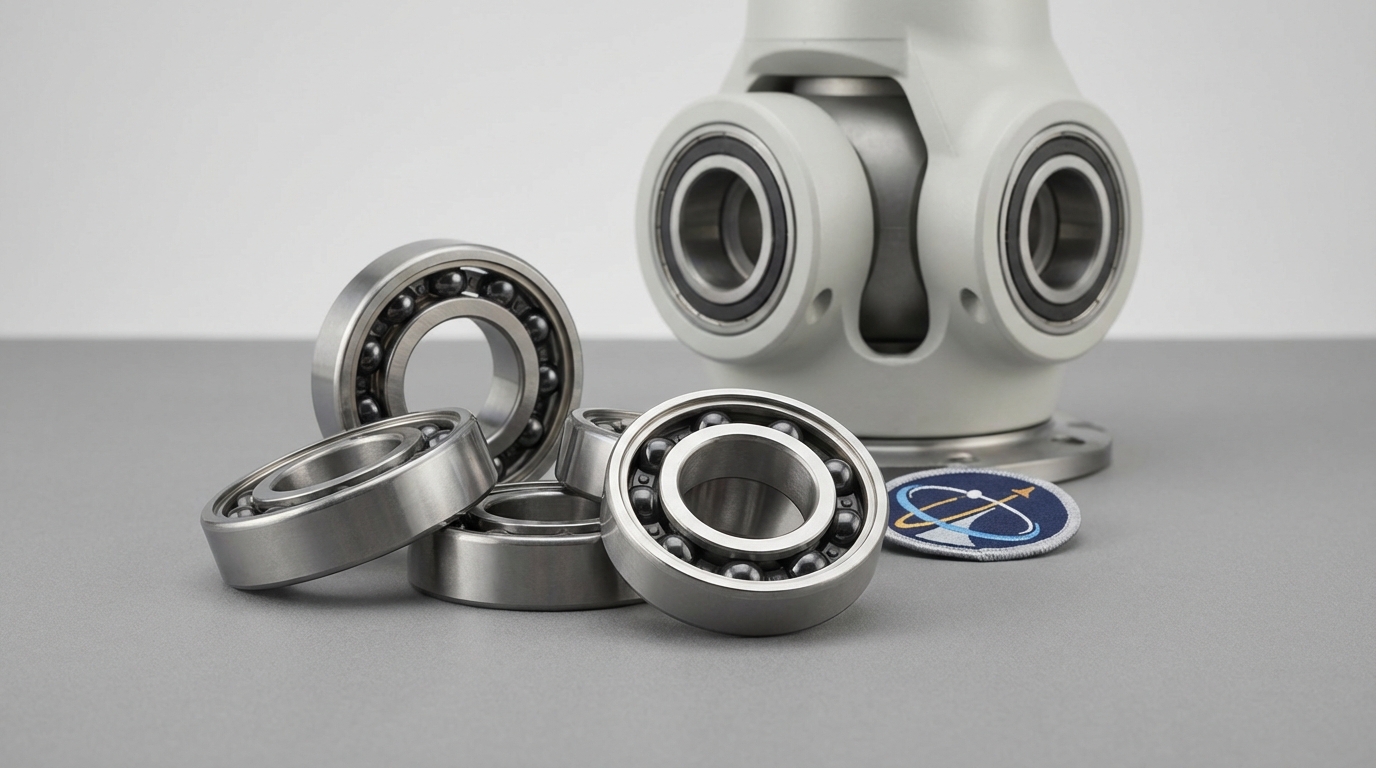
Aerospace Constraints That Drive Bearing Choice
Space mechanisms prioritize reliability and predictable tribology over cost. Material pairs, lubrication chemistry, and outgassing are often more important than raw load rating. For robotics-style mechanisms used in space (e.g., deployment joints, gimbals, rovers), lightweight and low torque are still valuable, but never at the expense of stability and wear control.
- Typical selection criteria
- Vacuum/lubricant behavior (outgassing, evaporation, oil separation)
- Thermal stability and differential expansion
- Contamination tolerance (dust, regolith in rover contexts)
- Electrical effects (EDM risk in motor-driven axes)
- Redundancy and fault tolerance requirements
Haron Bearing Pro Tip: If you’re benchmarking “space-grade” for a terrestrial robot, focus on the transferable ideas—low torque consistency, robust sealing strategy, and lubricant selection—rather than copying a space bill-of-materials that may be overkill and cost-prohibitive.
Do robots have bearings?
Yes—most robots use bearings in nearly every moving axis: motor shafts, gearboxes, joint modules, idlers, wheels, and end-effectors. Bearings enable low-friction motion, carry combined loads, and maintain alignment so sensors and control loops can achieve repeatable positioning. The more compact and dynamic the robot, the more critical bearing choice becomes.
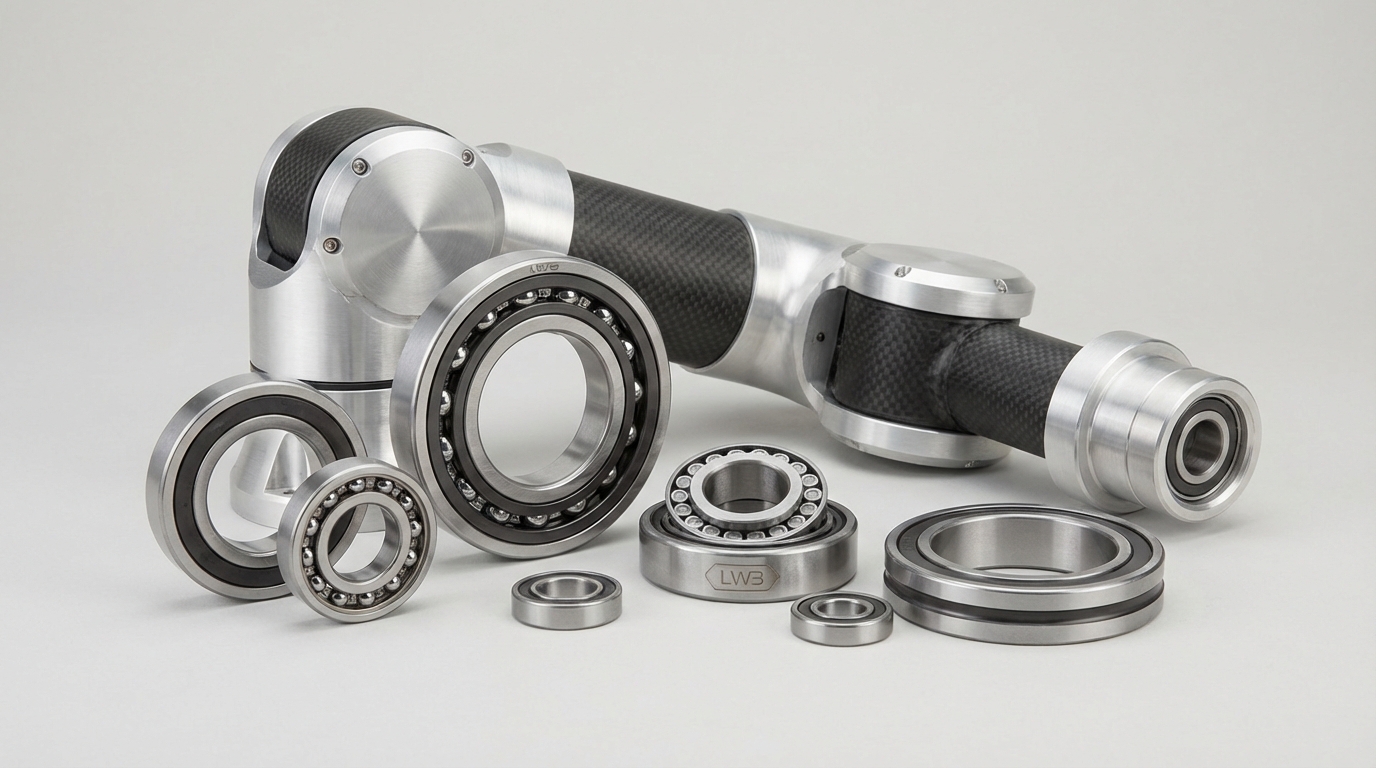
Where Bearings Appear in Real Robot Architectures
Bearings are not just “inside the motor.” They are structural elements that define stiffness and positional stability of the kinematic chain. Eliminating or underspecifying bearings typically shows up as heat, drift, backlash, vibration, or shortened gearbox life.
- Common robot locations
- Joint output stages (harmonic/planetary output support)
- Shoulder/elbow/wrist rotary axes (moment-load dominant)
- Linear axes (guides and support rollers)
- Mobile bases (wheel hubs, caster pivots)
- End-effectors (grippers, spindles, tool changers)
Haron Bearing Pro Tip: I recommend mapping bearings by “precision impact”: identify which bearing most influences tool-center-point (TCP) deflection and repeatability, then prioritize lightweight/high-stiffness upgrades there first.
What is a lightweight material for a robot?
Common lightweight materials for robots include aluminum alloys, carbon-fiber composites, magnesium alloys, and high-performance polymers—chosen to reduce mass while preserving stiffness and fatigue life. For bearing-related components, pairing lightweight housings with steel or hybrid-ceramic bearings is a common strategy to cut inertia without sacrificing raceway hardness or dimensional stability.
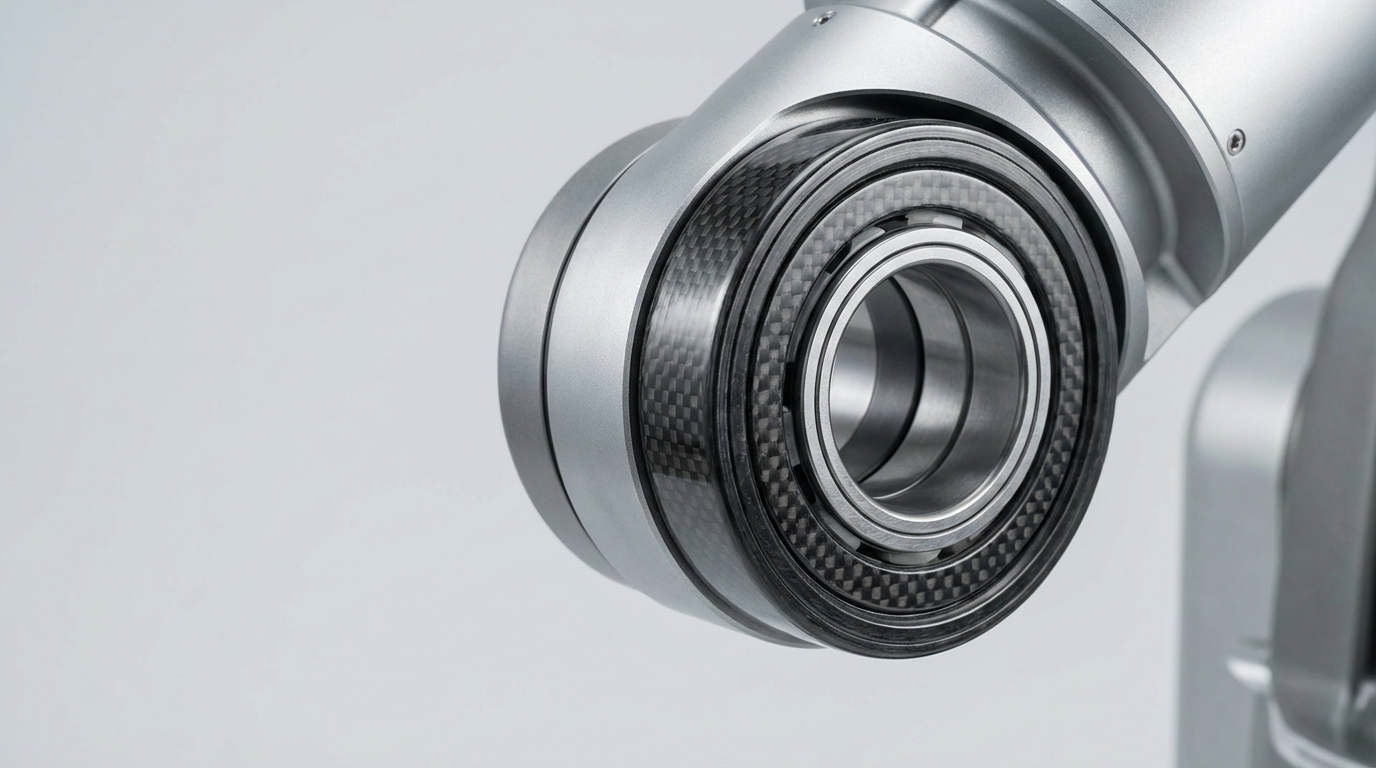
Practical Material Choices (and Where They Fit)
“Lightweight” must be evaluated alongside stiffness, thermal expansion, machinability, and cost. In many robot joints, a lightweight housing plus a high-precision bearing is the most reliable path: the housing saves mass, and the bearing preserves accuracy and wear resistance.
| Material | Why it’s used in robots | Typical cautions |
|---|---|---|
| Aluminum alloys (e.g., 6061/7075) | High strength-to-weight, easy machining | Higher thermal expansion; may need inserts for threads/bearing seats |
| Carbon fiber composites | Very light, high stiffness | Complex joining; anisotropy; higher cost |
| Magnesium alloys | Lighter than aluminum, good damping | Corrosion control; manufacturing constraints |
| Engineering plastics (PEEK, PA, acetal) | Low mass, low friction options | Creep, temperature limits, lower stiffness |
| Titanium alloys | High strength, corrosion resistance | Costly; machining time/expense |
Haron Bearing Pro Tip: If you use aluminum for bearing seats, I prefer adding a hardened sleeve or using an interference fit validated by temperature analysis—seat creep and fretting are common root causes of “mystery” joint looseness.
Key Features & Comparison
Lightweight bearings for robots are defined by mass-to-stiffness efficiency, low and stable friction, controlled preload, and durability under oscillation and combined loads. The best option depends on whether your joint is moment-load dominant (robot wrists/rotary tables) or speed/efficiency dominant (spindles, small actuators), plus your sealing and lubrication constraints.
Performance Tradeoffs by Bearing Type
Based on our internal data and market analysis, here is the breakdown:
| Bearing Type | Weight Advantage | Stiffness / Moment Capacity | Friction / Efficiency | Typical Robot Use | Key Watchouts |
|---|---|---|---|---|---|
| Thin-section ball bearing | High | Medium | High (good) | Compact joints, wrists | Sensitive to housing roundness; preload control critical |
| Cross-roller bearing | Medium | Very high | Medium | Rotary joints, indexing axes | Contamination sensitive; careful mounting required |
| Hybrid ceramic (ball) | Medium | Medium | Very high | High-speed/low-torque joints | Cost; ensure proper lubrication compatibility |
| Standard deep-groove ball | Low | Medium | High (good) | Motors, idlers, general axes | May be heavier than needed; may lack moment stiffness |
| Plain bearing/bushing | High | Low–Medium | Variable | Tiny robots, low-speed pivots | Wear, stick-slip, higher maintenance risk |
Haron Bearing Pro Tip: When comparing options, I look at “torque ripple” over the full motion profile, not only catalog friction. In robots, micro-motion and reversals can make two bearings with similar specs feel completely different in servo tuning.
Cost & Buying Factors
The cost of lightweight bearings for robots is driven by precision grade, stiffness requirements, material choices (e.g., hybrid ceramic), sealing, lubrication, and integration level. Buying decisions should prioritize repeatability and thermal stability over headline load ratings, because robot joints often fail first from heat, contamination, or mounting-related distortion—not from static overload.
What to Specify (and What to Validate)
- Loads and moments by axis: Provide radial/axial/moment loads plus duty cycle (reversals, dwell, oscillation angle).
- Stiffness and accuracy targets: Define allowable deflection at the TCP and required runout.
- Speed/torque profile: Include peak acceleration, max speed, and expected operating temperature.
- Environment: Dust, washdown, cleanroom, vacuum, or electrical discharge risk.
- Mounting stack-up: Housing material, fits, surface finish, and distortion risk from clamping.
- Lubrication strategy: Grease type, relube interval, or sealed-for-life requirement.
Haron Bearing Pro Tip: I ask customers to share housing drawings early. In my experience, the fastest way to waste money is buying a premium lightweight bearing and then distorting it with an overconstrained pocket, poor coaxiality, or an aggressive clamp ring. Haron Bearing can help you review fits and tolerances before you commit.
Conclusion
Lightweight bearings for robots are a leverage point: they reduce inertia, improve control response, cut heat, and help maintain accuracy under fast, repetitive motion. The right choice balances mass savings with stiffness, preload stability, sealing, and lubrication for the real duty cycle. If you’re specifying a new axis or upgrading performance, Haron Bearing can help match bearing architecture to your robot’s load, speed, and precision targets.