
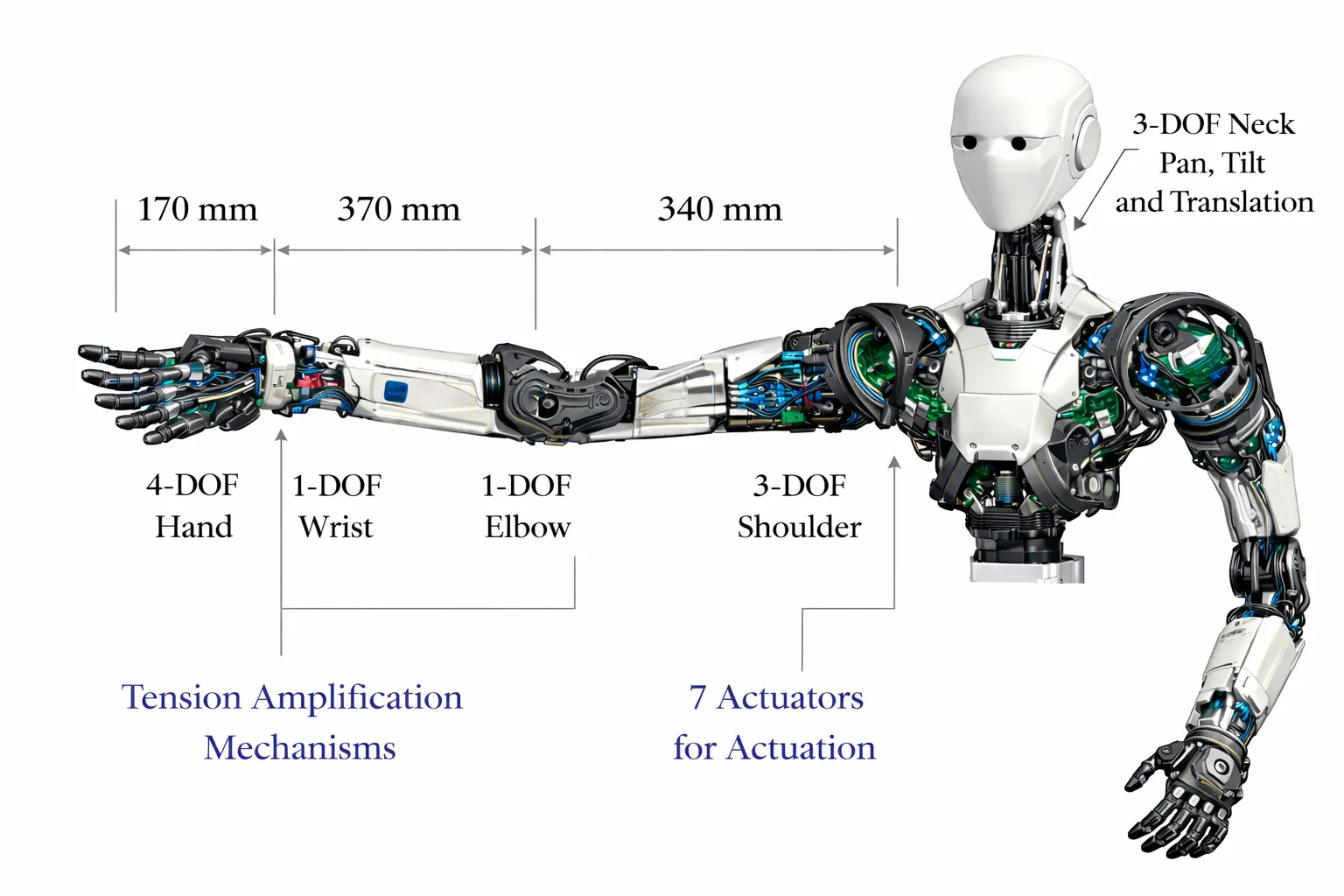
Robot joints typically use cross-roller bearings, thin-section ball bearings (deep-groove or angular-contact), tapered roller bearings, and integrated strain-wave (harmonic drive) bearings—selected by joint load, moment stiffness, accuracy, speed, and envelope. In practice, shoulders/elbows favor high-tilting-moment cross-rollers, while wrists often use thin-section or matched angular-contact pairs for compact precision.
Bearing types used in robot joints (and why)
Robot joints see combined loads—radial, axial, and large overturning moments—plus demanding runout and repeatability requirements. The bearing choice is driven by: tilting-moment stiffness, allowable runout, preload strategy, speed/heat, lubrication life, and mounting accuracy (housing/shaft fits and shoulder squareness).
Common bearing solutions for robot joints
| Bearing type | Where it’s used | Strengths | Typical trade-offs |
|---|---|---|---|
| Cross-roller bearing | Shoulder, elbow, base axes; RV reducers | Very high moment stiffness in a compact axial height; supports combined loads | Needs precise mounting; sensitive to misalignment; higher cost |
| Thin-section deep-groove ball | Wrist joints, small axes | Extremely compact; low torque | Lower moment stiffness vs cross-roller; may require pairing/preload |
| Thin-section angular-contact (single or matched pair) | Wrist/forearm, high-precision end joints | High axial capacity and controllable preload; good precision | Requires correct preload and rigid seats; speed/heat management |
| Tapered roller bearing (paired) | Larger arms, heavier payload joints | Strong combined load capacity; adjustable preload | Larger envelope; more friction than ball bearings |
| Four-point contact ball / slewing ring (compact turntable) | Base rotation, large yaw axes | High axial + moment capacity in one bearing | Runout/stiffness often below cross-roller for the same size; seal/lube care |
| Harmonic drive (strain-wave) integrated bearing | Harmonic gear output side | Simplifies structure; good concentricity between reducer and joint | Bearing selection tied to reducer; replacement/service strategy differs |
Haron Bearing Pro Tip: In our lab tests at Haron Bearing, we found that “bearing choice” alone doesn’t guarantee accuracy—mounting geometry does. Squareness error of housing shoulders and uneven bolt torque can add more tilt/runout than the bearing’s rated precision, especially on cross-rollers and thin-section angular-contact pairs.
What are robot joints made of?
Robot joints are made of a drive unit (servo motor + encoder), transmission (harmonic drive, RV reducer, belt/gear), bearings to support combined loads, a joint housing, seals, lubrication, and fasteners. Structural parts are typically aluminum or steel; precision interfaces are ground. Cable routing, brakes, and torque sensors are common additions in collaborative arms.
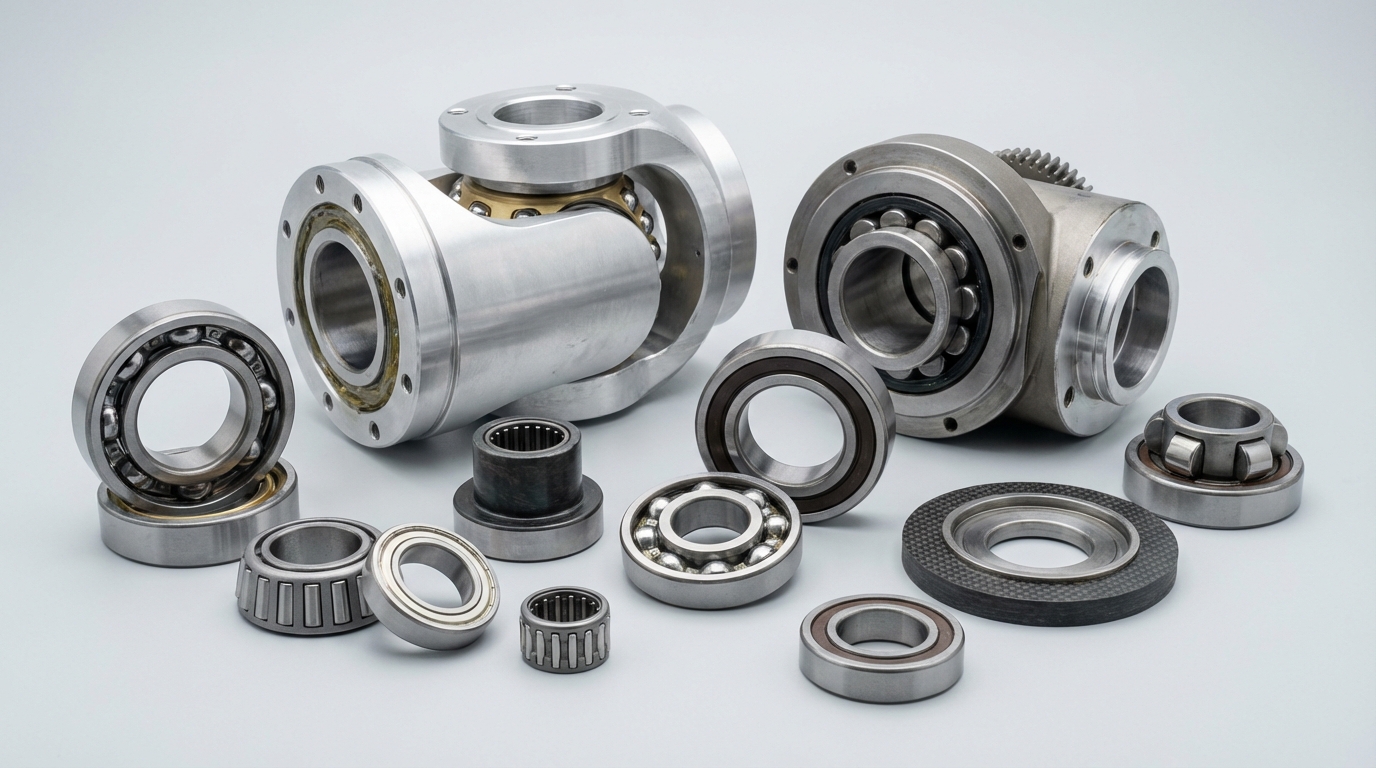
Typical joint stack-up (from motor to output)
- Motor + encoder (position feedback)
- Brake (optional, for vertical axes)
- Reducer (harmonic/RV/planetary)
- Output bearing set (often cross-roller or angular-contact pair)
- Output flange + hollow shaft (often for cables/air)
- Seals + grease management (life lubrication or relube port)
Haron Bearing Pro Tip: Our technicians often see joint stiffness blamed on the reducer, but the housing ribs and bearing seat thickness dominate deflection. We routinely recommend verifying seat roundness, shoulder squareness, and bolt pattern stiffness before changing bearing grade.
Do robots have bearings?
Yes—nearly all industrial and collaborative robots use bearings in each rotational axis to support loads, keep the reducer aligned, and deliver repeatable positioning. Bearings also appear in end-effectors, idlers, pulleys, and linear guides. Even small educational robots use bushings or miniature bearings to reduce friction and improve alignment.
Where bearings are typically found in robots
| Robot area | Common bearing/bushing solution | Purpose |
|---|---|---|
| Main rotary joints | Cross-roller / angular-contact pair / tapered pair | Moment stiffness + accuracy |
| Wheels/idlers | Deep-groove ball bearing | Low friction rotation |
| Grippers/end-effectors | Miniature ball bearings | Smooth actuation, longer life |
| Low-cost link pivots | Polymer bushings | Simplicity, contamination tolerance |
Haron Bearing Pro Tip: Our technicians often see premature wear caused by contamination and poor sealing, not load rating. We recommend selecting seals and grease first (duty cycle, washdown, dust), then confirming the bearing’s dynamic capacity and preload method.
What is a bearing in robotics?
A bearing in robotics is a precision machine element that constrains motion (usually rotation) while reducing friction and maintaining alignment under combined loads. In robot joints, bearings carry radial/axial forces and overturning moments so the motor and reducer can deliver accurate, repeatable motion with controlled torque, runout, and stiffness.
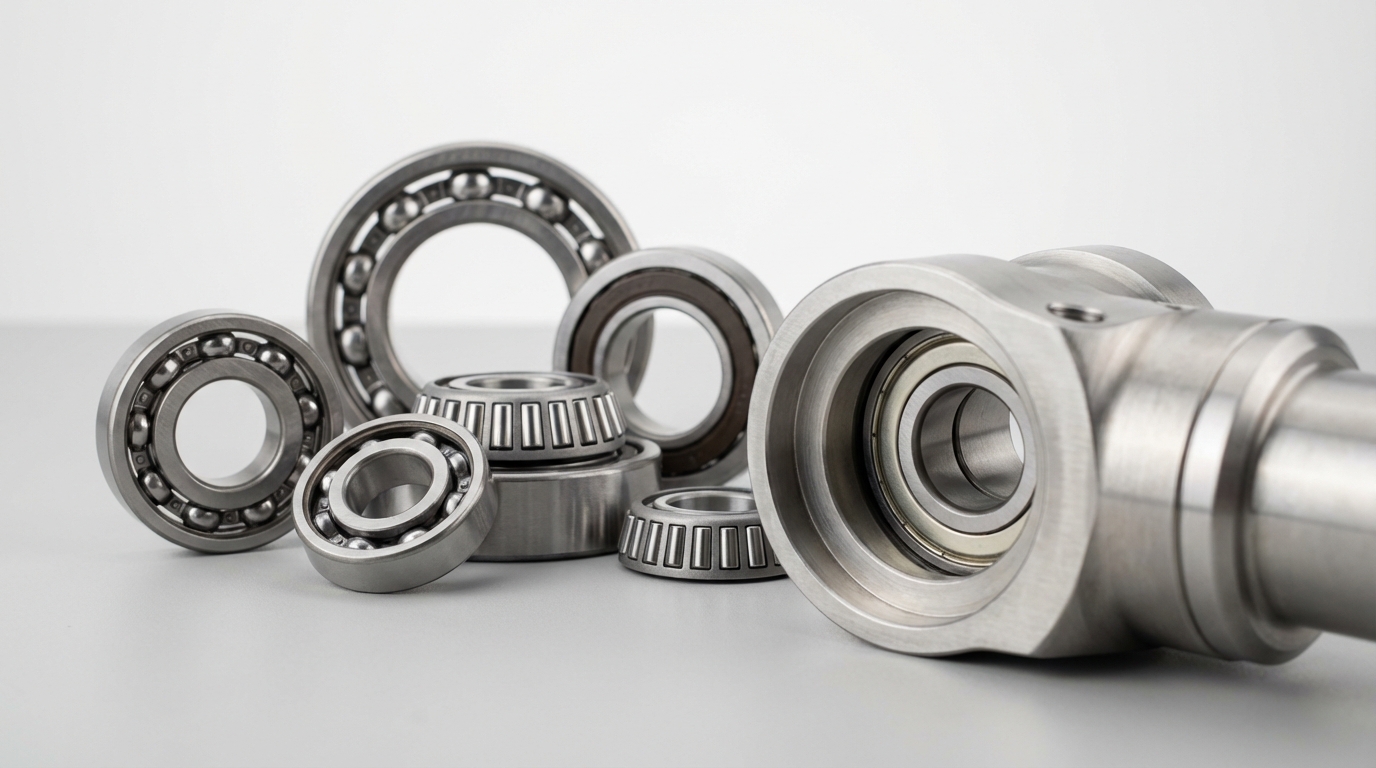
What the bearing is “doing” in a robot joint
- Load support: radial + axial + moment loads from payload and acceleration
- Accuracy control: runout, tilt, and deflection directly affect TCP repeatability
- Torque management: preload and lubrication influence friction and heat
- Life: fatigue life depends on load spectrum, contamination, and grease life
Haron Bearing Pro Tip: Our technicians often see joints that meet catalog load ratings but still fail accuracy targets. We focus on tilting stiffness and preload stability under temperature rise—especially for wrists where small deflection becomes large TCP error.
What type of joints are in the Scara robot?
SCARA robots typically use two coplanar revolute joints (R-R) for X-Y motion, a vertical prismatic joint (Z), and a final wrist revolute joint (R) for tool rotation—often described as R-R-P-R. Bearing choices follow this: high moment bearings on the first two axes and compact precision bearings on the wrist.
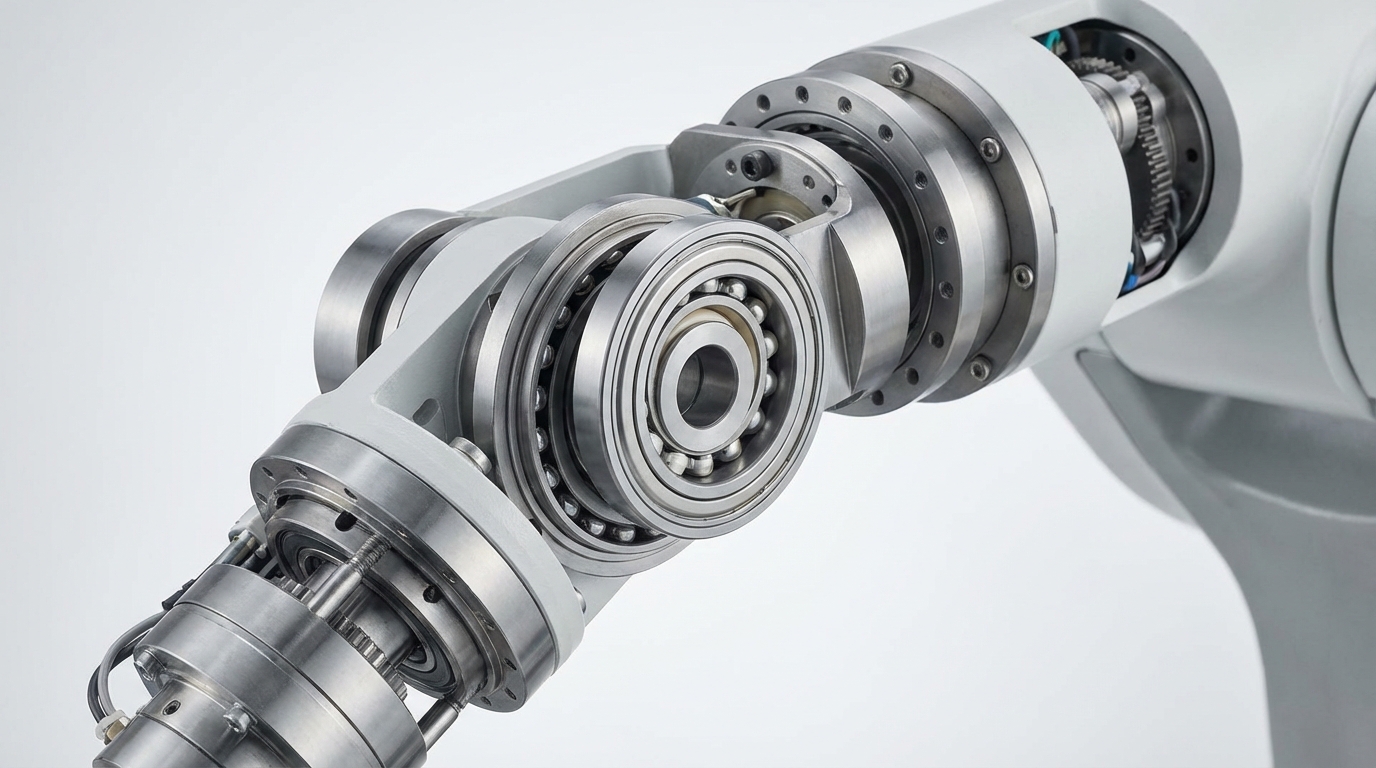
Typical SCARA axis layout and bearing implications
| SCARA axis | Motion | Common bearing choice | Why |
|---|---|---|---|
| J1 (base) | Revolute | Cross-roller / slewing ring | High moment from arm reach |
| J2 (shoulder) | Revolute | Cross-roller / paired angular-contact | High moment + precision |
| Z axis | Prismatic | Linear guide + ball screw bearings | Vertical stiffness + smooth travel |
| Wrist | Revolute | Thin-section angular-contact / deep-groove | Compact, low inertia |
Haron Bearing Pro Tip: Our technicians often see SCARA J2 accuracy limited by housing flex and reducer mounting rather than the bearing grade. We recommend verifying flange flatness and bolt torque sequence before upgrading to higher-precision bearings.
What’s your wholesale price and MOQ for robot-joint bearings (e.g., cross-roller, thin-section, harmonic drive bearings)?
Wholesale price and MOQ depend on bearing type, precision grade, size, preload class, material, seals, and whether it’s standard or customized for a reducer interface. For most robot-joint bearings, typical MOQ ranges from 1–20 pcs for standard items and 50–200 pcs for custom. Contact Haron Bearing with sizes and drawings for a quote.
What we need to quote accurately (send these)
- Bearing type (cross-roller / thin-section / angular-contact pair / integrated)
- Dimensions (ID × OD × width) and ring configuration
- Precision target (runout/tilt, ISO/ABEC class) and preload requirement
- Load spectrum (radial/axial/moment), speed, duty cycle, temperature
- Lubrication (grease type, relube interval) and sealing requirement
- Certifications/documentation needed (see below)
Haron Bearing Pro Tip: Our technicians often see RFQs missing the tilting moment and required preload. When you share those two items plus envelope limits, we can usually propose a cross-roller vs angular-contact solution with predictable stiffness and torque—avoiding over-design and unnecessary cost.
Which bearing types and sizes do you recommend for specific robot joints (shoulder/elbow/wrist), and what lead times and certifications do you offer?
For shoulders and elbows, we typically recommend cross-roller bearings (or paired tapered rollers for heavy payload) sized by overturning moment and stiffness targets; for wrists, thin-section angular-contact pairs or thin deep-groove bearings are common for compact, low-inertia designs. Lead times vary by size/grade; standard sizes are faster than customized.
Practical joint-by-joint recommendation framework
| Joint | Primary design driver | Common recommendation | Sizing “quick check” inputs |
|---|---|---|---|
| Shoulder (J2) | Highest moment + stiffness | Cross-roller bearing (preloaded) | Max payload, reach, accel/decel, required tilt/deflection |
| Elbow (J3) | High moment, compactness | Cross-roller or matched angular-contact | Moment load + envelope + allowable torque |
| Wrist (J4–J6) | Low inertia + precision | Thin-section angular-contact pair (DB/DF) or thin deep-groove | Speed, temperature rise, preload stability, runout |
| Base (J1) | Moment + mounting tolerance | Cross-roller or slewing ring | Moment load + contamination + sealing |
Lead times & certifications (typical offerings)
- Lead time: depends on size/grade and customization; standard catalog items are shortest, custom rings/preload/seals take longer.
- Certifications/docs: commonly available include material certs, dimensional inspection reports, and quality-system documentation (availability depends on order requirement and part family).
Haron Bearing Pro Tip: Our technicians often see wrist joints over-preloaded to “fix backlash,” which increases heat and shortens grease life. We recommend separating transmission backlash (reducer/gearbox) from bearing stiffness targets, then setting preload to meet torque and temperature limits at maximum duty cycle.
Bearings used in robot joints must be selected for combined loads, stiffness, accuracy, and mounting quality to achieve repeatable performance.