
Thin section bearings for robotics enable compact joints without sacrificing accuracy: they keep a constant cross‑section while offering high radial/axial load capacity, low friction, and tight runout control. Compact design matters because it reduces joint envelope and inertia, improves positioning, and can raise payload-to-weight ratio while extending service life.
Working Principle: Why Thin Cross-Section Changes Robot Performance
Thin section bearings for robotics maintain a constant ring cross-section across bore sizes, so designers can scale joint diameter (for torque and stiffness) without a proportional increase in bearing thickness. In robotic joints, this reduces package size, lowers rotational inertia, and supports precise, repeatable motion under combined loads.
Key technical effects in compact robot joints (summary):
| Design lever | What changes | Result in robotics joints |
|---|---|---|
| Constant cross-section | Thin rings for large bores | More hollow space for cables, brakes, encoders |
| Reduced mass at radius | Lower polar moment | Faster accel/decel, lower motor sizing |
| Precision race geometry | Better runout control | Improved repeatability and path accuracy |
| Optimized contact geometry | Lower friction/heat | Longer grease life, higher duty cycle |
Haron Bearing Pro Tip: In our lab tests at Haron Bearing, we found that thin section bearings most often fail prematurely due to installation distortion (housing out-of-round, face misalignment) rather than basic load rating limits—so we prioritize ring stiffness matching, controlled fits, and flatness targets as much as dynamic rating.
How does Thin Section Bearings for Robotics: Why Compact Design Matters work?
Thin section bearings for robotics work by using a constant, thin ring cross-section with precision raceways to carry radial and axial loads in a compact envelope. This lets robot joints achieve large inner diameters for stiffness and routing space while minimizing added mass, friction, and joint stack height—directly improving dynamics and accuracy.
Load Paths and Joint Integration (What to Watch)
- Define load case: radial, axial, and moment loads from arm reach, tooling, and acceleration.
- Select bearing type: deep groove ball bearing (primarily radial), angular contact bearing (combined), or four-point contact bearing (bi-directional axial + moment in one row).
- Control distortion: thin rings are more sensitive to housing/shaft geometry, so tolerance stack-up matters.
- Seal/lube for duty: choose grease, preload level, and sealing for cycle rate and contamination.
Haron Bearing Pro Tip: Our technicians often see joint friction spikes traced to over-preload combined with tight housing fits. We recommend verifying starting torque after press-fit and checking that the housing roundness is within your bearing’s allowable distortion envelope.
Benefits of using Thin Section Bearings for Robotics: Why Compact Design Matters
The benefits of thin section bearings for robotics include smaller joint packages, lower inertia for faster motion, high precision for repeatability, and improved routing space for cables and sensors. When specified correctly, they also reduce heat generation and can lower lifecycle costs by improving lubrication life and minimizing drivetrain losses.
Benefits vs. What They Replace (Quick Comparison)
| Metric | Thin section bearings (robot joints) | Standard bearings (same bore) |
|---|---|---|
| Joint envelope | Smaller | Larger |
| Inertia | Lower | Higher |
| Sensitivity to distortion | Higher (needs better geometry) | Lower |
| Precision potential | High | Moderate–high (depends on series) |
| Cable/utility routing | Easier (more hollow space) | Harder |
Haron Bearing Pro Tip: Our technicians often see the biggest “hidden” benefit in robots as thermal stability: lower friction reduces temperature rise, which helps maintain encoder alignment and repeatability over long duty cycles.
Maintenance tips for Thin Section Bearings for Robotics: Why Compact Design Matters
Maintenance for thin section bearings for robotics focuses on contamination control, lubrication condition, and monitoring torque/temperature trends. Keep seals intact, avoid solvent wash-down unless relubrication is planned, and inspect for mounting-induced distortion during rebuilds. Predictive checks like vibration and starting torque help catch issues before accuracy degrades.
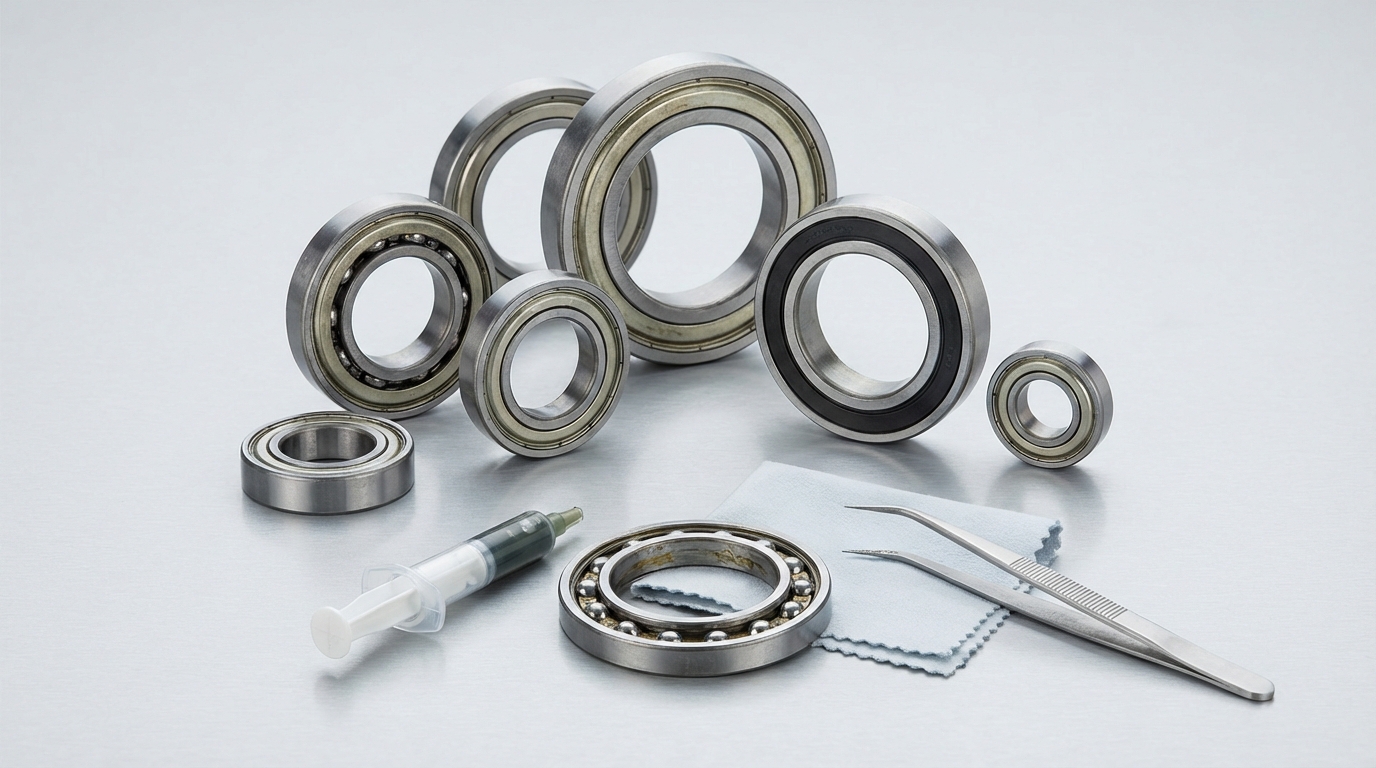
Preventive Maintenance Checklist (Robotics-Focused)
- Trend starting torque per joint (baseline vs. current).
- Check temperature rise at steady cycle rate (bearing/gearbox).
- Inspect seals and labyrinths for damage and grease purge patterns.
- Relubricate on condition: discoloration, noise, increased torque, or duty-cycle thresholds.
- Verify fits on rebuild: housing roundness, shoulder squareness, clamp force uniformity.
Haron Bearing Pro Tip: Our technicians often see relube failures caused by incompatible grease chemistry. We standardize grease families per robot platform and require a full purge procedure when changing grease type to prevent thickener incompatibility and channeling.
What wholesale pricing and MOQ options do you offer for thin section bearings used in compact robotics joints?
For thin section bearings for robotics, our wholesale pricing depends on bearing type (four-point, angular contact), precision grade, material, coatings, and inspection requirements. We typically support low-to-medium MOQs for standard sizes, with price breaks at higher quantities. For OEM programs, we can lock pricing with forecast commitments and PPAP-style documentation.
Typical Commercial Options (What We Can Quote Fast)
| Item | Common options |
|---|---|
| MOQ (standard catalog) | Often low MOQ; varies by size/spec |
| MOQ (custom) | Higher MOQ for non-standard rings, coatings, special grease |
| Lead time | Stock to short lead; custom programs longer |
| Pricing drivers | Precision class, preload, material, seals, special testing |
Haron Bearing Pro Tip: Our technicians often see OEMs underestimate the cost impact of “small” spec additions like tighter runout or full-lot traceability. We help you split requirements into must-have vs nice-to-have so you hit performance without over-specifying.
How does your compact thin section bearing design impact robot payload, stiffness, and lifecycle cost versus standard bearings?
Our thin section bearings for robotics improve payload-to-weight by reducing joint mass and inertia, enabling smaller motors/gear stages for the same motion profile. Stiffness can be increased by allowing larger bearing diameters in the same envelope, but it requires controlled housing geometry to avoid distortion. Lifecycle cost drops via lower friction, heat, and maintenance frequency.
Engineering Tradeoffs (Payload vs Stiffness vs Cost)
| Factor | Thin section approach | Standard bearing approach |
|---|---|---|
| Payload (system) | Higher potential via lower joint inertia and mass | Often limited by heavier joint stack |
| Joint stiffness | High if diameter increases and preload is controlled | High but may require larger envelope |
| Accuracy | High with proper fits and runout control | Good; less sensitive to distortion |
| Lifecycle cost | Often lower (energy + service intervals) | Can be higher due to friction/heat |
| Risk | Sensitive to mounting distortion | More forgiving |
Haron Bearing Pro Tip: Our technicians often see stiffness complaints that are actually housing compliance problems. We co-review joint cross-sections and recommend shoulder thickness, clamp patterns, and fit strategy so the bearing operates at its intended preload and stiffness.
In short: thin section bearings for robotics make compact joint design practical—improving dynamics, routing space, and precision when the surrounding structure and fits are engineered to protect thin rings from distortion.