
Selecting bearings for collaborative robots (cobots) requires balancing precision, low friction, compact packaging, and long service life under frequent start-stop motion and human-safe torque limits. The right cobot bearings reduce vibration, improve repeatability, and protect gearboxes and motors. Below is a practical, engineering-led approach to specifying, comparing, and purchasing bearings for collaborative robots.
Video Guide: This overview explains why bearings matter in robotics and automation, linking friction, rigidity, accuracy, and reliability.
What is bearings for collaborative robots / cobot bearings?
Bearings for collaborative robots (cobot bearings) are engineered rolling-element or plain bearing solutions used in cobot joints and end-effectors to support radial/axial loads, control runout, and maintain stiffness with low friction. They are typically compact, quiet, and optimized for repeatable motion, high duty cycles, and safe operation near people.
Typical bearing locations and bearing families in cobots
Cobots concentrate bearing performance in joint modules (base, shoulder, elbow, wrist) and in tooling such as grippers and rotary tables. Most “cobot bearings” are not a single type—rather a set of bearing choices matched to each axis’ load, moment, speed, and precision targets.
- Joint bearings (high moment loads): crossed roller bearings, thin-section angular contact bearings, four-point contact bearings
- Motor support bearings (higher speed): deep groove ball bearings, angular contact ball bearings
- Gearbox support (stiffness/positioning): paired angular contact, tapered roller (less common in compact cobots), cylindrical roller (select cases)
- End-effector/tooling (compact, contamination exposure): stainless bearings, sealed deep groove, polymer/plain bearings for low-load pivots
Haron Bearing Pro Tip: I treat “cobot bearings” as a joint-level system decision—bearing type, preload, seals, and lubricant must match the harmonic/planetary gearbox behavior, not just the catalog load rating.
How Does bearings for collaborative robots / cobot bearings Work?
Cobot bearings work by separating moving parts with rolling elements (balls/rollers) or low-friction sliding interfaces to carry loads while enabling smooth rotation. In robot joints, they manage combined radial, axial, and overturning moments, converting motor torque into controlled motion with minimal deflection—critical for repeatability, force sensing, and safe collaboration.
Video Guide: This tutorial demonstrates bearing fundamentals—how they reduce friction and support shafts—which maps directly to joint and motor support in cobots.
Load paths in cobot joints (why stiffness matters)
In collaborative robots, you often see frequent acceleration/deceleration, short strokes, and constant micro-corrections from control loops. Bearings must provide:
- Stiffness (tilting rigidity): to resist end-effector moment loads and maintain TCP accuracy
- Controlled friction/torque: to keep motor sizing reasonable and improve backdrivability where needed
- Predictable preload: to limit backlash and runout without overheating
Key mechanisms:
- Raceways guide rolling elements to constrain motion to rotation while carrying load.
- Contact angle (ball bearings) or line contact (roller bearings) determines axial capacity and stiffness.
- Preload removes internal clearance to improve rigidity and repeatability, but increases friction and heat.
- Seals and lubrication stabilize torque, reduce wear, and protect from dust/coolant in collaborative workcells.
Haron Bearing Pro Tip: If a cobot joint “feels fine” by hand but fails repeatability under load, it’s usually a tilting stiffness issue—start by checking bearing type/preload and the moment load at maximum reach, not just radial load.
How to choose the bearing?
Choose cobot bearings by first defining the joint’s combined loads (radial/axial/moment), target stiffness, speed, and allowable friction torque. Then select a bearing type that matches the moment load and packaging, decide preload class, sealing and lubrication, and finally validate life and thermal performance under the real duty cycle.
A practical selection workflow (joint-by-joint)
- Define the axis requirements
- Payload, reach, tool mass, external forces, acceleration profiles
- Required repeatability/deflection limit at the TCP
- Speed, duty cycle, ambient temperature, contamination
- Convert to bearing loads
- Radial load (Fr), axial load (Fa), and overturning moment (M) at the joint
- Consider worst-case orientations (gravity vectors change by pose)
- Select the bearing family (by dominant requirement)
- High moment + compact: crossed roller / four-point contact
- Higher speed + paired stiffness: angular contact pair
- General support: deep groove (usually not sufficient alone for high moments)
- Set internal clearance/preload
- Light preload for low torque/backdrivability
- Medium/high preload for accuracy and stiffness (watch heat)
- Choose sealing, lubrication, and materials
- Grease for life vs relube design
- Low-noise grease for collaborative spaces
- Corrosion-resistant variants if washdown/chemicals exist
- Validate
- ISO/ABMA life calculations (including duty cycle)
- Thermal check (friction torque × speed)
- Mounting fits, housing stiffness, and shaft/housing runout stack-up
Haron Bearing Pro Tip: I always ask for the cobot’s “worst pose”—max reach, max payload, tool offset—because that’s where the joint moment spikes and a “safe-looking” bearing choice becomes under-sized fast.
Which of the following best characterizes collaborative robots (cobots) in contrast to traditional industrial robots?
Collaborative robots are designed to operate safely near people using force/torque limiting, speed monitoring, and rounded, lower-inertia structures—often without full fencing—while traditional industrial robots prioritize maximum speed, payload, and throughput in segregated cells. This difference drives bearing choices toward quieter operation, smoother torque, and predictable friction.
Video Guide: This introduction clarifies how cobots differ from traditional robots, which helps explain why joint friction, noise, and safety-driven dynamics matter to bearing selection.
Design implications for cobot bearings
Because cobots emphasize safe interaction and controlled contact forces, bearings often must balance stiffness with controlled torque.
- Lower allowable joint friction torque to support backdriving and force sensing
- Noise and vibration control for human-adjacent environments
- High repeatability at moderate payloads with frequent small motions
- Robust sealing for flexible deployment (benches, labs, light industrial)
Haron Bearing Pro Tip: When a cobot uses torque sensing (direct or observer-based), inconsistent bearing torque (poor lubrication choice, seal drag variation) shows up as “bad force control”—spec torque ripple, not only average torque.
What are the 7 main parts of a robot?
The seven main parts commonly referenced are the controller, actuators (motors/drives), mechanical structure (links/arm), joints/transmission, sensors, end effector, and power system. Bearings primarily live in joints, transmissions, and motor supports, where they determine stiffness, friction, and durability—directly affecting accuracy, force control, and uptime.
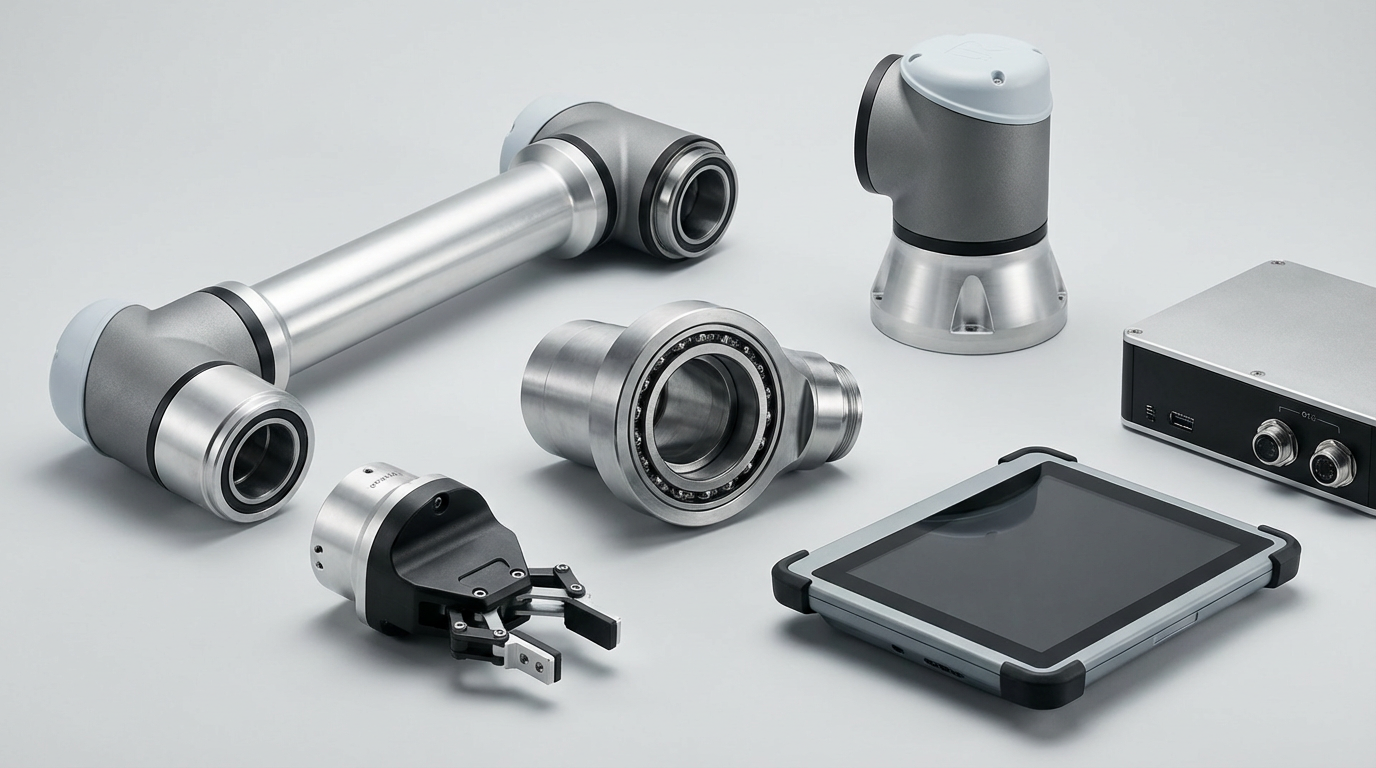
Where bearings fit within the robot architecture
- Controller: motion planning and servo control (indirectly sensitive to friction/stiction)
- Actuators: motors + drives; bearings support rotor/shaft alignment
- Structure (links): bearing seats require stiffness to avoid deformation
- Joints/transmission: bearings manage combined loads and maintain axis alignment
- Sensors: encoders/torque sensors depend on low runout and stable mechanics
- End effector: bearings enable gripper pivots, rotary wrists, tooling spindles
- Power system: cabling and energy chains impose additional drag/loads that reflect into joints
Haron Bearing Pro Tip: If you’re troubleshooting accuracy, don’t isolate bearings from the structure—thin housings and flexible joint plates can “undo” a premium bearing by letting the outer ring ovalize under moment load.
Key Features & Comparison
Key cobot bearing features include high tilting rigidity, compact cross-sections, stable preload, low and repeatable friction torque, effective sealing, and long grease life. Comparing bearing families by moment capacity, stiffness, speed, and integration risk helps you pick the right joint architecture—especially at the wrist where space is tight and precision is most visible.
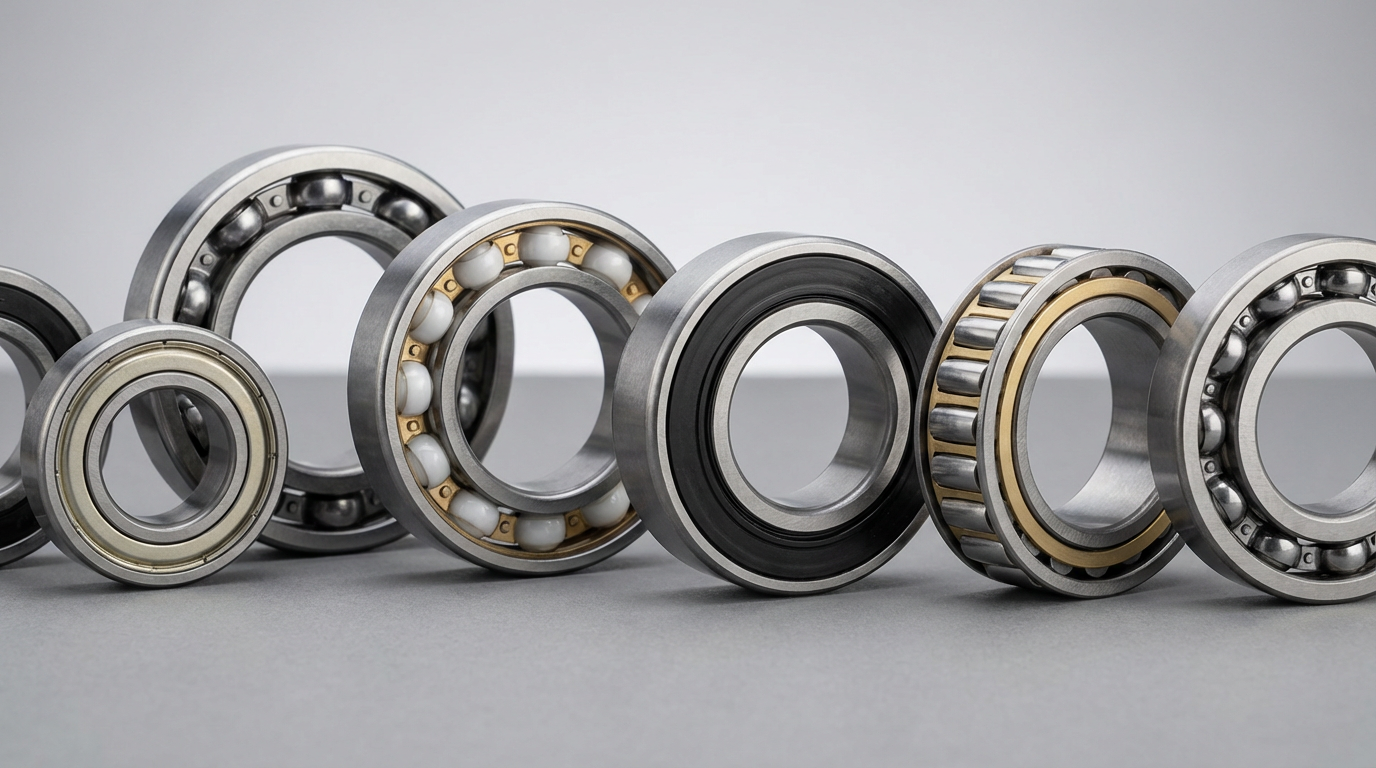
Cobot bearing families compared for joint use
Based on our internal data and market analysis, here is the breakdown:
| Bearing type | Best for cobot locations | Strengths | Trade-offs | Typical selection cue |
|---|---|---|---|---|
| Crossed roller bearing | Shoulder/elbow/wrist joints | Very high tilting stiffness, compact, handles combined loads | Sensitive to mounting accuracy; torque rises with preload | High moment load + tight space + high repeatability |
| Thin-section angular contact (paired) | Wrist joints, compact modules | Good axial stiffness, higher speed capability | May need two bearings + spacing; less moment capacity than crossed roller at same envelope | Moderate moment + need speed + controlled preload |
| Four-point contact ball bearing | Turntables, compact joints | Takes axial loads in both directions, compact | Stiffness lower than crossed roller; friction/clearance management critical | Compact joint where simplified assembly is needed |
| Deep groove ball bearing | Motor support, light joints | Low cost, widely available, good speed | Limited axial/moment stiffness without pairing | Motor shaft support or low-moment axes |
| Cylindrical roller bearing | Some gearbox supports | High radial stiffness, good for radial loads | Poor axial capacity without additional bearing | High radial load with separate axial constraint |
| Plain/polymer bearing | Light pivots, tooling | No rolling-element noise, tolerant of dirt, low cost | Wear, higher friction, lower precision | Low load, oscillation, contamination-prone tooling |
Haron Bearing Pro Tip: In cobot wrists, I often prefer “stiffness-per-mm” over raw load rating—crossed roller or properly spaced angular contact pairs usually outperform a bigger deep-groove bearing that still allows tilt.
Cost & Buying Factors
Cobot bearing cost is driven by precision grade, thin-section geometry, preload specification, sealing, and lubrication requirements—not only size. Buying factors should include total joint performance (stiffness/torque consistency), mounting and tolerance support, grease life targets, and supplier quality controls. A slightly higher unit price often reduces integration risk and warranty exposure.
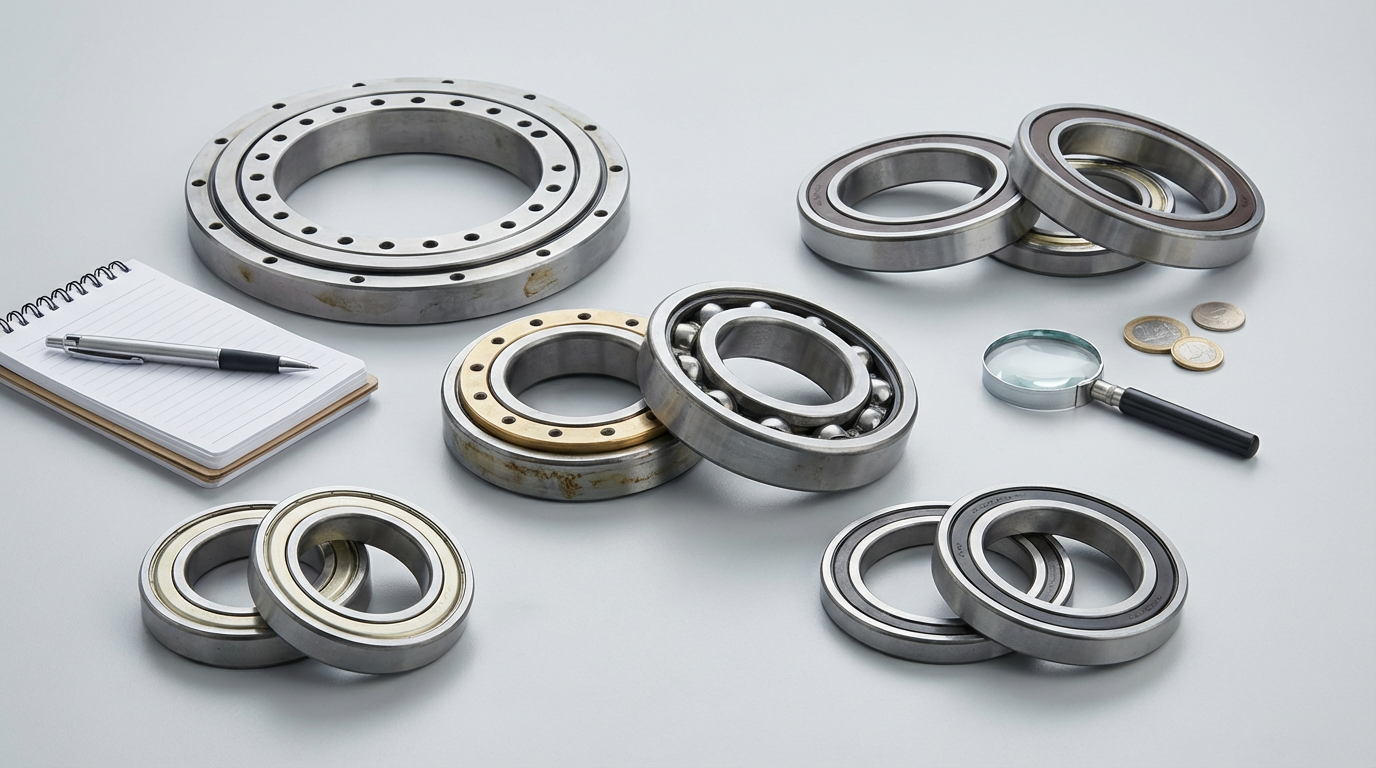
What to evaluate before purchasing
- Performance requirements
- Target deflection/stiffness at load
- Friction torque window (average and ripple)
- Runout and repeatability targets
- Reliability and environment
- Seal type and ingress protection needs
- Grease specification (noise, low-temperature, life)
- Corrosion resistance (humidity/washdown)
- Integration and quality
- Fit recommendations (shaft/housing tolerances)
- Preload/clearance verification method
- Traceability, incoming inspection data, batch consistency
- Commercial factors
- Lead time stability, MOQ, customization ability
- Technical support for failure analysis and mounting design
Haron Bearing Pro Tip: I recommend budgeting for testing, not just parts—run a short torque-vs-temperature and repeatability-under-load validation on the first batch; it’s the fastest way to catch preload, grease, or seal drag issues before scaling.
Conclusion
Choosing bearings for collaborative robots is a joint-level engineering decision that directly affects accuracy, safe force interaction, noise, and service life. Define real load cases (especially moment loads), select the right bearing family and preload, and validate torque and thermal behavior under the duty cycle. Haron Bearing can support cobot bearing selection with application review, preload guidance, and integration recommendations for stable, repeatable joint performance.