
Robot accuracy is not only a controller or calibration topic—the mechanical stack-up in each joint often sets the real ceiling. Bearing precision for robots (robot bearing accuracy) influences repeatability, path smoothness, stiffness under load, and long-term drift as wear accumulates. Selecting the right precision class, preload, and lubrication strategy is a direct lever for better TCP accuracy and stability.
Video Guide: Use this overview to connect “why bearings matter in automation” with how precision and stiffness translate into practical robot accuracy.
What is bearing precision for robots / robot bearing accuracy?
Bearing precision for robots (robot bearing accuracy) describes how tightly a bearing controls runout, internal geometry, and rotational smoothness under load. In robot joints, it mainly shows up as lower backlash, lower radial/axial runout, and more consistent stiffness—so the end-effector stays closer to commanded position across speeds and payloads.
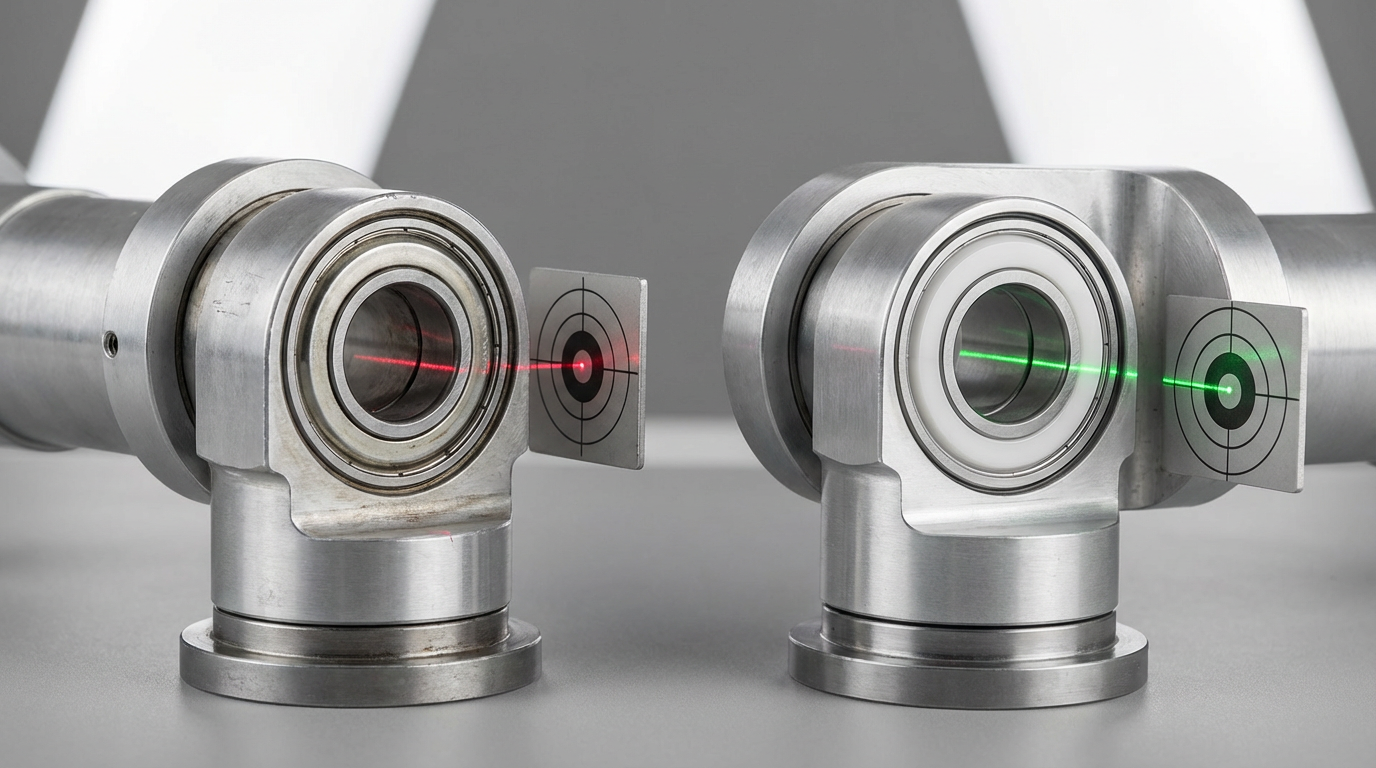
Precision elements that matter in robot joints
Robot joints amplify small geometric errors into visible TCP deviation, especially with long arms and high moment loads. “Precision” is not one single number—it is a bundle of manufacturing tolerances and assembly conditions that determine how the bearing behaves when the reducer and motor apply torque.
Key components of robot bearing accuracy typically include:
- Radial runout: how much the bearing center wanders while rotating, affecting circular interpolation and smooth motion
- Axial runout: axial wobble that impacts tool Z positioning and surface finish in process tasks
- Raceway geometry & waviness: micro-geometry that drives vibration, noise, and servo following error
- Internal clearance / preload: directly impacts joint stiffness and lost motion
- Cage guidance and stability: influences torque ripple and repeatable friction behavior
Haron Bearing Pro Tip: When you evaluate “precision,” ask for runout and stiffness under the same preload and load direction your joint sees, not only free-running catalog values—robot joints rarely run in ideal, unloaded conditions.
How Does bearing precision for robots / robot bearing accuracy Work?
Robot bearing accuracy works by controlling elastic deflection and geometric error at the joint so the reducer output axis stays stable during rotation, acceleration, and payload changes. Higher precision bearings reduce runout and friction variation, enabling the servo loop to track commands with less compensation and fewer micro-corrections that create path error.
How precision turns into measurable robot accuracy
A robot joint is a system: motor + reducer (harmonic/cycloidal/planetary) + bearings + housing + encoder. Bearings contribute in two big ways:
- Geometric fidelity (runout and axis stability)
- Mechanical stiffness (how much the axis deflects under moment load)
A practical cause-and-effect chain looks like this:
- Bearing raceway accuracy + controlled preload reduce internal motion
- Lower axis runout improves encoder-to-output axis alignment consistency
- Higher stiffness reduces tool-tip deflection under acceleration/payload
- More stable friction improves servo tuning and following performance
- Less heat/wear drift preserves accuracy over time between calibrations
Common robot-level symptoms linked to insufficient bearing precision:
- Good static accuracy but poor path accuracy at speed (friction variation, waviness)
- Orientation drift when payload changes (insufficient moment stiffness)
- Growing backlash-like behavior after hours (wear from poor lubrication or contamination)
Haron Bearing Pro Tip: If your robot shows accuracy changes with payload direction (up vs. side load), prioritize moment-load stiffness and preload stability—runout alone won’t fix gravity-dependent TCP shift.
What are the benefits of bearing precision for robots / robot bearing accuracy?
Higher bearing precision for robots improves repeatability, reduces vibration, and increases joint stiffness—leading to tighter TCP control during fast motion and heavy payload changes. It also stabilizes torque and friction, which helps servo tuning, reduces heat generation, and extends the time before recalibration or mechanical adjustment is needed.
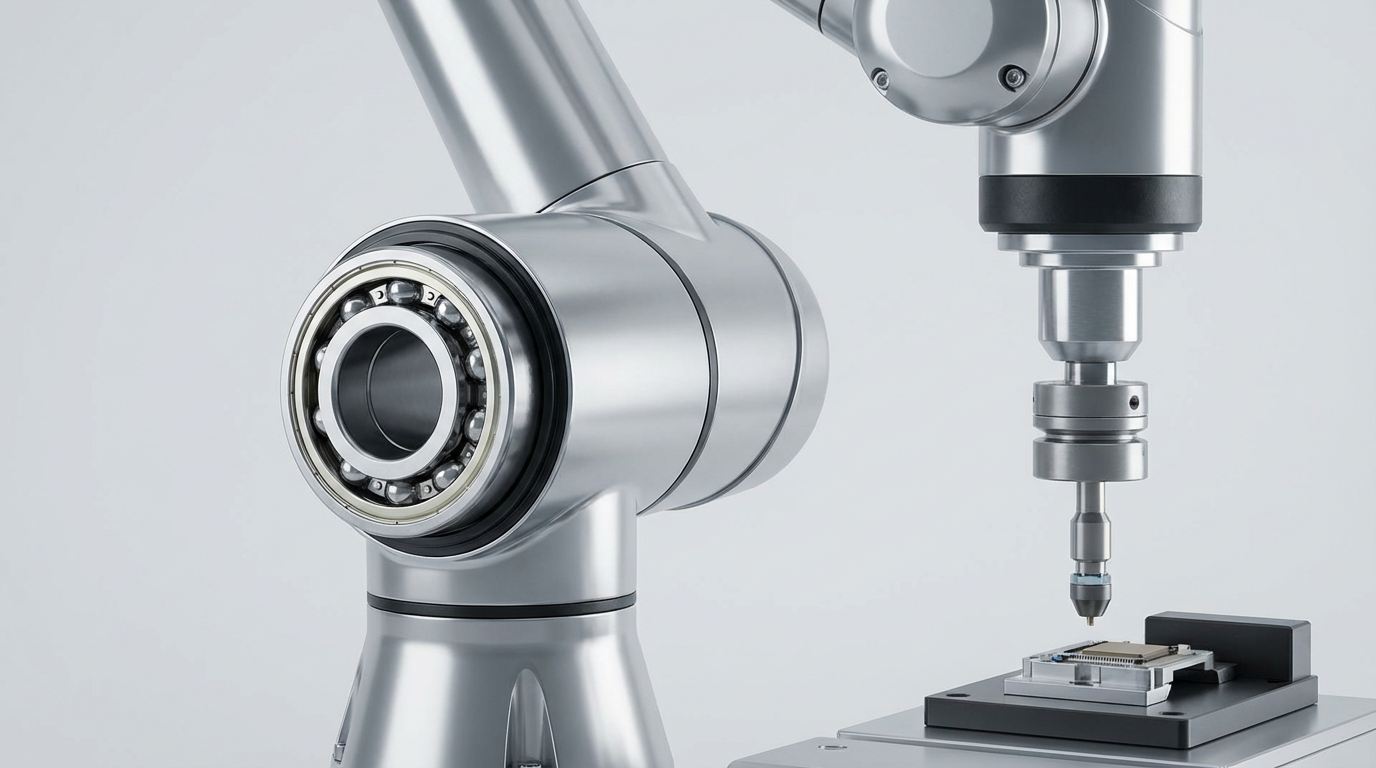
Operational benefits you can validate on the production floor
Precision bearings typically deliver value in three categories: quality, throughput, and maintenance risk.
- Better TCP stability during acceleration/deceleration (less elastic deflection)
- Improved circularity and contouring for arc paths, sealing beads, dispensing, and polishing
- Lower vibration supporting vision-guided tasks and better sensor repeatability
- More consistent cycle time because the controller needs less corrective motion
- Longer service life by reducing edge loading and wear from internal micro-slip
A quick mapping of benefits to common applications:
- Welding: steadier torch angle, less path wobble
- Dispensing/adhesives: more uniform bead width and placement
- Machine tending: more reliable insertion/pick accuracy
- Metrology/inspection: reduced vibration improves measurement stability
Haron Bearing Pro Tip: In high-speed robots, “precision” must include friction consistency—request torque variation data (or run a torque signature test) so your servo tuning stays stable across temperature and duty cycle.
How to maintain a bearing precision for robots / robot bearing accuracy?
Maintaining robot bearing accuracy depends on keeping preload, lubrication, and cleanliness stable over time. The biggest enemies are contamination, lubrication breakdown, and mounting distortion—each increases friction variability, wear, and runout. A structured inspection plan plus correct grease choice and sealing protects precision and extends calibration intervals.
A maintenance checklist that protects joint precision
Use a maintenance routine that targets the failure modes that degrade precision first.
- Control contamination
- Verify seals, breathers, and cable entry points
- Prevent washdown ingress and abrasive dust exposure
- Manage lubrication
- Use grease suited to speed factor and temperature
- Avoid over-greasing (churning raises heat and torque)
- Track relubrication intervals by duty cycle, not only time
- Prevent mounting distortion
- Follow torque patterns and housing tolerance requirements
- Check for shaft/housing fits that shift preload unintentionally
- Monitor condition
- Trend temperature at comparable loads and speeds
- Listen for new tonal noise; measure vibration if available
- Track repeatability drift or increased following error in logs
- Plan service actions
- Replace seals before bearings if contamination is suspected
- Re-verify joint preload after any reducer or housing work
Haron Bearing Pro Tip: The fastest way to lose precision is an invisible mounting error—after any joint rebuild, we always verify runout and torque under preload before closing the assembly, not after the robot is back on the line.
What is the price of bearing precision for robots / robot bearing accuracy?
Robot bearing accuracy pricing depends on bearing type, size, precision grade, preload design, sealing, and validation requirements. Higher precision typically adds cost through tighter runout tolerances, better raceway finishing, controlled preload, and higher QA sampling. For robots, the “true price” must include downtime risk, calibration frequency, and life under moment loads.
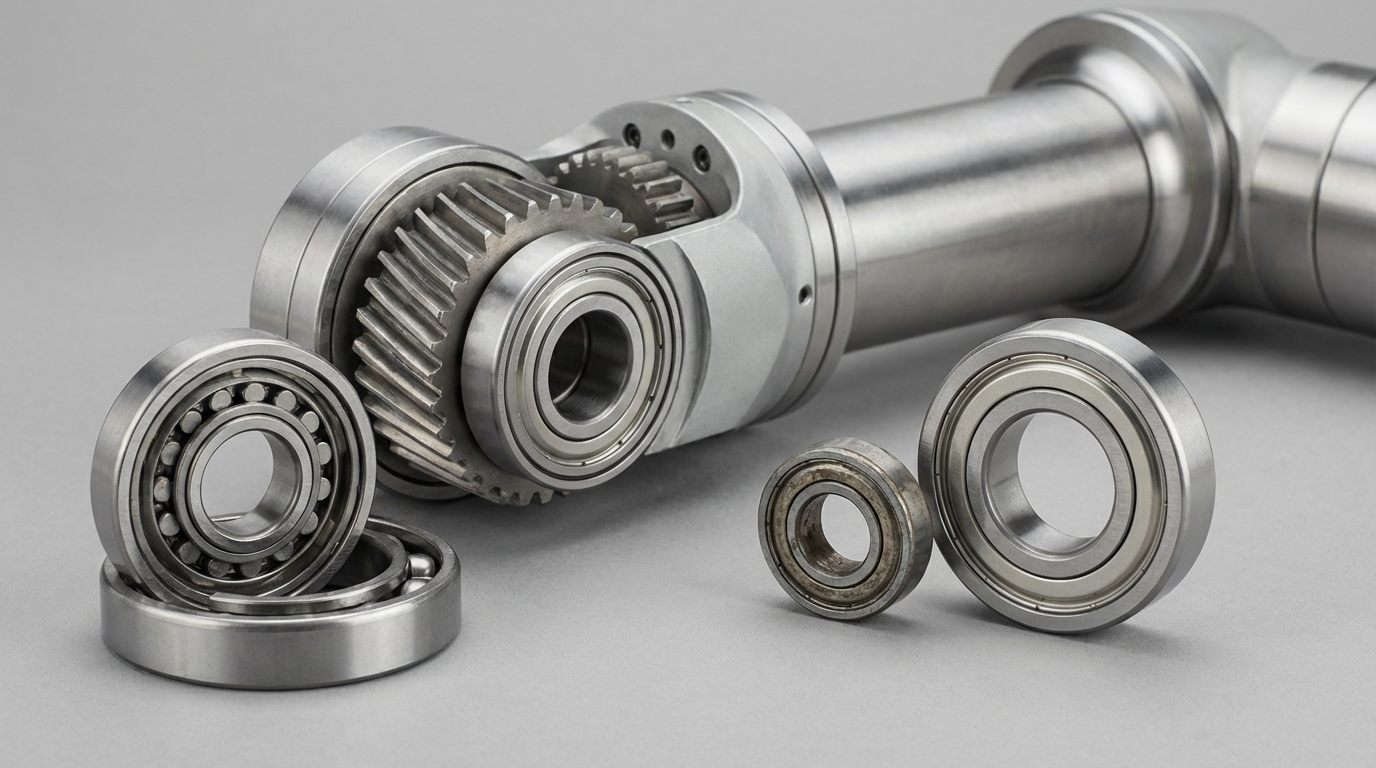
What drives cost up (and when it’s justified)
The main cost drivers usually include:
- Precision grade and runout limits (tighter geometry, more inspection)
- Integrated preload and matched sets (more process control)
- Moment-load capacity & stiffness (design and material choices)
- Sealing and corrosion protection (for harsh environments)
- Documentation and traceability (robot OEM and critical cell demands)
Typical procurement approaches:
- Cost-focused cells: standard precision where cycle loads are mild
- Quality-critical cells: higher precision + better sealing to avoid drift
- High-duty cells: prioritize stiffness and lubrication stability to maximize life
Haron Bearing Pro Tip: Don’t compare quotes by precision grade alone—ask what preload condition the runout spec assumes, and whether the supplier can provide stiffness/torque data for your load case. That’s where “cheap” bearings get expensive.
Key Features & Comparison
Robot bearing accuracy is best compared using stiffness under moment load, runout under preload, friction stability, sealing effectiveness, and life in your duty cycle. A bearing that looks similar on basic dimensions can behave very differently in a robot joint, especially under reversing torque and frequent acceleration where micro-slip and heat build-up.
Feature comparison that maps to robot joint outcomes
Based on our internal data and market analysis, here is the breakdown:
| Feature | What it controls in the robot | Higher-performance target | Trade-off / note |
|---|---|---|---|
| Radial/axial runout (under preload) | TCP deviation, contouring quality | Lower runout, stable across temperature | Must be specified under assembly preload |
| Moment-load stiffness | Deflection under payload and acceleration | Higher stiffness at working load | Too much preload can raise heat/torque |
| Preload stability | Repeatability over time | Minimal preload loss with cycles | Housing fits and torque sequence matter |
| Friction/torque consistency | Servo following, smooth motion | Low torque ripple, stable friction curve | Grease choice strongly influences this |
| Raceway waviness control | Vibration and noise | Lower waviness, better finishing | Often increases manufacturing cost |
| Sealing & contamination resistance | Long-term accuracy retention | Better ingress protection | May increase drag if over-specified |
| Material/heat treatment | Wear and fatigue life | Higher cleanliness steel, controlled hardness | Impacts lead time and cost |
Haron Bearing Pro Tip: If you must choose one metric to protect robot accuracy under real loads, choose stiffness at the joint’s working moment load—it directly limits deflection that calibration cannot fully remove.
Cost & Buying Factors
Buying for robot bearing accuracy is a balance of precision, stiffness, life, and risk. The right choice is the bearing that maintains performance under your joint’s moment load, speed profile, and environment—not the one with the tightest catalog tolerance. Evaluate total cost by including service intervals, scrap risk, and the cost of downtime.
A practical buying checklist for robot applications
- Define the accuracy need
- Repeatability vs. absolute accuracy vs. path accuracy requirements
- Specify the real load case
- Radial/axial loads, moment load, duty cycle, reversing torque frequency
- Align precision specs to assembly
- Runout under preload, preload method, fit class, housing tolerance
- Validate friction behavior
- Starting torque, torque ripple, temperature rise at speed
- Plan for environment
- Dust, coolant, washdown, corrosion—seal and grease selection accordingly
- Confirm QA and traceability
- Incoming inspection plan, certificates, sampling, batch traceability
- Compare total cost
- Bearing cost + expected life + maintenance labor + downtime exposure
Haron Bearing Pro Tip: When sourcing, we ask customers for the joint duty profile (speed, acceleration, payload, cycle time). With that, Haron Bearing can recommend precision and preload that protect accuracy without overpaying for tolerance you can’t use.
Conclusion
Robot bearing accuracy is a mechanical foundation for repeatable, stable positioning—especially under payload changes, high acceleration, and long duty cycles. By focusing on runout under preload, stiffness at working moment load, friction consistency, and disciplined maintenance, you can reduce drift and protect TCP performance. If you want a selection recommendation, Haron Bearing can size the right precision and preload from your joint load profile.