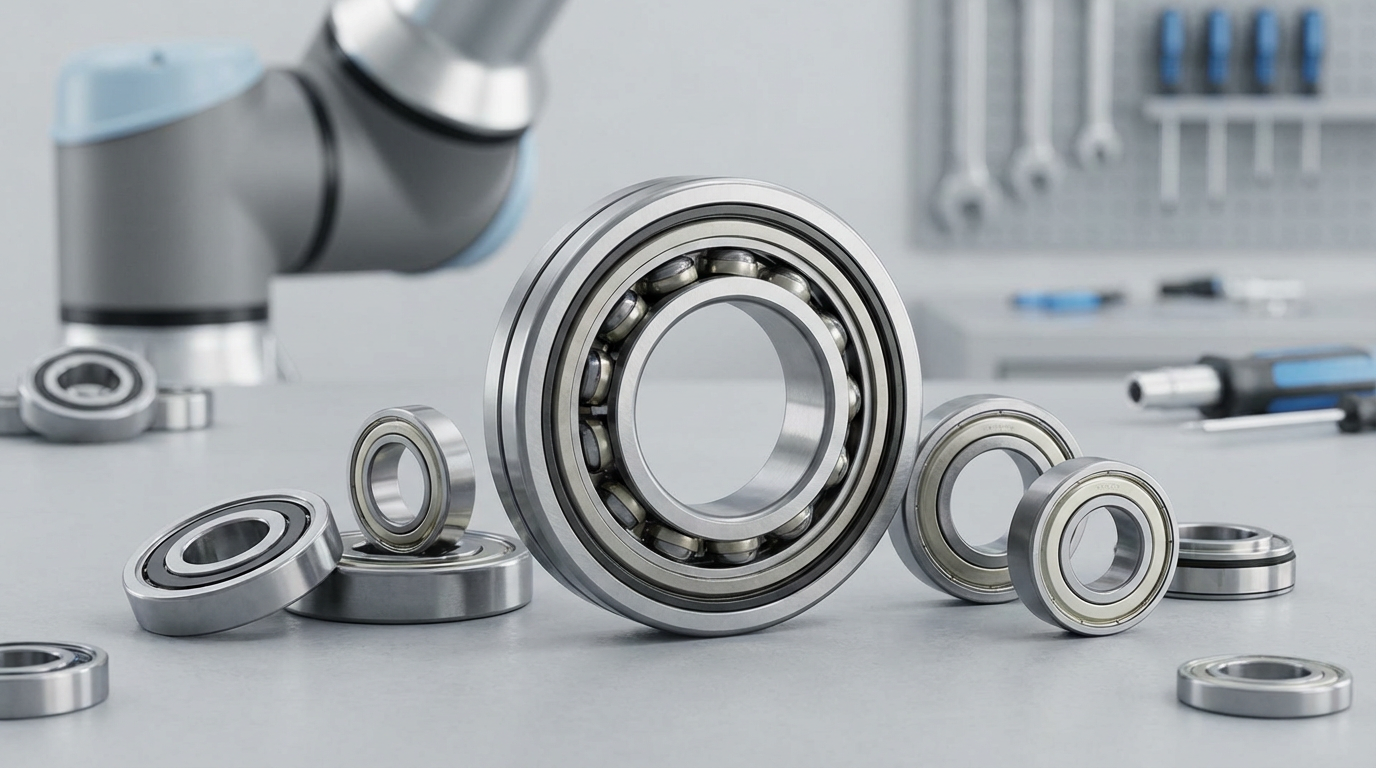
Robot bearing trends are shifting quickly as robots move into higher-speed, higher-precision, and human-adjacent tasks. Buyers who track the future of robot bearings will prioritize friction reduction, longer grease life, cleaner operation, and smarter condition monitoring—because these directly affect uptime, accuracy, and total cost of ownership. This guide highlights what to watch and how to specify bearings more confidently.
Video Guide: A practical overview of manufacturing-focused robotics trends that indirectly drive bearing requirements like precision, uptime, and maintainability.
What is robot bearing trends / future of robot bearings?
Robot bearing trends describe how bearing design, materials, lubrication, sealing, and monitoring are evolving to meet next-generation robot needs—higher torque density, faster cycles, better precision, and lower maintenance. The future of robot bearings emphasizes reliability, compactness, contamination control, and predictive health data to reduce downtime and stabilize accuracy.
What “trends” actually mean for bearing specifications
In robotics, “trend” is not a marketing label—it usually translates into measurable specification shifts such as tighter runout limits, longer relubrication intervals, higher rigidity in compact envelopes, and better behavior under frequent reversals.
Key trend drivers buyers should recognize:
- More robots, more duty cycles: 24/7 operation pushes fatigue life, lubricant life, and seal wear.
- Higher precision requirements: Vision-guided assembly and metrology tasks demand lower runout and lower friction variation.
- Human-robot collaboration: Cleaner operation (less grease bleed), lower noise, and more predictable failure modes matter.
- Decentralized maintenance: Plants want “replace-by-condition,” not “replace-by-calendar.”
A simple way to map “robot bearing trends” to purchasing language:
- Performance: friction torque, rigidity, runout, noise
- Durability: L10 life, lubricant life, corrosion resistance
- Maintainability: sealing concept, grease strategy, monitoring readiness
- Integration: compact cross-sections, lightweight components, standardized mounting
Haron Bearing Pro Tip: When a supplier talks about “robot bearing upgrades,” ask for the measurable delta—starting torque distribution, runout class, grease life at your rpm/temperature, and a seal wear estimate. If they can’t quantify it, it’s not a trend you can buy against.
How Does robot bearing trends / future of robot bearings Work?
Robot bearing trends “work” by aligning bearing engineering with modern robot loads: fast acceleration, frequent reversals, high moment loads, and compact joints. Improvements come from optimized raceway geometry, higher cleanliness steel, advanced heat treatment, low-torque seals, long-life greases, and optional sensorization—together stabilizing precision and extending service intervals.
The engineering mechanisms behind the trend
Most robot joint failures and performance drift trace back to a few physical mechanisms: lubricant starvation, contamination ingress, false brinelling/fretting during micro-motions, and fatigue under combined radial/axial/moment loads.
Common “future of robot bearings” upgrades and how they deliver value:
- Geometry optimization
- Raceway profile updates reduce stress concentrations under moment loads.
- Preload control targets rigidity without excessive friction.
- Material and heat-treatment improvements
- Higher cleanliness reduces inclusion-driven fatigue.
- Surface hardening and retained austenite control improve wear resistance.
- Lubrication evolution
- Grease formulations tuned for low torque and long life at robot joint temperatures.
- Improved oil separation control to prevent bleed and contamination.
- Sealing and contamination control
- Low-torque seals that still block fine particles and coolant mist.
- Better labyrinth designs in compact spaces.
- Condition monitoring enablement
- Provisions for vibration/temperature sensing and “health baselines.”
- Predictive maintenance shifts from reactive to planned shutdowns.
Buying takeaway: if your application has frequent micro-oscillation (teach mode, pick-and-place dithering), prioritize anti-fretting strategies (preload selection + grease + vibration exposure mitigation) over purely catalog L10 life.
Haron Bearing Pro Tip: Don’t evaluate friction torque only at steady rpm—request torque ripple data during start/stop and reversal. In robots, reversal behavior is where precision and heat buildup often diverge from catalog expectations.
What are the future trends in robotics?
Future robotics trends are pushing robots toward higher autonomy, faster deployment, and safer collaboration with people. This increases demand for quieter, cleaner, more efficient joints, which elevates bearing requirements for low friction, stable preload, long lubricant life, and better contamination resistance. Buyers should expect higher expectations for uptime and data-driven maintenance.
Video Guide: A broad look at 2026 robotics directions that influence component needs like joint efficiency, reliability, and maintainability.
Robotics changes that directly pressure bearing selection
As robot architectures evolve, bearings are impacted by shifts in the entire system stack—controls, sensing, actuators, and mechanical packaging.
Key robotics trends and bearing implications:
- AI-enabled autonomy and adaptation
- More variable motion profiles → wider load spectra → specify for real duty cycles, not nominal loads.
- Collaborative robots and safety
- Lower noise and smoother motion → lower torque ripple, better runout control.
- Mobile manipulation (AMR + arm)
- More contamination, vibration, and shock → tougher seals and robustness to misalignment.
- High-mix, quick-change tooling
- Frequent start/stop cycles → grease shear stability and reversal torque stability become critical.
Practical checklist for buyers aligning bearings to robotics trends:
- Validate joint thermal model (bearing friction + motor losses) at peak duty.
- Specify seal type based on actual contaminants (coolant mist, dust, washdown).
- Confirm preload strategy for accuracy retention across temperature.
- Ask for life modeling that includes reversals and micro-motion, not only constant rpm.
Haron Bearing Pro Tip: If your robotics roadmap includes mobile platforms or washdown cells, treat sealing and corrosion resistance as first-class specs—retrofits are expensive and often force a full joint redesign.
What is Elon Musk’s prediction for robots in 2027?
Public statements associated with Elon Musk often suggest rapid progress in humanoid and general-purpose robots, implying increased deployment and faster iteration cycles. For bearing buyers, the actionable takeaway isn’t a specific date—it’s preparing for higher production volumes, cost-down pressure, and stricter requirements on noise, efficiency, and serviceability in compact joints.
Video Guide: Discusses AI and robotics acceleration themes that may compress development timelines and amplify reliability and cost pressures on core components like bearings.
How to translate “bold robot timelines” into procurement readiness
Whether or not any single prediction lands on schedule, aggressive roadmaps tend to create the same supply-chain realities: shorter qualification windows, higher demand volatility, and faster design revisions.
What to do as a buyer:
- Dual-source critical bearing types early (especially thin-section and joint-specific designs).
- Lock key tolerances (runout, preload range, torque) in controlled drawings, not only part numbers.
- Design for testability: include access for vibration/temperature readings or baseline commissioning tests.
- Plan end-of-line checks: torque signature, noise, and runout sampling reduce field failures.
A simple risk map:
- High risk: new robot models + new suppliers + new grease + new seals (all at once)
- Lower risk: change one variable per revision cycle with clear acceptance criteria
Haron Bearing Pro Tip: When program timelines compress, the failure mode shifts from “wrong bearing” to “insufficient validation.” We recommend freezing torque/runout acceptance tests early and using them as gates for any supplier or grease change.
Who are the big 4 in robotics?
“Big 4 in robotics” typically refers to major industrial robot manufacturers widely recognized in global automation—commonly FANUC, ABB, KUKA, and Yaskawa. For bearing procurement, the key is not the brand list but the shared expectations they set: high uptime, consistent quality, stable supply, and proven bearing performance under standardized endurance testing.
What leading robot OEM expectations mean for bearing buyers
Even if you’re not buying directly from these OEMs, their qualification norms influence the broader market: integrators and tier suppliers often mirror similar reliability and quality requirements.
Common expectations you should mirror in your bearing sourcing:
- Traceability: heat/lot control, material certs, process control
- Consistency: tight distribution of torque and runout, not just average values
- Endurance: validated grease life, seal wear, and noise growth over time
- Change control: formal PCN (process change notification) discipline
Recommended documentation pack to request:
- Dimensional and geometric tolerance report (including runout)
- Torque measurement method and distribution data
- Grease specification + life test summary at representative temperature
- Seal type, material, and contamination test notes
- Supplier change-control procedure
Haron Bearing Pro Tip: If you want “OEM-grade” consistency, require distribution metrics (Cpk/Ppk or percentile bands) for torque and runout. Robots feel variability immediately—even when catalog specs look compliant.
Key Features & Comparison
The future of robot bearings centers on predictable precision over time: low friction, stable preload, long grease life, strong sealing, and optional health monitoring. Comparing bearing options by torque stability, rigidity, contamination resistance, and maintainability helps buyers match joint performance goals while avoiding over-specification that increases heat, cost, and lead time.
Feature-by-feature comparison buyers can use in RFQs
Based on our internal data and market analysis, here is the breakdown:
| Feature Area | What’s Trending | Why It Matters in Robots | What to Specify / Ask For |
|---|---|---|---|
| Low torque & torque stability | Optimized geometry, low-shear greases, low-torque seals | Less heat, better control accuracy, reduced energy use | Starting torque distribution, reversal torque, torque ripple method |
| High rigidity in compact joints | Thin-section designs, controlled preload | Better repeatability and payload handling | Preload range, axial/radial stiffness curves, allowable moment load |
| Long lubricant life | Grease chemistry upgrades, better retention | Longer service intervals, fewer failures | Grease type, life test at your temperature/rpm, bleed rate |
| Advanced sealing | Labyrinth + contact hybrids, low wear materials | Protects against dust/coolant, extends life | Seal type, ingress test method, seal torque contribution |
| Corrosion resistance | Coatings, stainless options, improved surface finish | Washdown/humid cells, longer storage life | Salt spray or humidity test data, material/coating callout |
| Quiet operation | Tighter geometry control, improved finishing | Cobots and human-adjacent cells | Noise test method, vibration spectrum, acceptance limits |
| Condition monitoring readiness | Sensor provisions, baseline data | Predictive maintenance, fewer surprises | Mounting features, recommended sensors, alarm thresholds guidance |
Haron Bearing Pro Tip: In RFQs, separate “peak torque” from “torque stability over reversals.” Many bearings look similar at steady speed, but only a few stay consistent across the stop-start profiles robots actually run.
Cost & Buying Factors
Robot bearing cost is driven by precision level, preload control, materials/heat treatment, seal design, and validation scope—not just size. Buyers should evaluate total cost of ownership by factoring downtime risk, grease life, contamination exposure, and qualification time. The best value usually comes from matching bearing performance to the joint’s real duty cycle and environment.
A practical pricing-and-selection framework
Main cost drivers you can control:
- Precision & consistency requirements
- Tight runout/torque distributions raise manufacturing and inspection cost.
- Preload strategy
- Higher preload can improve stiffness but increases friction and heat (may require upgrades elsewhere).
- Seals
- Better sealing often adds torque and cost; the right balance depends on contamination level.
- Materials/coatings
- Corrosion-resistant options cost more but can save major rework in humid/washdown cells.
- Testing and qualification
- Endurance, noise, and grease life validation can dominate program cost if added late.
Buyer decision flow:
- Define duty cycle (speed, reversals, dwell, temperature) and contamination level.
- Prioritize 2–3 critical KPIs (e.g., torque stability, rigidity, grease life).
- Request evidence (test methods + distributions), not single-point catalog values.
- Assess supply risk (lead time, change control, dual sourcing).
- Model TCO (bearing cost + maintenance + downtime + scrap risk).
Quick “when to spend more” triggers:
- High reversal frequency with precision requirements
- Contamination (coolant mist, abrasive dust) or washdown
- Hard-to-access joints where maintenance is expensive
- High duty cycle with tight thermal margins
Haron Bearing Pro Tip: If you’re cost-down optimizing, start by reducing over-specification in stiffness and seals—then validate torque/temperature margins. Cutting bearing grade blindly often shows up later as heat, drift, and unexpected grease or seal failures.
Conclusion
Robot bearing trends are converging on the same buyer priorities: stable low torque, compact rigidity, longer grease life, stronger contamination defense, and monitoring-friendly designs. The future of robot bearings will reward teams that specify against real duty cycles and verify consistency with data—not assumptions. If you want help translating your robot joint loads and environment into a bearing spec, Haron Bearing can support selection, validation planning, and supply continuity.