
Deep groove ball bearings are the most widely used rolling bearings because they balance versatility, efficiency, and cost. They support primarily radial loads while also handling moderate axial loads in both directions, making them a go-to choice for motors, pumps, gearboxes, fans, and general machinery. Below is a practical, application-focused guide from Haron Bearing to help you select and use them correctly.
Video Guide: A clear, general overview of deep groove ball bearings, why they’re popular, and where they’re commonly used.
What is Deep groove ball bearings?
Deep groove ball bearings are single- or double-row bearings with deep raceway grooves that closely match the ball radius, enabling smooth, low-friction rotation. They primarily carry radial load and can also carry axial load in both directions. They’re common in high-speed, low-noise applications across many industries.
Video Guide: Explains what deep groove ball bearings are and shows typical real-world applications.
Definition, construction variants, and common designations
A deep groove ball bearing is defined by its deep, continuous raceway grooves on the inner and outer rings. This geometry increases guidance of the balls and improves stability at higher speeds compared with shallower groove designs.
Typical variants you’ll encounter when sourcing from Haron Bearing include:
- Open type: Lowest drag; requires clean environment or external sealing.
- Shielded (Z/ZZ): Metal shields reduce dust ingress with low friction.
- Sealed (RS/2RS): Rubber seals retain grease and block contamination better.
- Snap ring groove (NR): Helps axial location in housings for certain assemblies.
- C3/C4 clearance: Extra internal clearance for heat/speed or press fits.
Haron Bearing Pro Tip: I treat “what is it?” as “what environment is it for”—open for clean, sealed for dirty/wet, and C3 clearance whenever temperature rise or tight fits could eliminate internal clearance in operation.
How Does Deep groove ball bearings Work?
Deep groove ball bearings work by rolling balls between hardened inner and outer raceways, converting sliding friction into rolling friction. Under load, the balls form a load zone where contact stresses concentrate, while a lubricant film reduces wear and heat. The cage spaces balls evenly to stabilize speed and noise.
Video Guide: Walks through fundamentals—load zone, lubrication, and operating behavior—at a practical engineering level.
Load transfer, lubrication film, and heat management
The inner ring rotates with the shaft (most common), and the outer ring is seated in the housing. As the bearing turns, balls roll with micro-slip at the contact patch. Proper lubrication creates an elastohydrodynamic (EHL) film that separates metal surfaces and extends fatigue life.
Key operating elements to understand:
- Radial load path: Load transmits from shaft → inner ring → balls → outer ring → housing.
- Axial load capability: Deep grooves provide shoulder support to resist thrust in both directions (within limits).
- Cage function: Prevents ball-to-ball rubbing, improves grease distribution, and reduces heat.
- Noise/vibration drivers: Contamination, poor fits, insufficient lubrication, and raceway waviness.
Haron Bearing Pro Tip: I always validate three things together—fit, clearance, and lubricant. A “perfect” grease can’t compensate for an over-tight housing fit that removes clearance and drives heat and early spalling.
Why use deep groove ball bearings?
Deep groove ball bearings are used because they are efficient, widely available, and easy to install while supporting high speeds with low noise. They handle radial loads plus moderate two-direction axial loads, work in compact spaces, and offer many sealing/clearance options. For most general machinery, they deliver strong cost-performance.
Video Guide: Covers basics and practical reasons deep groove ball bearings are selected across general machinery.
Typical applications and selection advantages
Deep groove ball bearings fit both consumer and industrial equipment where simplicity and speed matter.
Common use cases include:
- Electric motors and generators: High speed, low torque loss.
- Fans and blowers: Low noise and stable running.
- Pumps: Moderate radial + occasional axial load.
- Gearboxes (light/medium duty): Compact radial support.
- Conveyors and idlers: Cost-effective standardization.
- Household appliances and power tools: High volume, reliable supply chains.
Primary advantages to consider:
- Standard sizes and global interchangeability
- Broad options: seals/shields, grease fills, clearances
- Lower friction vs many roller bearing types at similar speeds
- Suitable for both grease and oil lubrication regimes
Haron Bearing Pro Tip: If your application sees frequent washdown, I default to 2RS sealing plus a corrosion-resistant grease—most “mystery failures” in the field trace back to water ingress, not load rating.
What is the difference between normal bearing and deep groove ball bearing?
“Normal bearing” is a broad term for any bearing type, while a deep groove ball bearing is a specific design with deep raceway grooves and balls. Compared with other “normal” options (tapered roller, needle, angular contact), deep groove ball bearings prioritize high speed, low friction, and general-purpose loading versatility.
Video Guide: Shows deep groove ball bearing product positioning and performance focus (speed, efficiency, reliability).
Practical differences versus other common bearing families
In purchasing and design discussions, “normal bearing” often means “the default bearing we usually use,” but technically it can mean many types. The key differences come down to load direction, stiffness, speed, and misalignment tolerance.
| Bearing type | Best at | Limitations vs deep groove ball bearings | Typical examples |
|---|---|---|---|
| Deep groove ball | High speed, low friction, radial + moderate axial both directions | Less axial capacity than angular contact/tapered; less shock than some rollers | Motors, fans, pumps |
| Angular contact ball | Higher axial load (one direction) and rigidity | Often needs paired arrangement for both directions | Spindles, pumps |
| Tapered roller | High combined loads and stiffness | Higher friction; often lower speed; needs preload/endplay control | Wheel hubs, heavy gearboxes |
| Cylindrical roller | Very high radial load and stiffness | Limited axial load (unless special design) | Gearboxes, large motors |
| Needle roller | High radial load in small radial space | Needs hardened raceways; limited speed and axial capacity | Transmissions, compact mechanisms |
| Spherical roller | Misalignment + heavy loads | Higher friction; larger envelope | Mining, conveyors |
Haron Bearing Pro Tip: I don’t choose by “type” first—I choose by failure mode risk. If heat and speed dominate, deep groove is usually safest; if axial thrust dominates, I move to angular contact or tapered roller before oversizing a deep groove bearing.
What are the 4 major parts of a deep groove ball bearing?
The four major parts of a deep groove ball bearing are the inner ring, outer ring, balls (rolling elements), and cage (retainer). The rings provide hardened raceways, the balls carry the load through rolling contact, and the cage spaces the balls evenly for stable speed, lubrication flow, and low noise.
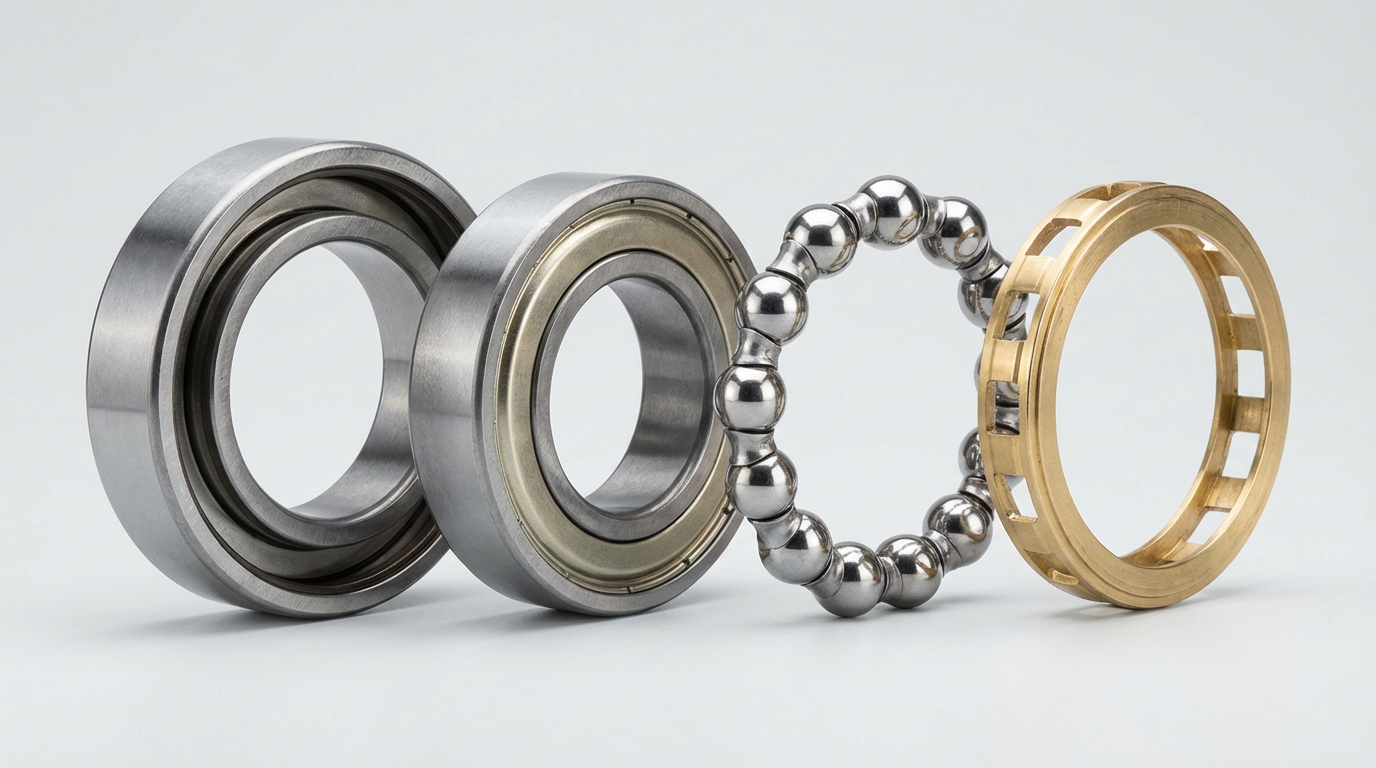
Component roles and what to inspect in each
Understanding the parts helps diagnose issues like noise, overheating, or premature fatigue.
- Inner ring: Fits on the shaft; its raceway quality strongly affects vibration.
- Outer ring: Fits in the housing; distortion from improper fit can raise noise and heat.
- Balls: Determine load capacity and fatigue life; surface defects lead to pitting/spalling.
- Cage: Guides and separates balls; damage can cause rapid failure at speed.
Quick inspection checklist (incoming or teardown):
- Rings: Look for scoring, discoloration (overheat), brinelling dents, or corrosion.
- Balls: Check for pitting, flaking, or dull “frosted” wear from contamination.
- Cage: Inspect for cracks, pocket wear, or deformation.
- Lubricant condition: Darkened grease, water washout, or debris indicates root cause.
Haron Bearing Pro Tip: When a bearing is noisy, I inspect the housing seat and shaft seat before blaming the bearing—oval bores and burrs can distort the outer ring enough to create “bearing noise” even with perfect parts.
Key Features & Comparison
Deep groove ball bearings combine high-speed capability, low friction, and broad availability with flexible sealing and clearance options. Their main trade-off is lower axial capacity than specialized thrust/combined-load bearings. Comparing sealing, clearance, and cage options side-by-side helps match reliability needs, environment, and speed without overspending.
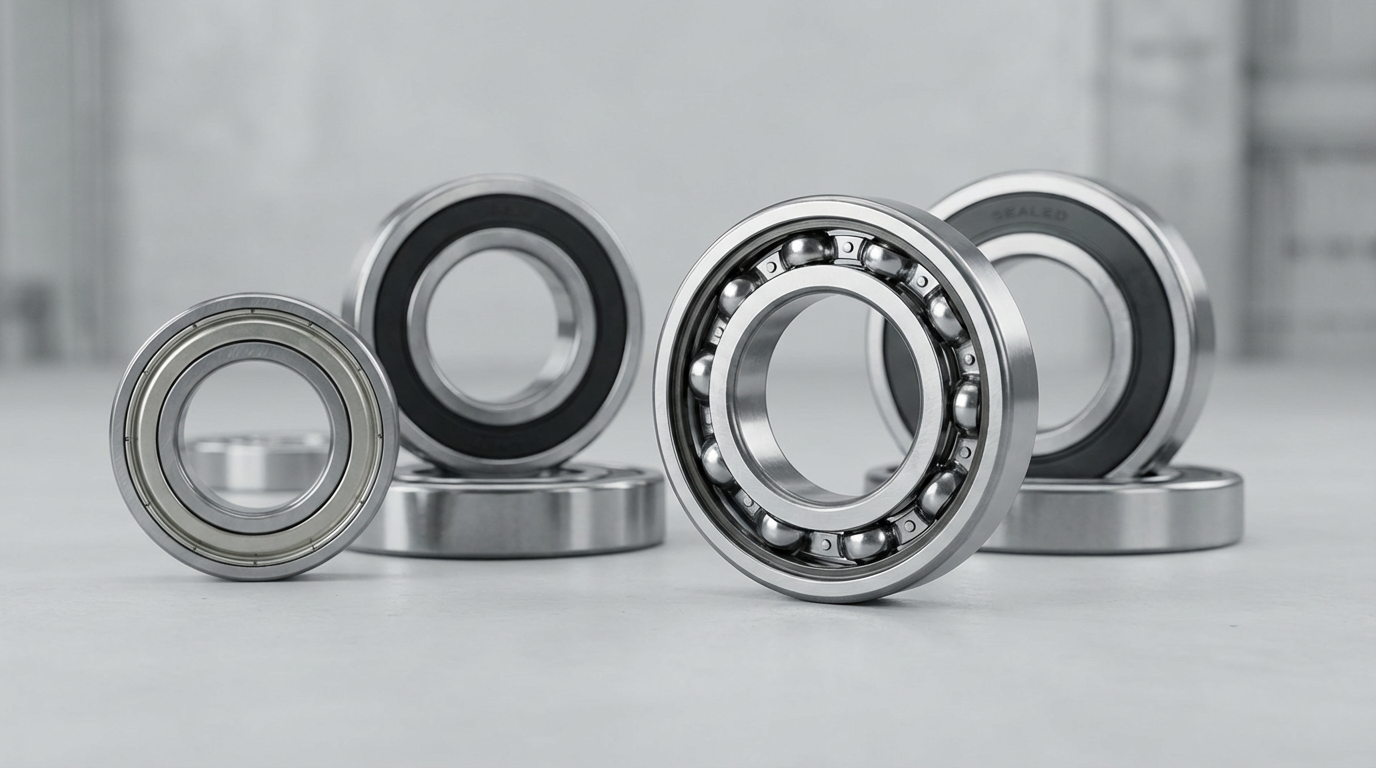
Performance comparison across common configurations
Based on our internal data and market analysis, here is the breakdown:
| Feature / Option | Open | ZZ (double shield) | 2RS (double seal) | Typical best-fit scenarios |
|---|---|---|---|---|
| Contamination resistance | Low | Medium | High | Dusty/wet environments favor 2RS |
| Friction / speed potential | Highest speed | High | Medium | High RPM motors often open/ZZ |
| Grease retention | Low | Medium | High | Long relube intervals favor 2RS |
| Washdown / water splash | Poor | Fair | Good | Food processing, outdoors, pumps |
| Noise potential (all else equal) | Low | Low | Low–Medium | Seal drag can increase noise slightly |
| Maintenance needs | Higher | Medium | Lower | Sealed units reduce regreasing frequency |
Haron Bearing Pro Tip: I choose sealing first, then clearance. If you choose the wrong sealing for the environment, no amount of load rating margin will prevent contamination-driven wear.
Cost & Buying Factors
Deep groove ball bearing cost depends mainly on size series, precision/noise grade, sealing type, internal clearance, cage material, and brand quality control. The cheapest bearing is rarely the lowest-cost solution once downtime, rework, and warranty risk are included. A structured buying checklist helps match performance and budget reliably.
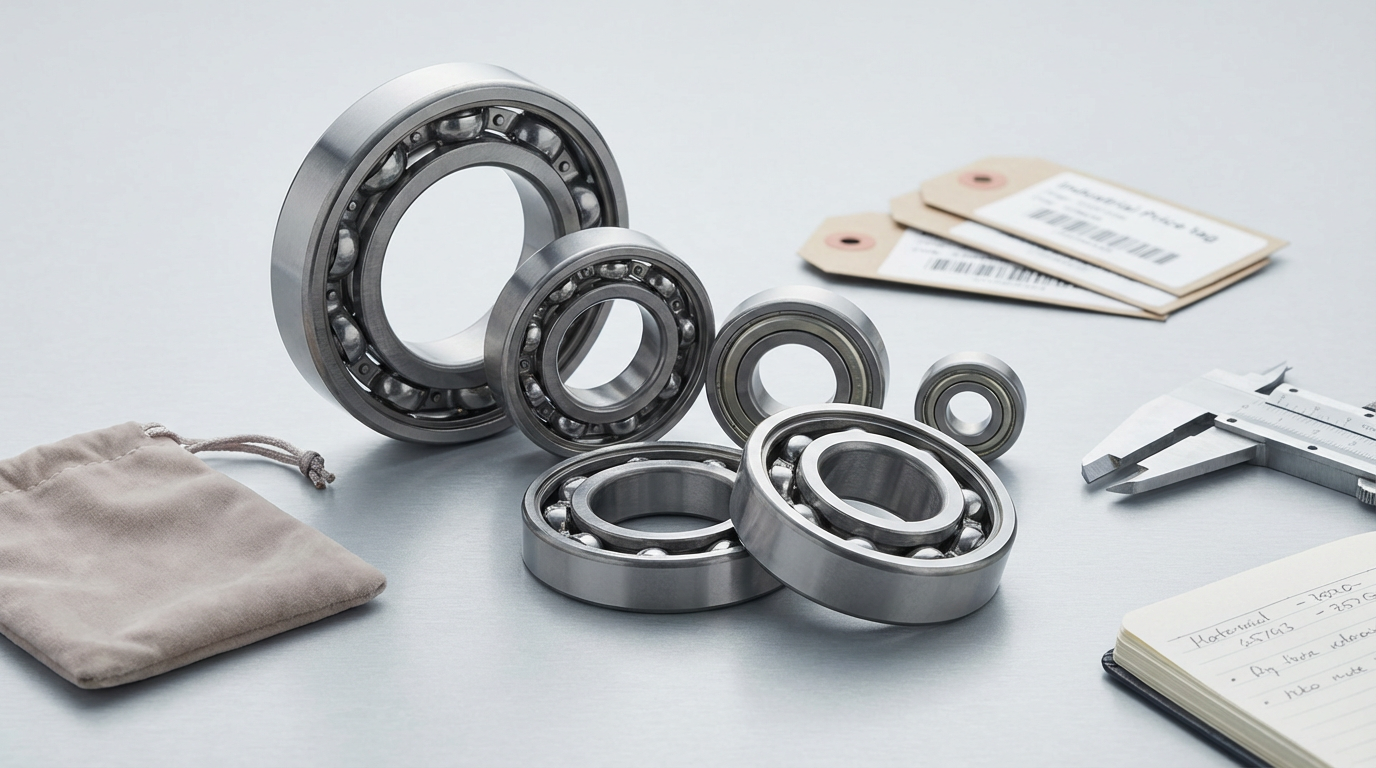
What drives price, lead time, and lifecycle value
Key cost drivers you should specify on the RFQ/PO:
- Bearing series and size (e.g., 6000/6200/6300; bore diameter)
- Precision grade (typical: P0/PN; higher grades cost more)
- Noise/vibration requirements (electric motor grades, low-noise grease)
- Sealing (open < ZZ < 2RS, generally)
- Internal clearance (CN vs C3/C4)
- Material (standard bearing steel vs stainless for corrosion environments)
- Packaging/traceability (barcoding, batch/heat traceability)
Buying checklist (use as a quick spec template):
- Operating speed (RPM) and temperature range
- Radial and axial load estimates (including shock)
- Environment (dust, water, chemicals) → sealing choice
- Target life and maintenance strategy (sealed-for-life vs relubrication)
- Fit and clearance plan (shaft/housing tolerances, C3 needs)
- Noise/vibration requirement (especially for motors/fans/appliances)
Haron Bearing Pro Tip: I recommend requesting a “fit + clearance recommendation” from your supplier with your shaft/housing tolerances—many premature failures come from correct bearings installed with incorrect interference fits.
Conclusion
Deep groove ball bearings remain the default choice for countless machines because they deliver dependable performance across speed, load, and cost constraints. When you specify sealing, clearance, lubrication, and fits correctly, they provide long service life with minimal maintenance. If you share your application speed, loads, and environment, Haron Bearing can recommend the most suitable configuration and equivalent part options.