
Selecting between deep groove ball bearings and angular contact bearings comes down to load direction, required rigidity, speed, and mounting constraints. Deep groove designs excel as a versatile bearing for radial load and moderate axial load, while angular contact types are purpose-built as a bearing for combined load at higher axial capacity and stiffness. This bearing selection guide helps you match performance requirements to the right geometry.
Video Guide: This overview visually compares deep groove ball bearings and angular contact bearings and explains where each type is typically used.
What is deep groove ball bearings vs angular contact bearings deep groove ball bearings angular contact bearings ball bearing comparison single row deep groove ball bearings angular contact ball bearing uses deep groove bearing applications bearing for radial load bearing for combined load deep groove vs angular contact how to choose ball bearings bearing selection guide?
Deep groove ball bearings are general-purpose radial bearings that can carry radial loads and some axial loads in both directions. Angular contact bearings have raceways offset to create a contact angle, allowing higher axial load capacity and better stiffness, typically in one direction per bearing. Choosing depends on load mix, speed, and rigidity needs.
Video Guide: This explains the practical meaning of “radial vs angular contact” and how the load path changes between bearing types.
Definitions that drive selection
Deep groove ball bearings (including single row deep groove ball bearings) use symmetric raceway grooves that closely match the ball diameter, making them stable, low-noise, and tolerant for everyday duty. They are the default choice in many deep groove bearing applications such as electric motors, fans, pumps, conveyors, and general machinery.
Angular contact bearings have an intentional raceway offset that forms a contact angle (commonly 15°, 25°, or 40°). This geometry makes them a go-to angular contact ball bearing uses list for machine tool spindles, gearboxes, precision pumps, and applications needing higher axial capacity or higher rigidity.
- Deep groove ball bearings: best general ball bearing comparison baseline; radial-first, bidirectional moderate axial, simple mounting.
- Angular contact bearings: best for combined loads; higher axial in one direction; often paired (DB/DF/DT) to handle axial both ways.
- How to choose ball bearings: start with load direction/magnitude, then stiffness, speed, temperature, and installation complexity.
Haron Bearing Pro Tip: I treat deep groove bearings as the “default” unless axial load or stiffness is driving the failure mode—if you’re seeing heat, noise, or early fatigue from axial thrust, it’s usually time to evaluate angular contact (often as a matched pair).
How Does deep groove ball bearings vs angular contact bearings deep groove ball bearings angular contact bearings ball bearing comparison single row deep groove ball bearings angular contact ball bearing uses deep groove bearing applications bearing for radial load bearing for combined load deep groove vs angular contact how to choose ball bearings bearing selection guide Work?
Both bearing types reduce friction by rolling balls between inner and outer raceways, but they differ in how loads travel through the contact points. Deep groove bearings primarily route forces radially and tolerate limited axial load. Angular contact bearings route forces along a contact angle, increasing axial capacity and stiffness, often requiring pairing for bidirectional thrust.
Video Guide: This walks through how load direction and contact angle change the way forces pass through the bearing.
Load path, contact angle, and pairing
The key “working principle” difference is the resultant force vector through the ball-to-race contact.
- Deep groove ball bearing load path
- The groove curvature supports the ball with a near-centered contact.
- Works best as a bearing for radial load, with moderate axial load possible due to the deep grooves.
- Typically easy to install as a single bearing with standard fits.
- Angular contact bearing load path
- The contact angle tilts the load path so the bearing can carry higher axial force.
- Works best as a bearing for combined load (radial + axial), but axial load is usually one direction per bearing.
- For axial loads in both directions, designers commonly use configurations:
- DB (back-to-back): higher stiffness and moment stiffness, common in spindles.
- DF (face-to-face): more misalignment tolerance.
- DT (tandem): higher axial in one direction.
- Preload (often used with angular contact) improves stiffness and runout control but increases heat if excessive.
- Speed depends on lubrication, cage design, preload, and heat dissipation; deep groove is often simplest for high-speed general duty, while angular contact dominates high-speed precision where axial control matters.
Haron Bearing Pro Tip: If you need axial positioning accuracy (repeatable shaft location), I recommend angular contact with a defined preload strategy; if you just need reliable rotation with minimal setup variables, deep groove is usually the safer production choice.
What is the difference between angular contact and deep groove?
The main difference is geometry and load capability: deep groove bearings have symmetric grooves for primarily radial loads plus moderate axial in both directions, while angular contact bearings have a contact angle that significantly increases axial load capacity and stiffness in one direction. Angular contact often needs a pair arrangement to handle thrust both ways.
Video Guide: This Q&A style explanation clarifies how to decide between radial-style (deep groove) and angular contact bearings in real repairs and builds.
Practical differences that show up in machines
- Axial load handling
- Deep groove: moderate axial in both directions (application-dependent).
- Angular contact: higher axial, typically one direction per bearing.
- Rigidity and positioning
- Deep groove: good general rigidity; less suitable for precision axial location under thrust.
- Angular contact: higher stiffness; better for controlled shaft positioning.
- Mounting and complexity
- Deep groove: straightforward; fewer stacking tolerances.
- Angular contact: may require pairing, orientation control, preload, and tighter assembly discipline.
- Typical use cases
- Deep groove bearing applications: motors, blowers, idlers, household appliances, general gear drives.
- Angular contact ball bearing uses: machine tools, servo drives, high-precision pumps, ball screw supports, performance gearboxes.
Haron Bearing Pro Tip: When customers describe “axial chatter,” “poor surface finish,” or “tool marks,” I look past RPM and go straight to stiffness and axial control—those symptoms often point to an angular contact solution rather than a deeper-groove radial bearing.
Are angular contact bearings better?
Angular contact bearings are “better” when your application demands higher axial load capacity, higher stiffness, and precise axial positioning—especially under combined loads. They are not universally better because they often require more careful mounting, correct orientation, and sometimes preload management, which can increase cost and sensitivity to heat, misalignment, and assembly variation.
Video Guide: This explains when angular contact designs outperform radial designs, especially under thrust and combined loading conditions.
When angular contact is the right upgrade
Angular contact bearings usually win in these scenarios:
- High axial load or frequent thrust reversals (with proper pairing)
- High moment loads (especially DB arrangements)
- Precision requirements (runout control, axial location)
- Performance under combined load where deep groove would run hotter or wear faster
But they can be a poor fit when:
- Misalignment is expected and no self-aligning feature exists
- Assembly capability is limited (orientation, preload, cleanliness)
- Cost sensitivity is high and loads are mostly radial
- Choose angular contact if you need: stiffness, thrust capacity, controlled axial float, matched pairs.
- Avoid angular contact if you can’t control: preload, fits, thermal growth, and mounting accuracy.
Haron Bearing Pro Tip: I only call angular contact “better” after confirming the load case and the assembly process—without correct orientation and preload control, you can pay more and still get shorter life than a properly selected deep groove bearing.
Are deep groove bearings better?
Deep groove bearings are “better” for most general-purpose rotating equipment because they’re versatile, efficient, widely available, and easy to mount. They excel as a bearing for radial load and can accommodate moderate axial loads in both directions. They may be inferior to angular contact bearings when high axial loads, high stiffness, or precision axial positioning are required.
Video Guide: This provides a practical framework for choosing between bearing types based on application needs.
Where deep groove consistently wins
Deep groove ball bearings are often the best choice when you prioritize simplicity and robustness.
- Best-fit applications
- Electric motors and generators
- Fans and blowers
- Light-to-medium duty pumps
- Conveyors and general industrial drives
- Advantages
- Simple single-bearing solutions (including single row deep groove ball bearings)
- Good high-speed potential with straightforward lubrication
- Generally lower cost and broad interchangeability
- Lower assembly sensitivity versus paired angular contact sets
- Limitations
- Lower axial capacity and stiffness than angular contact
- Less ideal for precision spindles or high-thrust duty cycles
Haron Bearing Pro Tip: If your shaft sees mostly radial load and only occasional thrust, I’d rather overspec a quality deep groove bearing (material, seals, lubrication) than jump to angular contact and introduce pairing/preload risks you don’t actually need.
Key Features & Comparison
Deep groove ball bearings prioritize versatility, low friction, and easy installation for primarily radial loading. Angular contact bearings prioritize axial capacity, stiffness, and precision under combined loads, often using paired arrangements. A good ball bearing comparison should weigh load direction, required rigidity, speed/heat, allowable misalignment, and installation complexity—not just load ratings alone.
Video Guide: This introduces common bearing types and helps place deep groove and angular contact bearings in the broader selection landscape.
Side-by-side selection criteria
Based on our internal data and market analysis, here is the breakdown:
| Criteria | Deep Groove Ball Bearings | Angular Contact Bearings |
|---|---|---|
| Primary load strength | Radial | Combined (radial + axial) |
| Axial load capability | Moderate, typically both directions | High, typically one direction per bearing |
| Stiffness / axial positioning | Moderate | High (especially with preload/pairs) |
| Typical arrangement | Single bearing | Single (one-direction thrust) or paired DB/DF/DT |
| Mounting complexity | Low | Medium to high (orientation, preload, pairing) |
| Misalignment tolerance | Limited (depends on design) | Limited (generally more sensitive) |
| Common applications | Motors, fans, general machinery | Spindles, precision drives, pumps, ball screw supports |
| Typical cost level | Lower | Higher (especially matched pairs) |
| Best “fit” in a bearing selection guide | Default for general duty | Upgrade for thrust + stiffness/precision needs |
Haron Bearing Pro Tip: I validate selection by checking three things together—axial load direction, required stiffness, and mounting capability—because angular contact performance gains disappear quickly if the assembly process can’t consistently hit the intended fits and preload.
Cost & Buying Factors
Cost differences usually reflect complexity: deep groove bearings are broadly standardized and typically lower cost, while angular contact bearings often cost more due to geometry, precision classes, and the common need for matched pairs. Buying the right bearing means balancing total lifecycle cost—downtime, heat, lubrication, and replacement labor—against initial unit price.
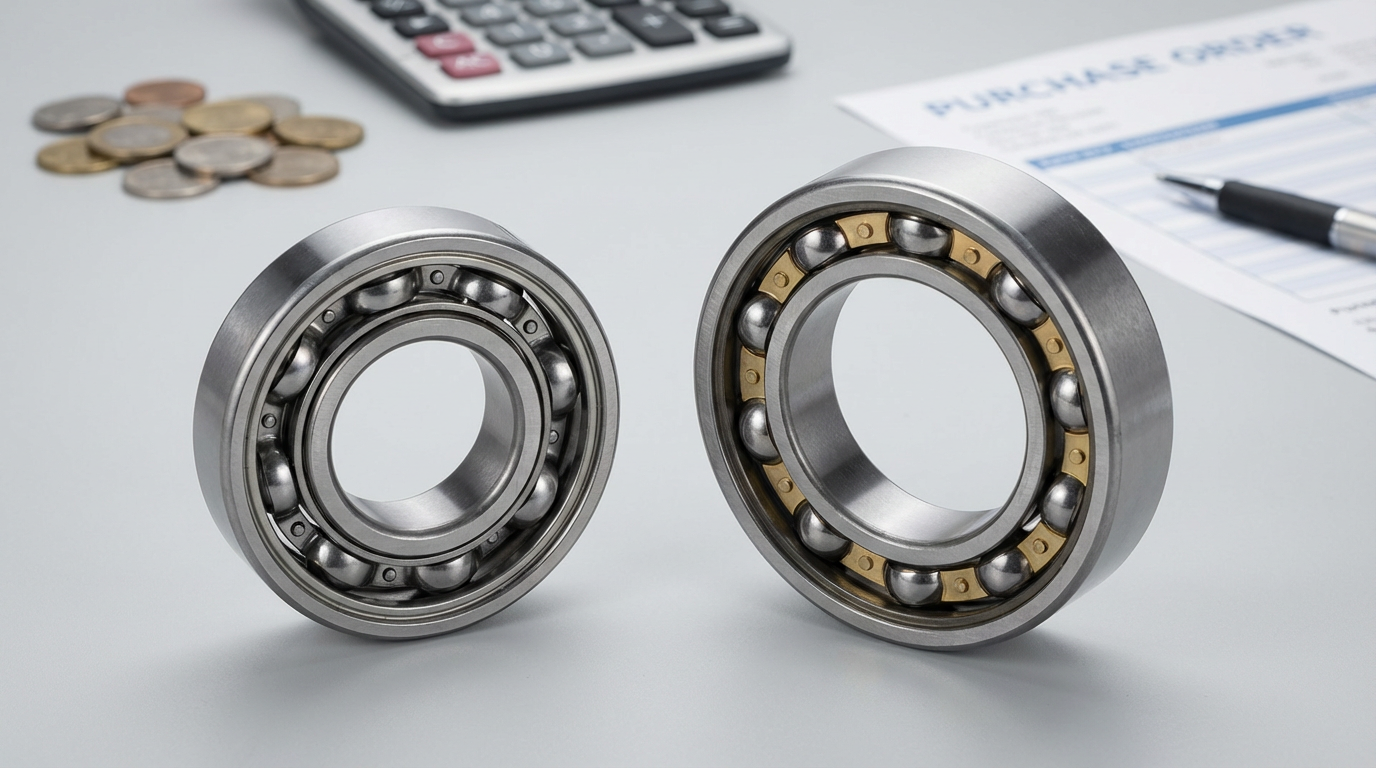
What to evaluate before you buy
- Load case clarity
- Radial-only or mostly radial: deep groove is often best.
- Significant thrust or combined load: evaluate angular contact (often paired).
- Precision and runout requirements
- Consider tolerance class and internal clearance/preload needs.
- Arrangement needs
- If thrust reverses, budget space and cost for a paired angular contact set (DB/DF).
- Sealing and lubrication
- Sealed deep groove options are common for contaminated environments.
- Angular contact in high-speed precision often prefers controlled grease/oil systems.
- Operating speed and heat
- Preload and axial load raise heat; verify limiting speeds and thermal growth.
- Total cost of ownership
- Include installation time, alignment/preload setup, and failure consequences.
- Quick buying checklist
- Required life (L10), duty cycle, and contamination level
- Shaft/housing fits and tolerance stack-up
- Axial direction(s) and moment loading
- Available axial space for pairing and preload method
Haron Bearing Pro Tip: I advise buyers to quote two options—(1) the simplest deep groove bearing that meets life and sealing needs, and (2) the angular contact solution that meets stiffness/thrust needs—then compare total downtime risk, not just piece price.
Conclusion
Deep groove ball bearings are the go-to choice for general machinery as a dependable bearing for radial load with moderate bidirectional axial capacity. Angular contact bearings are the better fit when you need a bearing for combined load, higher axial capacity, and higher stiffness—often using paired arrangements. The best choice is the one that matches your load direction, precision needs, and assembly capability.
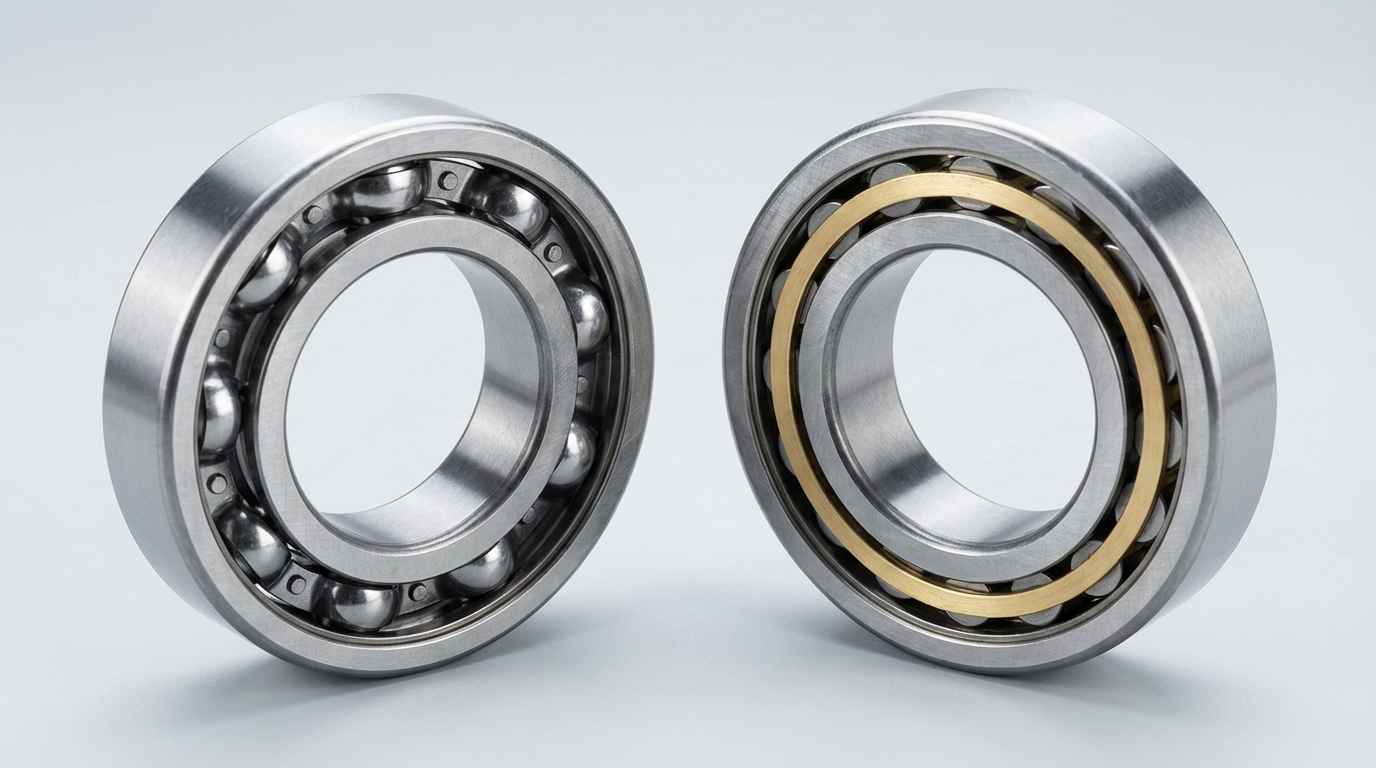
Next step for correct selection
- Confirm your radial load, axial load (magnitude and direction), speed, and required stiffness.
- If you want a fast recommendation, Haron Bearing can help you map those inputs to a deep groove vs angular contact option (including arrangement and lubrication), so you avoid overbuying—or premature failure.
Haron Bearing Pro Tip: If you’re unsure, send the load directions, RPM, shaft size, housing fit, and whether thrust reverses—those five details let me narrow the correct bearing type and arrangement quickly and safely.