
Deep groove ball bearings are widely used in robotic joints, wheels, and gearboxes because they are compact, efficient, and easy to source. However, whether they are “enough” depends on load direction, stiffness needs, contamination risk, and duty cycle. This guide explains how they work, where they fit best, where they fall short, and how to select cost-effective options without sacrificing reliability.
Video Guide: Use this overview to connect bearing selection to common robotics and automation load cases, speed requirements, and reliability goals.
What is deep groove ball bearings in robotics?
Deep groove ball bearings in robotics are compact rolling bearings that support radial loads and moderate axial loads in either direction, commonly used on motor shafts, idlers, wheels, and light-duty joints. They balance cost, speed capability, and availability, but are not always ideal for high-moment, high-rigidity, or harsh-environment robotic axes.
Video Guide: Watch this to understand what “deep groove” geometry means and why it matters for load direction and speed—then map that back to robotic mechanisms.
Typical robotic placements and what they solve
In robotics, deep groove ball bearings are often chosen because they simplify mechanical design: they handle high rotational speed with low friction, require minimal axial space, and come in standardized sizes (making replacements easy).
Common placements include:
- Drive motor output shafts (supporting rotor/shaft alignment)
- Timing belt idlers and tensioners (low drag, steady running)
- Robot wheels and rollers (smooth motion with moderate shock)
- Light-duty end-effector spindles (speed over stiffness)
- Small gearboxes where loads are mostly radial and moments are controlled by structure
Where they become less suitable is when a robotic axis must resist tilting moments (overhung payloads), maintain high positioning stiffness, or survive washdown, abrasive dust, or chemical exposure without upgraded seals and lubrication.
Haron Bearing Pro Tip: I treat deep groove ball bearings as a “default” for fast, compact radial support—but if your axis sees overhung load (moment), I immediately check deflection and consider pairing bearings, adding a support span, or switching to angular contact/cross-roller designs before I lock the layout.
How Does deep groove ball bearings in robotics Work?
Deep groove ball bearings in robotics work by rolling hardened steel balls between an inner and outer raceway, converting sliding friction into rolling friction. The “deep” raceway curvature stabilizes the balls, allowing high-speed rotation and some axial load capacity. Performance depends heavily on preload/clearance, fit, lubrication, and sealing.
Video Guide: Use this practical robotics-focused walkthrough to visualize how bearings are seated, aligned, and supported in typical robot mechanisms.
Load paths, clearance, and why robotics exposes weak points
A deep groove ball bearing carries load through Hertzian contact between each ball and the raceways. In robotics, three factors dominate real-world behavior:
- Radial load from belts, gears, wheels, and rotor imbalance is usually the primary design case.
- Axial load occurs from helical gears, belt tracking, thrust from end-effectors, or assembly misalignment; deep groove can handle moderate axial load, but not like angular contact bearings.
- Moment load (tilting) is the frequent “silent killer” in robotic arms: overhung loads or cantilevered pulleys generate a moment that deep groove bearings only tolerate indirectly (often causing uneven ball loading, noise, and early fatigue).
Key integration steps that matter in robotics:
- Choose internal clearance (CN/C3, etc.) based on fits and temperature rise.
- Select sealing (open/ZZ/2RS) based on dust, coolant mist, or washdown risk.
- Control alignment using precise shoulders/spacers; misalignment increases edge stresses.
- Set proper fits (shaft/housing tolerances) to prevent creep and fretting.
- Lubricate for duty cycle (grease for life vs relubrication ports for continuous operation).
Haron Bearing Pro Tip: I’ve seen “bearing failures” that were really fit-and-alignment failures—if you can twist a mounted bearing by hand in its seat, you’re inviting creep, fretting, and sudden backlash in your robot.
What are the disadvantages of deep groove ball bearings?
Deep groove ball bearings are not ideal when robotic joints demand high stiffness, high tilting-moment capacity, or controlled preload. They also struggle when contamination is high and sealing is inadequate, and they can develop noise/backlash if clearances, fits, or lubrication are mismatched to thermal growth and dynamic loading.
Video Guide: Use this to explore size-constrained robotics where traditional bearings are difficult—helpful for understanding when deep groove bearings are impractical or overkill.
Where deep groove bearings typically underperform in robots
The most common disadvantages show up in precision axes and harsh environments:
- Lower moment capacity: Overhung payloads load one side of the raceway, increasing contact stress and reducing life.
- Limited stiffness vs alternatives: Cross-roller bearings and angular contact arrangements generally produce less deflection under the same load.
- Preload control is harder: Deep groove designs are usually run with clearance; adding preload can increase heat and reduce speed margin if not engineered carefully.
- Sensitive to misalignment: Small misalignment increases vibration and noise—bad for precision sensing and repeatability.
- Seal drag vs protection tradeoff: Strong seals protect well but add torque, which can matter for cobots and small actuators.
Typical “robot symptom” mapping:
- Unexpected backlash → fit looseness, clearance too large, or race creep
- High motor current → seal drag, excessive preload, or contaminated grease
- Noise at specific speeds → brinelling, false brinelling, or waviness excited by PWM/stepper harmonics
Haron Bearing Pro Tip: If your robot axis must hold position precisely under an off-center load, I don’t rely on a single deep groove bearing—either widen the bearing span with a second bearing or move to an architecture designed for moment stiffness.
What are the advantages of deep groove ball bearings?
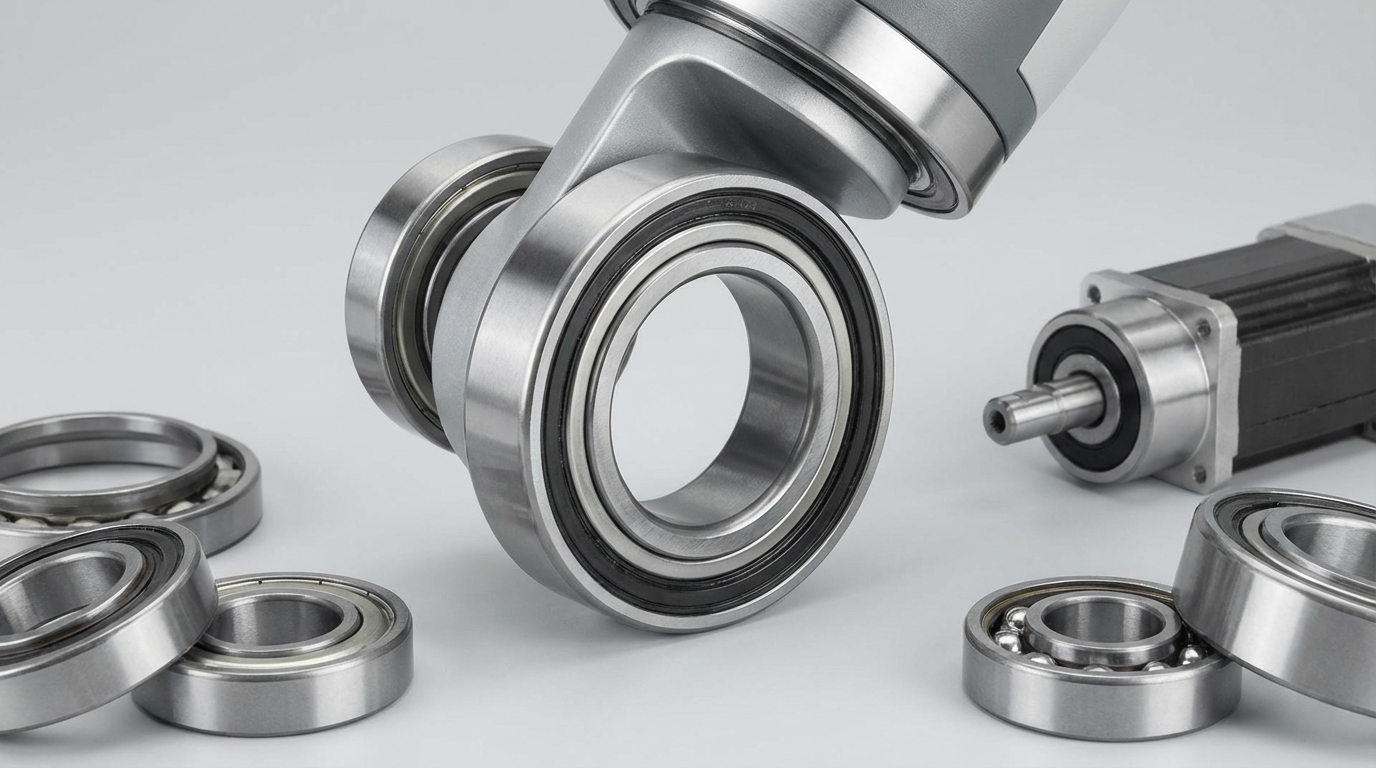
Deep groove ball bearings remain popular in robotics because they are efficient, compact, inexpensive, and available worldwide in many sizes and sealing options. They run smoothly at high speed, support radial loads well, and can handle moderate axial loads, making them a strong choice for wheels, idlers, motor shafts, and light-duty joints.
Why they are often the “default” bearing in robotic modules
Their advantages line up well with common robotic design priorities (space, efficiency, cost, and manufacturability):
- Low friction / high efficiency: Helps battery-powered robots and reduces motor sizing.
- High speed capability: Useful for spindles, fans, high-RPM drives, and compact gear stages.
- Standardization: Easy sourcing for maintenance and global builds (common series like 6000/6200/6300).
- Multiple sealing options: Open, metal shields (ZZ), rubber seals (2RS) to match environment.
- Simple mounting: Straightforward shoulders and bores; tolerant of common housings when aligned properly.
Practical “best fit” robotic applications:
- Wheels/rollers on AGVs and AMRs
- Belt idlers and pulleys
- Motor end supports (non-moment-dominant)
- Light gearbox support where radial load dominates
Haron Bearing Pro Tip: When I’m optimizing a robot for cost and lead time, deep groove bearings are usually my first check—then I upgrade only the few axes where stiffness, moment load, or sealing truly demands it.
What is the price of 6205 deep groove ball bearing?
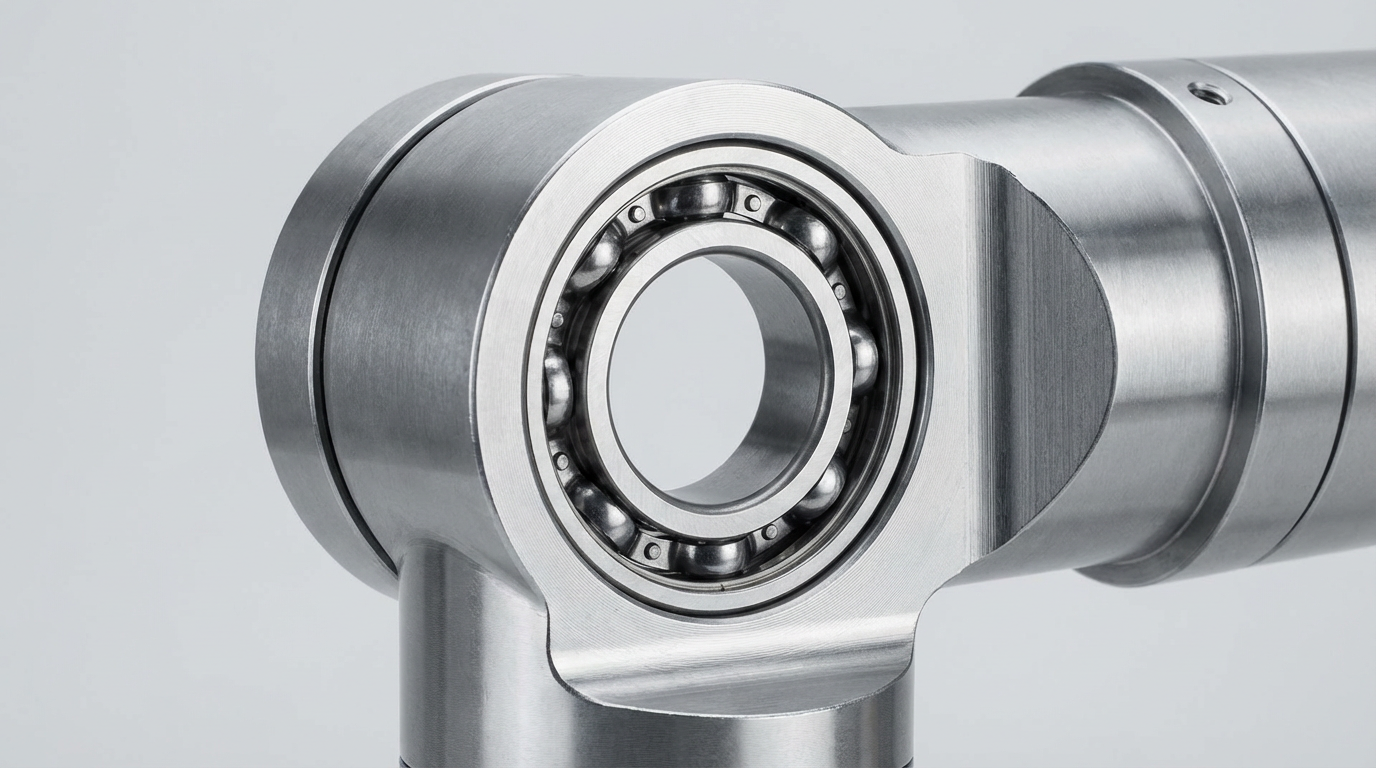
The price of a 6205 deep groove ball bearing varies mainly by brand tier, sealing (open/ZZ/2RS), precision grade, and whether it’s standard steel or corrosion-resistant. In most markets, a standard 6205 is a low-to-mid cost item, while premium, low-noise, or specialty-sealed versions cost notably more.
Practical pricing bands and what drives them
Based on our internal data and market analysis, here is the breakdown:
| 6205 Type | Typical Use in Robotics | What You’re Paying For | Budgetary Price Range (USD/pc) |
|---|---|---|---|
| 6205 Open | Clean, enclosed modules | Lowest drag, lowest cost | $2–$8 |
| 6205 ZZ (Shields) | Light dust, general automation | Better retention of grease, low drag | $3–$12 |
| 6205 2RS (Rubber seals) | Dusty floors, mobile robots | Better contamination resistance | $4–$18 |
| Premium low-noise / higher precision | Sensors/encoders nearby, quieter robots | Tighter runout, noise control | $10–$35 |
| Stainless / corrosion-resistant variants | Humidity, washdown risk | Material and sealing upgrades | $15–$60 |
What most changes cost in real purchasing:
- Quantity & consistency requirements: matched batches and traceability cost more.
- Noise/vibration specification: critical near encoders and for smooth torque control.
- Seal material and grease: low-temperature, food-grade, or long-life greases raise price.
Haron Bearing Pro Tip: When budgeting a 6205 for robotics, I always price two versions—ZZ for low torque and 2RS for contamination—then choose based on measured environment, not assumptions, because rework and downtime dwarf the bearing cost.
Key Features & Comparison
Deep groove ball bearings are a strong baseline for many robotic mechanisms, but comparison against angular contact, tapered, and cross-roller bearings is essential when stiffness, moment load, or precision dominates. The right choice reduces backlash, heat, and maintenance. Use the table below to match bearing type to axis requirements and environment.
Selection comparison for robotic axes and modules
Based on our internal data and market analysis, here is the breakdown:
| Bearing Type | Best For in Robotics | Handles Moment Loads? | Stiffness | Speed Capability | Cost Level | Notes |
|---|---|---|---|---|---|---|
| Deep groove ball | Wheels, idlers, motor shafts, light joints | Limited | Medium | High | Low | Great default; verify deflection and sealing |
| Angular contact ball (single/paired) | Robot joints needing axial control & preload | Good (paired) | High | High | Medium | Preloadable; better for precision axes |
| Tapered roller | High combined load, robust shafts | Good | High | Medium | Medium | Higher friction; careful setup needed |
| Cross-roller | Compact high-precision robot joints | Excellent | Very high | Medium | High | Excellent rigidity; sensitive to contamination |
| Needle roller | Very tight radial space | Limited to medium | Medium | Medium | Low–Medium | Needs hardened raceways; not for high axial load |
| Plain bushing (polymer/bronze) | Low-speed pivots, cost-down designs | Medium (design-dependent) | Low–Medium | Low | Low | Tolerates dirt; higher friction and wear |
Haron Bearing Pro Tip: If you’re debating between deep groove and angular contact for a robot joint, I recommend you calculate tilt under peak moment (not just radial load). That single check usually makes the correct choice obvious.
Cost & Buying Factors
For robotics, the lowest bearing price rarely equals the lowest system cost. Focus on load ratings, sealing, grease suitability, noise/vibration limits, and supplier consistency. Deep groove bearings are economical, but the right variant (ZZ vs 2RS, clearance class, precision grade) prevents field failures that cause downtime, recalibration, and customer returns.
A purchasing checklist that prevents “cheap bearing” problems
Key buying factors to evaluate:
- Loads and duty cycle: include shock loads, starts/stops, and reversing motion.
- Moment exposure: identify cantilevered pulleys, offset wheels, and overhung grippers.
- Sealing choice: match to dust, fibers, coolant mist, and cleaning methods.
- Grease selection: consider temperature range, speed factor, and compatibility with plastics.
- Internal clearance and fits: ensure clearance isn’t lost after press-fit and thermal growth.
- Noise/runout requirements: crucial for encoder stability and smooth torque control.
- Supplier QA: material certs, hardness control, dimensional consistency, traceability.
A simple decision guide many teams use:
- Clean, enclosed module + speed sensitive → ZZ or open with controlled lubrication
- Dusty mobile robot / warehouse → 2RS with appropriate grease
- Precision joint with payload offset → consider paired angular contact or cross-roller
Haron Bearing Pro Tip: At Haron Bearing, we encourage teams to prototype with standard deep groove bearings—but validate torque, temperature rise, and repeatability early. If any metric drifts after a contamination or endurance test, upgrade sealing or bearing type before you scale production.
Conclusion
Deep groove ball bearings in robotics are often enough for wheels, idlers, and many motor-shaft supports because they are efficient, compact, and cost-effective. They become insufficient when your axis is dominated by tilting moments, demands high stiffness, or operates in contamination-heavy environments. If you share your axis load case, speed, and sealing constraints, Haron Bearing can help you select the most reliable bearing arrangement for your robot.